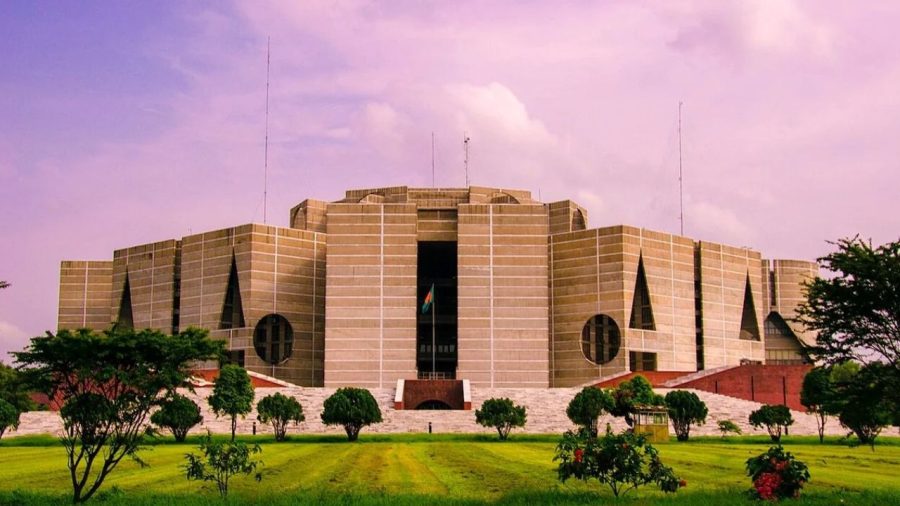



The fourth session of the current parliament, which is set to begin on Monday afternoon after 60 days of the prorogation of the previous session, will continue till November 18 next.
During the fourth session, the Parliament will sit at 4:20pm every day except Fridays and Saturdays.
The decision was taken at a meeting of the Parliamentary Business Advisory Committee held at the Cabinet Room of the Jatiya Sangsad Bhaban on Sunday, a day ahead of the commencement of the session.
Speaker Hafiz Uddin Ahmad, chaired the meeting, while prime minister and Leader of the House Tarique Rahman attended it.
The meeting discussed the allocation of time for conducting parliamentary business and the duration of the fourth session of the 13th Parliament.
It was also decided that the Speaker would be authorised to make any changes to the sitting schedule and working days of the session, if necessary.

Committee members – Leader of the Opposition Md Shafiqur Rahman, Finance Minister Amir Khosru Mahmud Chowdhury, Home Minister Salahuddin Ahmed, Deputy Speaker Barrister Kayser Kamal, Chief Whip Md Nurul Islam, Law Minister Md. Asaduzzaman, BNP standing committee member Goyaswar Chandra Roy, Jamaat leader ATM Azharul Islam and Opposition Chief Whip Md Nahid Islam also attended the meeting.
According to the meeting, one government bill has so far been received for placement in the House during the fourth session.
Besides, three ordinances issued between the third and fourth sessions will be placed before Parliament at its first sitting.
The ordinances are the Public Procurement (Amendment) Ordinance, 2026, the Value Added Tax and Supplementary Duty (Amendment) Ordinance, 2026, and the Special Solar Power Installation Ordinance, 2026.



A total of 3,751 questions have been received for the session, including 174 for the Prime Minister and 3,577 for other ministers.
Besides, 92 notices have been received under Rule 71 of the Rules of Procedure for drawing the attention of ministers to matters of public importance, while 281 notices have been submitted under Rule 131 of the Rules of Procedure seeking decisions on various proposals.
During the meeting, Tarique proposed declaring the Jatiya Sangsad premises a smoke-free area. The proposal was unanimously welcomed by the committee members.
The prime minister also enquired about the progress of the sound system at the Parliament building.
In response, Parliament Secretary Barrister Md Golam Sorwar Bhuiyan informed him that the sound system would be inaugurated at 3:30pm on Monday under the supervision of the Public Works Department.
The prime minister also enquired about the progress of installing solar panels at the Jatiya Sangsad Bhaban.
In response, Deputy Speaker Barrister Kayser Kamal, who is the convener of the relevant subcommittee, informed the meeting that the proposed solar power system would be capable of generating 7 megawatts of electricity.
He said the electricity generated would be sufficient to meet the Parliament’s demand during session periods, when consumption stands at around 6 megawatts, while demand remains lower at other times.
The surplus electricity would be supplied to the national grid.

The prime minister directed the authorities concerned to ensure that the solar power generation system includes electricity storage facilities.
On October 14 last, President Mirza Fakhrul Islam Alamgir summoned the session in exercise of the powers conferred upon him under Article 72(1) of the Constitution of Bangladesh.
According to the Article 72 (1) of the Constitution, a period exceeding 60 days shall not intervene between the end of one session and the first sitting of Parliament in the next session.
Earlier, the third session was prorogued on September 10 last after only nine sittings, the second session, also known as the budget session, was prorogued on 15 July after 27 working days.
During the budget session, Parliament passed the Tk938,000 crore national budget for the 2026-27 fiscal year, the first budget under the current BNP government.
The first session of the Parliament commenced on 12 March, following the general election held on 12 February 2026.
During its first session, Parliament passed 94 bills, including 91 bills against ordinances promulgated during the interim government’s tenure, and formed several parliamentary committees.