
Food manufacturers and packaged-goods companies in Bangladesh may soon be required to display clear warning labels on the front of products containing excessive levels of salt, sugar, or saturated fat, as the government moves to finalise regulations on Front-of-Package Labelling (FOPL).
Public health experts and policymakers stated that the proposed labelling system would improve transparency in the packaged-food market, assist consumers in comparing products more easily, and encourage manufacturers to reformulate unhealthy products.
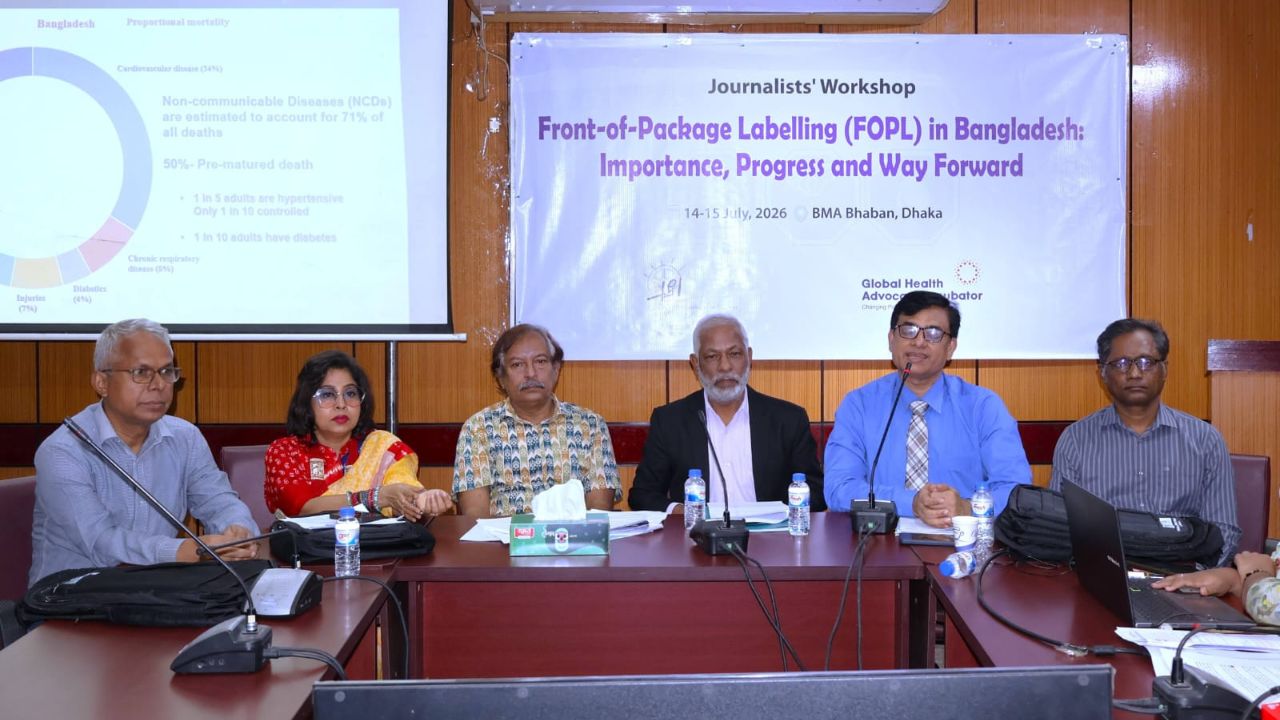
These observations were made during a two-day workshop for journalists titled “Front-of-Package Labelling in Bangladesh: Importance, Progress, and the Way Forward,” held on 14–15 July at the Bangladesh Medical Association Bhaban in Dhaka.
The event was organised by PROGGA (Knowledge for Progress) with support from the Global Health Advocacy Incubator (GHAI). A total of 25 journalists from print, television, and online media participated.

Professor Dr Mohammad Shoeb, a member of the Bangladesh Food Safety Authority, confirmed that the draft regulation making FOPL mandatory would be finalised soon, followed by steps for its swift implementation.
The introduction of mandatory warning labels could have significant implications for the country’s growing packaged-food industry, as manufacturers may need to review product formulations, packaging designs, and nutritional disclosures to comply.





Currently, nutritional information is generally printed on the back of food packages in a technical format that many consumers find difficult to understand. Under the proposed rules, products with excessive salt, sugar, or saturated fat would carry simple and visible warnings on the front.
Abu Ahmed Shamim, associate scientist at the BRAC James P Grant School of Public Health, noted that warning-based FOPL systems have contributed to reductions in unhealthy food consumption in several countries. “It is imperative to introduce this system in Bangladesh as well,” he said.
Muhammad Ruhul Quddus, Bangladesh country lead of GHAI, added that clear warning labels on ultra-processed food packages would help consumers make healthier choices and reduce long-term health risks.
The workshop highlighted that non-communicable diseases (NCDs), including hypertension, diabetes, and cardiovascular diseases, account for approximately 71 per cent of all deaths in Bangladesh, with around 19 per cent occurring prematurely. Experts attributed the country’s increasing burden of NCDs to the growing consumption of ultra-processed foods.
Sajjadur Rahman, deputy editor of The Business Standard, said regular media coverage on the role of FOPL in preventing NCDs could create positive pressure on policymakers to act promptly. However, speakers noted that implementation would require effective monitoring, clear nutritional thresholds, and sufficient preparation time for businesses.
Other speakers at the event included Mortuza Haider Liton, convener of the Anti-Tobacco Media Alliance (ATMA); Nadira Kiron and Mizan Chowdhury, co-conveners of the alliance; and ABM Zubair, executive director of PROGGA. Presentations were delivered by PROGGA Head of Programmes Md Hasan Shahriar and Programme Officer Shabnam Mostofa.