The governor of Iran’s historic city of Isfahan has accused the United States and Israel of waging a “declaration of war on a civilisation” following damage to heritage sites across the country from their bombing raids.
The most significant verified destruction so far has occurred at Tehran’s 14th-century Golestan Palace and Isfahan’s 17th-century Chehel Sotoon Palace, The Guardian reports. Evidence from video footage and official accounts suggests neither structure was directly struck by a missile; rather, the concussive force from nearby explosions, potentially combined with debris, shattered windows and dislodged tiles and masonry.
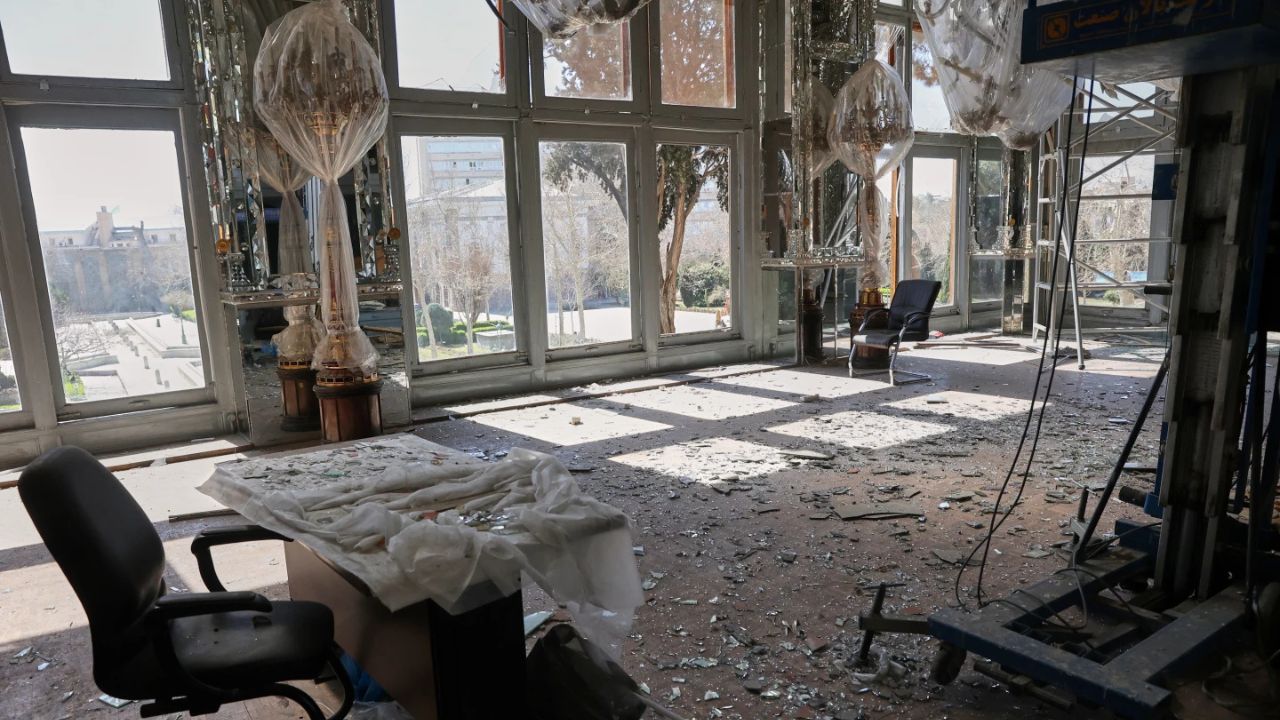
Video from the location depicted the famed hall of mirrors at Golestan Palace destroyed, with fragments of its delicate mirror-work scattered across the floor. The palace, a designated World Heritage site protected by UNESCO, prompted a concerned statement from the UN cultural body following the March 2 damage, noting that it had “communicated to all parties concerned the geographical coordinates of sites on the world heritage list.”
Iranian Foreign Minister Abbas Araghchi criticised UNESCO for not being more forceful in its response, stating on social media, the organisation’s silence was “unacceptable”. Araghchi attributed the destruction to Israel, accusing the nation of “bombing Iranian historical monuments dating as far back as the 14th century.”

He added on X, “It’s natural that a regime that won’t last a century hates nations with ancient pasts.”
Among the impacted sites was Falak-ol-Aflak Castle in Khorramabad, Lorestan province. According to the provincial heritage department head, Ata Hassanpour, a strike on Sunday hit the castle’s perimeter, destroying his department’s offices, adjacent archaeological and anthropological museums, and injuring five staff members.
“Fortunately, the main structure of Falak-ol-Aflak Castle was not damaged,” Hassanpour stated in a Telegram post.




Local media also reported damage to cultural treasures in Iran’s northwestern Kurdistan province. In Sanandaj, the country’s second-largest Kurdish city, the 19th-century Salar Saeed and Asef Vaziri mansions, which function as Kurdish museums and heritage sites, reportedly sustained damage to their doors and intricate stained-glass windows.
Recent days have witnessed major explosions in central Isfahan, a capital of Iran during three historical eras, where much architecture originates from the 16th to 18th-century Safavid dynasty. While Chehel Sotoon bore the worst impact, broken windows, doors, and dislodged tilework have been reported at Ali Qapu Palace and several mosques surrounding the expansive Naqsh-e Jahan Square. Resident-filmed videos from within the square showed smoke rising from nearby airstrikes.
Isfahan Governor Mehdi Jamalinejad stated that the damage occurred despite the coordinates of historic sites being shared among the warring parties and after blue shield signs – markers denoting historical treasures under the 1954 Hague Convention for the protection of cultural objects during war – had been placed on the roofs of significant buildings.
In a speech posted on social media, Jamalinejad said, “Isfahan is not an ordinary city, it’s a museum without a roof. In none of the previous eras, not in the Afghan wars, not in the Moghul conquest, not even during the ‘sacred defence’ [the 1980-88 Iran-Iraq war] was this ever done.”
He added, “This is a declaration of war on a civilisation. An enemy that has no culture pays no heed to symbols of culture. A country that has no history has no respect for signs of history. A country that has no identity sets no value for identity.”
An Iranian geologist who spent many years working in Isfahan remarked in a message forwarded to the Guardian that the ancient capital was particularly susceptible. “Isfahan has long been attacked from below, by land subsidence that is destroying the Safavid-era structures, and now from the above, by the Americans,” the geologist said. “Isfahan seems to have fewer friends than ever today.”
The US Committee of the Blue Shield, a non-profit organisation dedicated to upholding the Hague Convention, issued a statement declaring that Iran’s historic sites “belong not only to the Iranian people, but to all of humanity.”
The organisation expressed being “disturbed” by the US defense secretary’s declaration on the third day of the war that there would be no “stupid” rules of engagement, warning that disregarding international and US laws on the conduct of hostilities could result in the “commission of war crimes.”
The statement concluded, “The destruction of cultural heritage is irreversible. It erases identity, history, and the shared memory of civilisations. No military or political objective justifies the wilful or negligent destruction of humanity’s common inheritance.”