Commerce Minister Khandakar Abdul Muktadir has said the government is working to make licensing and approval process simpler, faster, and more integrated to ensure an investment-friendly environment in the country. To ensure that investors do not have to move from one office to another, a central online “One-Stop Window” system is being developed.
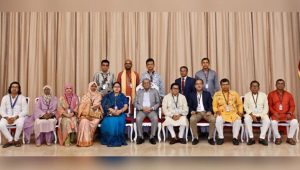
The minister made these remarks during a courtesy meeting with a delegation from the Japan-Bangladesh Chamber of Commerce and Industry (JBCCI) at the conference room of Ministry of Commerce on Sunday morning. The delegation was led by JBCCI President Tareq Rafi Bhuiyan, while Commerce Secretary Md Ataur Rahman Khan was also present.
Addressing the approval process for physical structures or industrial factories, the minister explained that completing the procedure within 15 days is not always possible as it involves infrastructural work.
He noted that various aspects, including safety, risk management, fire safety, and environmental issues, must be scrutinised, with the Fire Service and other relevant authorities conducting inspections before providing final approval.

However, to ensure that investment activities are not delayed, the government will introduce provisional licenses. This will allow investors to commence preliminary activities quickly.
“We have already formulated a roadmap to reduce the time required for the approval process,” the minister said, adding that work is currently underway regarding sector-specific licensing.




He pointed out that different sectors require different types of approvals and documents, noting that the process for setting up a power plant differs from that of a textile factory.
The minister also highlighted initiatives to coordinate factory inspections through Bangladesh Investment Development Authority (BIDA). Under this system, BIDA will schedule inspection dates and bring all relevant agencies together to complete inspections at once, sparing investors from visiting multiple organisations repeatedly.
Regarding Electric Vehicles (EVs), the minister said Bangladesh aims to move towards a more sustainable transport system to reduce fuel dependency. He remarked that recent energy crises have demonstrated that over-reliance on diesel and petroleum products is economically costly and poses supply risks during crises.
While the Cabinet maintains a positive attitude towards transitioning to electric and hybrid technologies, the minister noted that Bangladesh is not yet fully prepared for electric vehicles. Consequently, the government will place greater emphasis on the import and use of plug-in hybrid cars.
The JBCCI delegation emphasised the importance of Japanese investment, trade expansion, industrial setup, simplified licensing, and the use of sustainable technology.
Describing Japan as a long-standing development partner and a vital trade ally, the minister affirmed the government’s commitment to ensuring a transparent and effective business environment for Japanese investors.
“We want to create an investment environment where an investor can access all necessary services by clicking on a single online platform. Our goal is to increase investor confidence by reducing time, cost, and complexity,” he said.
During the meeting, JBCCI leaders praised Free Trade Agreement (FTA) between Bangladesh and Japan, stating that the agreement would further strengthen trade and investment cooperation between the two nations.