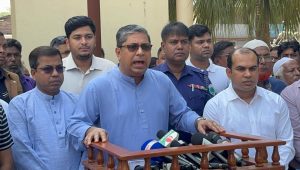
Nurul Haque Nur was once a name that stirred hope in Bangladesh’s student politics.
He rose to prominence as a key leader of the 2018 quota reform movement, where students protested against what they saw as an unfair recruitment system.
His fearless speeches and repeated survival of violent attacks made him a symbol of youth resistance.
That same energy carried him into the 2019 Dhaka University Central Students’ Union (Ducsu) election – the first in nearly three decades. Running as an independent candidate, Nur was elected vice-president, defeating a candidate backed by the then-ruling Awami League.
His victory was hailed as a rare triumph for an outsider in the politicised campus, as students of the country’s largest educational institution voted for him.
Six years later, Nur is no longer viewed in the same light. Once celebrated as a fighter for fairness, he now faces accusations of corruption, divisive politics, and reckless leadership – his story increasingly described as one of broken promises.
As Ducsu vice-president, Nur gained both praise and criticism.

Many admired his boldness in standing up to authorities and challenging the dominance of the Bangladesh Chhatra League – now banned for its role in July Uprising.
Between 2019 and 2020, Nur suffered multiple attacks on and around campus by the Chhatra League.
But criticisms grew around him. Students accused him of seeking media attention rather than solving campus problems, and of failing to build effective coalitions within Ducsu.
Controversy also erupted when he met the ousted prime minister Sheikh Hasina right after being elected union VP, saying that he saw “motherly affection” in her. This prompted students to question whether he was aligning with the ruling party’s agenda.

Questions were raised about whether he was using his position to launch personal political ambitions.
After Ducsu, Nur entered national politics. In late 2020, he co-founded Gono Odhikar Parishad with economist Reza Kibria, promising an alternative platform for young and marginalised groups free from mainstream corruption.
Many hoped that the new establishment would set an example against traditional corruption and fearmongering political culture.
The partnership, however, quickly soured. Disagreements over leadership turned into public accusations, with senior members alleging that Nur centralised control and used the party for publicity.
Trust eroded further when Kibria accused him of mishandling party finances, eventually leading to a split into two factions.
Allegations of financial scams have been among the most damaging to Nur’s image. Party insiders accused him of misusing donations, while explosive claims of “links” to Israeli intelligence stuck as political mud.
Though Nur denied any wrongdoing, his reputation as a clean alternative suffered. Instead of a reformist, critics began to see him as another leader willing to use funds for personal or factional gain.
Legal troubles also followed him. He was named in cases of vandalism, unlawful assembly, and assault.
In 2020, a female student filed a rape case against several of his supporters, accusing Nur of abetting the crime. Though he denied the charges and was later relieved of the charges, the incident severely damaged his reputation.
Today, Nur remains a visible figure in Bangladesh’s politics, but his influence has waned. What began as a journey filled with promise has become entangled in division, allegations, and mistrust.
Supporters argue that he is a victim of repression and smear campaigns meant to weaken him. But critics say his own actions – financial irregularities, poor coalition-building, and focus on publicity – are to blame for his fall from grace.
Many say that his image has become that of a typical political leader, practising power and seeking attention for his own political gain.
Political analyst and former Jahangirnagar University Professor Dilara Chowdhury was not surprised.
Pointing to the systemic flaws in politics, she asked, “Did any government, including the interim government, take effective initiatives to stop corruption?” She argued that young politicians inevitably learn from their seniors.
“If the top brass do not stop corruption from the core, it will spread everywhere. Young people enter politics with the dream to change, but they too head towards the same wrong path when they continue to face barriers,” she regretted.
Nur, who is currently receiving treatment at Dhaka Medical College Hospital, was seriously injured after a crackdown on a protest march in Dhaka’s Kakrail on 29 August. The demonstration was reportedly organised to demand a ban on the political activities of the Jatiya Party.