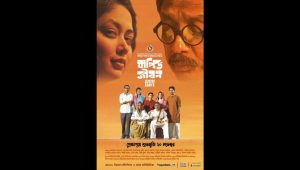



What if the forest, the river and the people who live beside them were never separate? In Non-duality (Adwaita), Khulna-based contemporary artist Moni Majhi explores that bond through objects, memories and rituals rooted in the Sundarbans. His solo exhibition invites viewers to see nature not as a resource to possess, but as a living world of which humanity is an inseparable part.
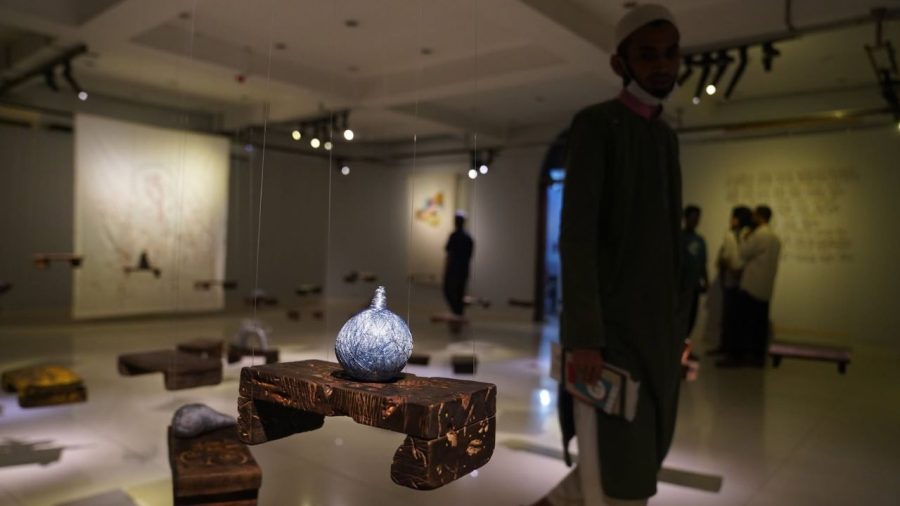
The exhibition opened at Alliance Française de Dhaka on 30 October and runs until 10 November. Visitors can attend daily from 3pm to 9pm. Majhi works across installation, drawing, thread, found objects and community-based research, drawing on the cultural memory and knowledge systems of the Sundarbans.
At the heart of the exhibition stand 41 piris, or low wooden stools. Each holds objects and memories gathered from different families. Some bear rhymes carved into the wood. They read like offerings to Paban Thakur, the wind, asking it to calm a storm.

Nearby, an embroidered work in the style of nakshi kantha brings another powerful image into view. Bonbibi, the guardian deity of the Sundarbans, holds the roots of a dying tree.
The composition recalls Michelangelo’s Pietà, in which a mother cradles what has been lost. The image speaks without needing a caption. Elsewhere, Majhi stitches an old song of Badar Gazi, also known as Badar Pir, in jute thread.




For Majhi, Adwaita is “not a repetition of religious doctrine”. Instead, he presents it as a lived relationship between humans, nature and all living beings. In this tradition, Bon Durga and Bonbibi represent the same mother, while Paban Thakur and Paban Pir belong to a shared cultural world.
The exhibition also recalls rituals once practised during severe storms. People would place a piri and offer sinni and payesh to the wind. Majhi sees these customs as signs of an alternative knowledge system, shaped by the close relationship between communities and their environment.
That relationship carries a clear ethical message: humans do not stand outside nature or rule over it. The same earth binds all living beings. The exhibition note extends this idea into a warning about environmental and cultural loss. Rivers change course, soil grows saline and animals lose their habitats.

Communities, meanwhile, risk losing their memories, languages and identities.
The result, the note suggests, is a shared displacement that leaves us all “refugees of the green”.