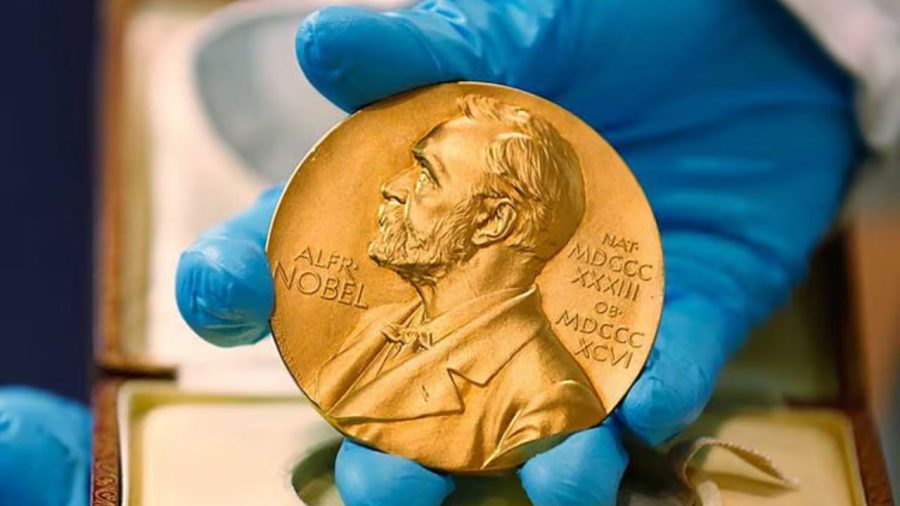



Since 1901, the Nobel Prizes have been awarded to individuals and organisations in recognition of achievements that significantly advance humanity, fulfilling the vision of founder and inventor Alfred Nobel.
The 2026 Nobel laureates are scheduled to be announced between 5 and 12 October, with the Nobel Prize in Medicine to be announced on Monday at 11:30am (0930 GMT), opening this year’s Nobel season, reports AFP.
Ahead of the announcements, here are some key historical facts and milestones highlighting the legacy of the prizes and their founder.
Laureates held in state detention
Since the awards were first presented in 1901, five Nobel Peace Prize laureates have been prevented from attending the official presentation ceremony in Oslo because they were detained or imprisoned by their governments.
In 1936, German journalist and pacifist Carl von Ossietzky was detained in a Nazi concentration camp when he was awarded the prize.
Myanmar opposition leader Aung San Suu Kyi was under house arrest when she won the honour in 1991. Although the ruling military junta allowed her to travel, she declined out of concern that she would not be allowed to return to her country.
Chinese dissident Liu Xiaobo was incarcerated when the 2010 award ceremony was held, with his prize placed on an empty chair.

When jailed Belarusian human rights campaigner Ales Bialiatski won the prize in 2022, his wife, Natalia Pinchuk, represented him at the ceremony.
Most recently, Iranian activist Narges Mohammadi was being held at Tehran’s Evin prison when her Nobel Peace Prize was conferred in 2023.
Record holders in age
Nobel laureates have ranged widely in age. Pakistani human rights activist Malala Yousafzai became the youngest-ever recipient when she won the Nobel Peace Prize at the age of 17 in 2014.
Australian physicist Lawrence Bragg was also remarkably young when he shared the 1915 Nobel Prize in Physics with his father at the age of 25. The prize recognised research he had conducted when he was just 21.
In 2018, Iraqi activist Nadia Murad received the Nobel Peace Prize at the age of 25 for her advocacy on behalf of the Yazidi minority.




At the other end of the age spectrum, American scientist John Goodenough became the oldest Nobel laureate in history when he won the 2019 Nobel Prize in Chemistry at the age of 97 for developing lithium-ion batteries, which power modern smartphones and electric vehicles.
A year earlier, fellow American Arthur Ashkin received the Nobel Prize in Physics at the age of 96.
Rules on posthumous honours
Following a statutory change by the Nobel Foundation in 1974, the rules explicitly state that Nobel Prizes cannot be awarded posthumously.
However, an exception allows an award to stand if a designated recipient dies between the official announcement in October and the formal presentation ceremony in December.
Before the 1974 rule change, only two people had received Nobel Prizes posthumously.
Swedish Secretary-General of the United Nations Dag Hammarskjöld, who died in a plane crash in 1961, was awarded the Nobel Peace Prize later that year.
Swedish poet Erik Axel Karlfeldt was posthumously awarded the Nobel Prize in Literature in 1931.
In 2011, the selection committee for the Nobel Prize in Medicine chose Canadian researcher Ralph Steinman, unaware that he had died three days before the announcement. The Nobel Foundation later confirmed that the award would remain valid.
Gender parity and female representation
Of the 633 Nobel Prizes awarded since 1901, only 68 have gone to women, accounting for roughly 10 per cent of all recipients. The proportion has, however, steadily increased since the early 2020s.
Scientific disciplines have the lowest representation of women. Nobel awarding committees have repeatedly rejected the introduction of quota systems, instead encouraging broader nominations of female scientists.
In Physics, five women have received the prize among 230 laureates. In Chemistry, eight women have been awarded the prize among 200 laureates. In Medicine, 14 women have received the prize among 232 laureates. In Economics, three women have been awarded the prize among 99 laureates.
Marie Curie became the first female Nobel laureate in 1903. She remains the only woman to have won two Nobel Prizes, receiving the Physics prize in 1903 and the Chemistry prize in 1911.
Alfred Nobel’s literary pursuits
Although globally renowned as the inventor of dynamite, Alfred Nobel had a lifelong passion for English poetry and admired literary figures including Percy Bysshe Shelley and Lord Byron.
Throughout his life, Nobel wrote verse in his native Swedish as well as predominantly in English.
In a letter to a friend, Nobel wrote: “I have not the slightest pretension to call my verses poetry; I write now and then for no other purpose than to relieve depression, or to improve my English”.
Earlier, in 1862, at the age of 29, he expressed doubts about his creative talent in a French letter to a young woman, writing: “Physics is my field, not writing”.
However, in 1896, the year of his death, Nobel wrote “Nemesis”, a controversial four-act tragedy inspired by Shelley’s play “The Cenci”. The work depicts a 16th-century Roman woman who murders her incestuous father.