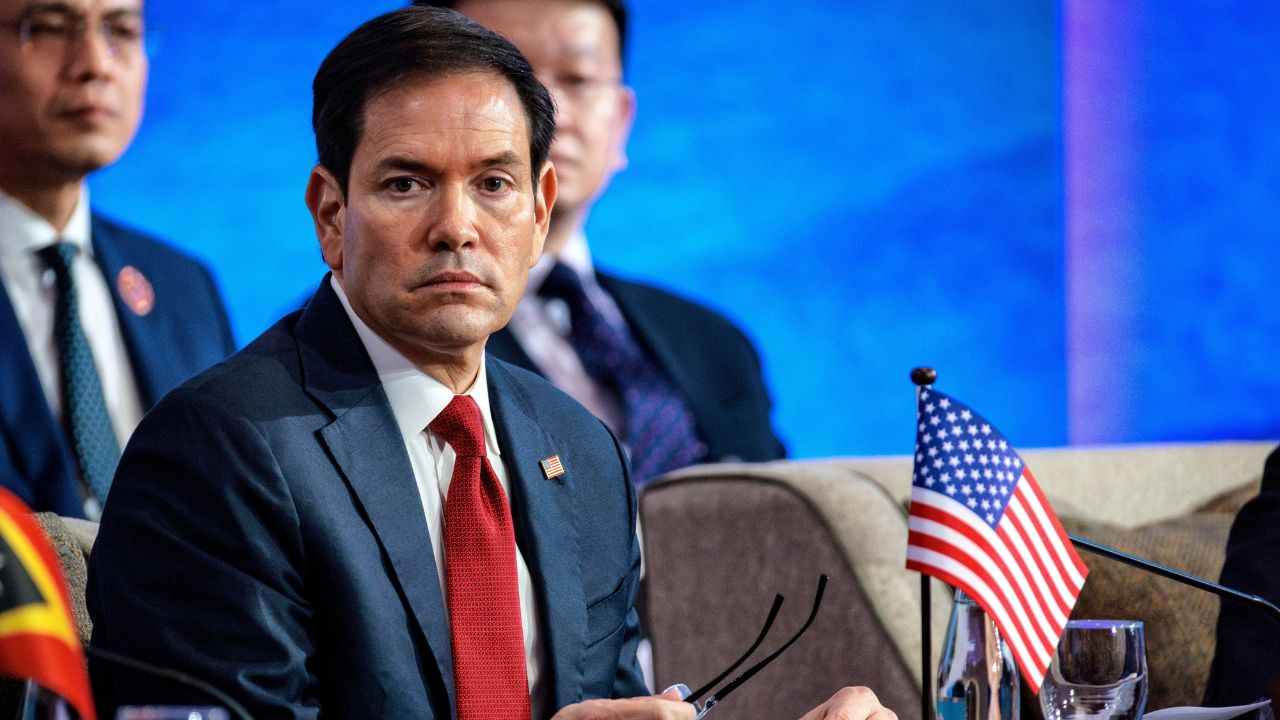

US Secretary of State Marco Rubio said on Thursday that the Trump administration stood ready to help end the “senseless war” in Ukraine, but cautioned that no swift agreement was in sight, with diplomacy set to demand sustained effort and fresh thinking, reports AP.
Speaking to reporters on the sidelines of a gathering of foreign ministers from the Association of Southeast Asian Nations (ASEAN) in the Philippine capital, Rubio said both Moscow and Kyiv ought to have an incentive to bring an end to a “very bloody war” that had devastated both sides.
His remarks came after talks with his Russian counterpart, Sergey Lavrov, as well as several other leaders, including China’s foreign minister.
Rubio acknowledged that previous US-mediated negotiations had stalled, describing them as “unsuccessful or at least unfruitful”, though he insisted President Donald Trump remained committed to the process “if conditions and factors have changed to make that possible”.
“That’s been the challenge — an end that both sides can accept. And we’ve tried and we’ll continue to try to see if we can, you know, find a middle ground that brings this about. And we’re prepared to play that role if the opportunity presents itself,” Rubio told reporters.
According to Russia’s foreign ministry, Lavrov largely declined to answer questions from journalists after his meeting with Rubio. Moscow said he had stressed to the US secretary of state “the unacceptability of further arming” Ukraine, while accusing European nations of seeking Russia’s “strategic defeat”.

The ministry added that Lavrov had reiterated Russia’s readiness for “a political and diplomatic resolution of the conflict” and reaffirmed Moscow’s commitment to the agreements reached at last year’s summit between Russian President Vladimir Putin and Trump in Alaska.
Rubio, however, said fresh approaches would be needed to reach a settlement acceptable to both sides. “We’ll have to find new suggestions and new ideas,” he said, adding that there had been no change to Washington’s military backing for Ukraine, with weapons continuing to be purchased by NATO allies and passed on to Kyiv.
The three days of closed-door discussions in Manila, which began on Tuesday, were dominated by the escalating conflict in the Middle East and rising tensions in the South China Sea, where a fresh confrontation erupted on Thursday.
Rubio rejected suggestions that Washington’s attention was being pulled away from Asia by the widening war involving Iran.



“There’s always going to be a concern that America is so focused on one place that it can’t focus on another,” he told reporters, insisting the US remained “engaged in Asia every single day” through strong partnerships and economic ties across the region.
On Iran, Rubio said US efforts to end the Ukraine war had been overshadowed this year by the outbreak of hostilities with Tehran, which have intensified since an interim ceasefire collapsed.
“The price will continue to get higher every single night until they come to their senses,” he said, adding that Tehran was “begging” for talks but that Trump saw little point in responding, since “Iran is clearly not ready to make a deal, at least not one they’re willing to live by”.
Trump has previously warned that the US would destroy an Iranian bridge or power plant for every attack on shipping in the Strait of Hormuz.
Iran’s foreign minister, Abbas Araghchi, responded by describing Tehran’s defence doctrine as “an eye for an eye” — to which Rubio retorted: “The president’s policy is a head for an eye. They will pay a very heavy price for the things they’re doing.”
Elsewhere at the forum, Australian Foreign Minister Penny Wong renewed her country’s concerns over a recent missile test-launch by a Chinese nuclear-powered submarine, saying Beijing’s failure to notify the Philippines and other Pacific nations over whose territory the missile travelled was destabilising.
Speaking at a university forum in Manila on Thursday, Wong said the test came “in the context of a rapid military build-up of China’s nuclear arsenal without the transparency or reassurance the region expects”, calling it “provocative and destabilizing”.
Beijing has defended the launch, saying it formed part of annual exercises and that appropriate advance notice had been given to countries in the area.
Rubio, who held lengthy talks with Chinese Foreign Minister Wang Yi on Wednesday, said the two had discussed a fresh altercation this week between Chinese and Filipino forces near a disputed shoal in the South China Sea, most of which Beijing claims as its own.
He described the incident as “escalatory”, adding: “Those need to be managed very carefully, because obviously, a conflict — be it economic or otherwise — between the US and China would have a dramatic global impact.”
Rubio said the pair had also discussed Chinese leader Xi Jinping’s planned visit to Washington in September, which he predicted would be “a very positive visit”.
Separately, China’s coast guard said it had taken necessary measures, including monitoring and obstruction, to drive away two Philippine vessels that had ignored repeated warnings during a fresh stand-off on Thursday, describing its actions as professional and lawful and calling on Manila to halt what it termed provocative infringements of Chinese territory.
The Philippine coast guard gave a different account, saying the two fishing boats had been harassed while delivering fuel aid to Filipino fishermen near Scarborough Shoal, and that a Chinese vessel had attempted to spray one of them with a water cannon but missed — actions it branded “illegal, coercive and aggressive”.
Washington has repeatedly criticised what it regards as Beijing’s assertive conduct in the South China Sea, to the detriment of smaller claimant states such as the Philippines, its oldest treaty ally in Asia. Taiwan, along with ASEAN members Vietnam, Malaysia and Brunei, have also been drawn into the often-tense territorial disputes.
According to a draft joint communiqué seen by AFP, ASEAN is aiming to conclude years-long negotiations with China on a proposed non-aggression pact by the end of this year.
The so-called code of conduct is intended to prevent a major conflict over the disputed waters — a vital global trade route that could potentially draw in the United States.