
Home Minister Salahuddin Ahmed has said the newly enacted 2026 Act will play a crucial role in preventing human trafficking and migrant smuggling.
The Prevention and Suppression of Human Trafficking and Migrant Smuggling Act, 2026 will also curb the misuse of digital platforms and technology by organised criminal networks, he said.
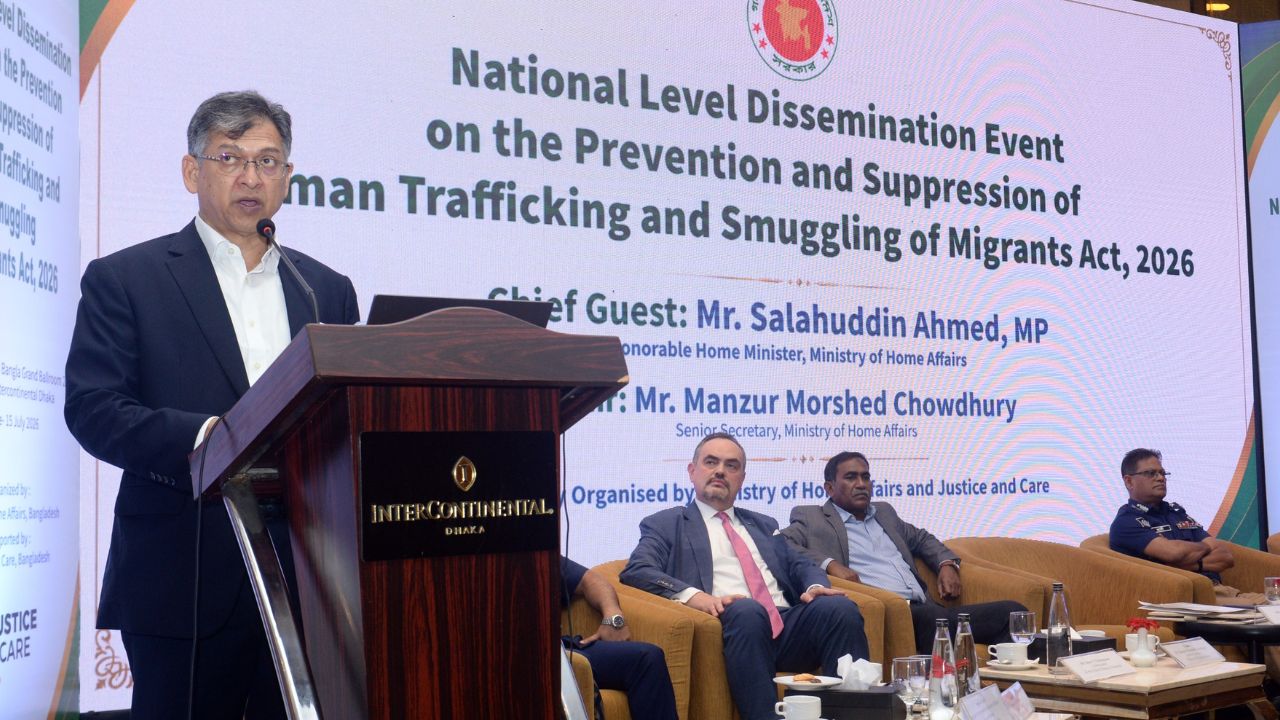
Salahuddin was speaking as the chief guest at the National Dissemination Meeting on the Act on Wednesday morning at the Ruposhi Bangla Grand Ballroom of Hotel InterContinental.
He said the country’s legal and institutional capacity has now been elevated to international standards, keeping pace with the evolving tactics of criminal syndicates.

The event was jointly organised by the Ministry of Home Affairs and Justice and Care, Bangladesh, to strengthen national commitment through a modern legal and institutional framework. Manzur Morshed Chowdhury, senior secretary of the Ministry of Home Affairs, presided over the programme.
Foreign Secretary Asad Alam Siam, British High Commissioner Sarah Cooke, US Ambassador Brent T Christensen, Inspector General of Police Md Ali Hossain Fakir, Coast Guard DG Rear Admiral Md Ziaul Hoque, BGB DG Major General Mohammad Ashrafuzzaman Siddiqui, and Additional Secretary Ziauddin Ahmed were present at the event.



Reiterating the government’s firm commitment, Salahuddin Ahmed said, “The newly enacted Act is a significant milestone in Bangladesh’s efforts to combat these serious transnational crimes.”
He also emphasised that close cooperation among government institutions, law enforcement agencies, the judiciary, development partners and civil society is essential for successful implementation.
The law defines trafficking and smuggling separately; stablishes migrant smuggling as a criminal offense; strengthens investigation and prosecution capacity; enhances victim and witness protection; expands international cooperation and upholds non‑criminalisation of victims.
The dissemination programme provided an opportunity for institutions to build a unified understanding of the Act. Participants discussed enforcement priorities, stressing stronger coordination across the criminal justice process from investigation to judicial disposal.
Human trafficking and migrant smuggling were described as among the most serious forms of transnational organised crime, exploiting vulnerable people, undermining rule of law and threatening national and regional security.
Speakers underscored the need for continuous national and international cooperation to protect victims, dismantle crime networks and bring perpetrators to justice.
Mohammad Tariqul Islam, Country Director of Justice and Care, Bangladesh, presented the background, rationale and key provisions of the law, followed by high‑level discussions on implementation priorities and inter‑institutional coordination.
Senior representatives from the Bangladesh Police, Border Guard Bangladesh, Coast Guard, CID, Special Branch, NSI, judiciary, prosecution, ministries, diplomatic missions, UN agencies, international organisations, NGOs and civil society attended the programme, reflecting broad national and international engagement in Bangladesh’s fight against trafficking and smuggling.