


Shaikh Rabiul Alam Robi, the authority on roads, railways, and waterways, has once again stirred political storm with a series of controversial remarks.
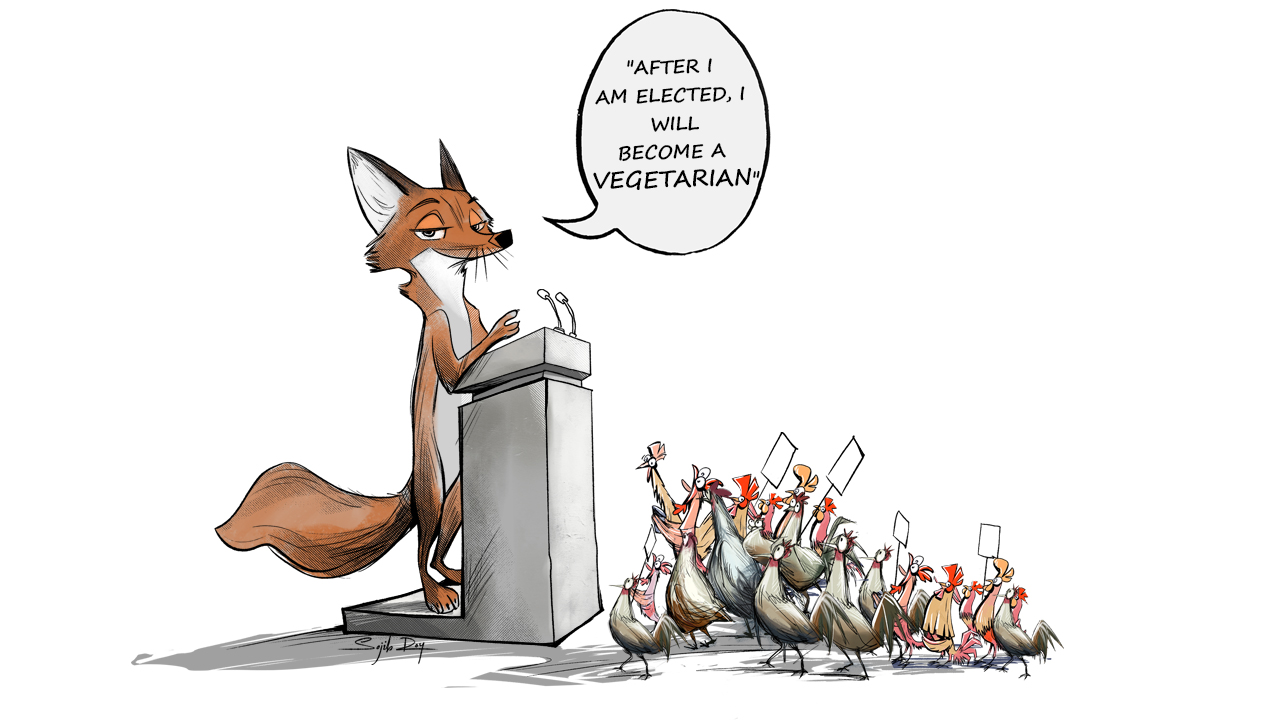
Standing in Parliament, he effectively burst the bubble of his own grand pre-election promises, proving that “vows” on the campaign trail and “gains” in corridors of power are two very different things.
He demonstrated that fiery field speeches can be merely a “charismatic performance” once one is seated on the throne of power – a fact he admitted with unparalleled nonchalance.
The overlord of this vast land, water, and rail empire recently blurted out a truth in Parliament that left the witty laughing but gave rise to a pointed joke among those still sensible.
His lips did not tremble as he dismissed the heated campaign promises he once distributed so freely as mere strategies to build public opinion. He nonchalantly remarked to the House, “One has to say many things before elections!”
Previously, after becoming a minister, Rabiul had introduced a new theory regarding extortion in the transport sector. He claimed that people actually pay “tolls” (extortion) through mutual understanding.

Since then, extortion has been rebranded in political jargon as “negotiated extortion.”
However, the story of how Rabiul secured his ministry is no less dramatic than a fairy tale. He is simultaneously a member of BNP National Executive Committee and the party Chairman’s advisory committee on foreign policy.
Even before BNP came to power, he made headlines following a murder case. A landowner was killed over a dispute regarding a flat in a building constructed by “Pleasant Properties,” a real estate firm owned by Rabiul.
The victim was an official of the private television channel, Deepto TV.



Although BNP suspended his party position after he was named the third accused in that sensational murder case, the “miraculous winds of power” ensured he faced no hurdles in securing the nomination for the Dhaka-10 constituency.
It is even said that Asif Mahmud Sajeeb Bhuiyan of the Jatiya Nagarik Party, despite preparing for the seat, did not pursue the election out of fear of Rabiul.
After defeating the Jamaat-e-Islami candidate, Rabiul reached Parliament. Then, in a stroke of luck akin to winning a lottery, the keys to three ministries landed in his pocket at once.
Many were surprised by the “extraordinary communication” skills of Rabiul, a graduate of the Department of Mass Communication and Journalism at Dhaka University.
Critics quipped that the prime minister likely lacked the opportunity to be explained that “mass communication” and “transport communication” (infrastructure) are entirely different concepts.
Nevertheless, Rabiul has repeatedly proven that he is highly “proficient” in his field of study. With his gift of the gab and ability to deploy data in television talk shows to defeat opponents, he is hard to match.
He is often so absorbed in the magic of his own rhetoric that he occasionally becomes entangled in his own words.
Upon taking his oath as a minister, he showcased this “skill” by introducing his “extortion theory.” Such an “aesthetic” coating on extortion was likely not even part of the Dhaka University Mass Communication syllabus.
Using that same “magic of communication,” he recently spilled the beans on his election promises in Parliament. During campaign rallies, he had passionately declared that if BNP came to power, tolls on the country’s major bridges would be completely waived.
As fate would have it, the party did come to power, and the responsibility for the Bridges Division fell to him. Yet, there is no sign of a toll waiver; instead, money is being collected as systematically as before.
When a lawmaker reminded him of this promise in Parliament on Monday, Rabiul Alam’s true “communication skills” emerged. Without flinching and with a sweet smile, he replied, “I spoke of waiving tolls before the election.
“Perhaps I said it to build public opinion, for the sake of being elected.”
He implied that if one holds onto every truth or lie told to build public opinion and get elected, the government cannot function.
Through Rabiul’s peculiar political chemistry, the public is now realising that a leader’s sweet words during election time are, in fact, the most bitter medicine for the common man.