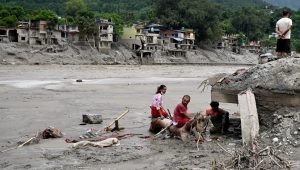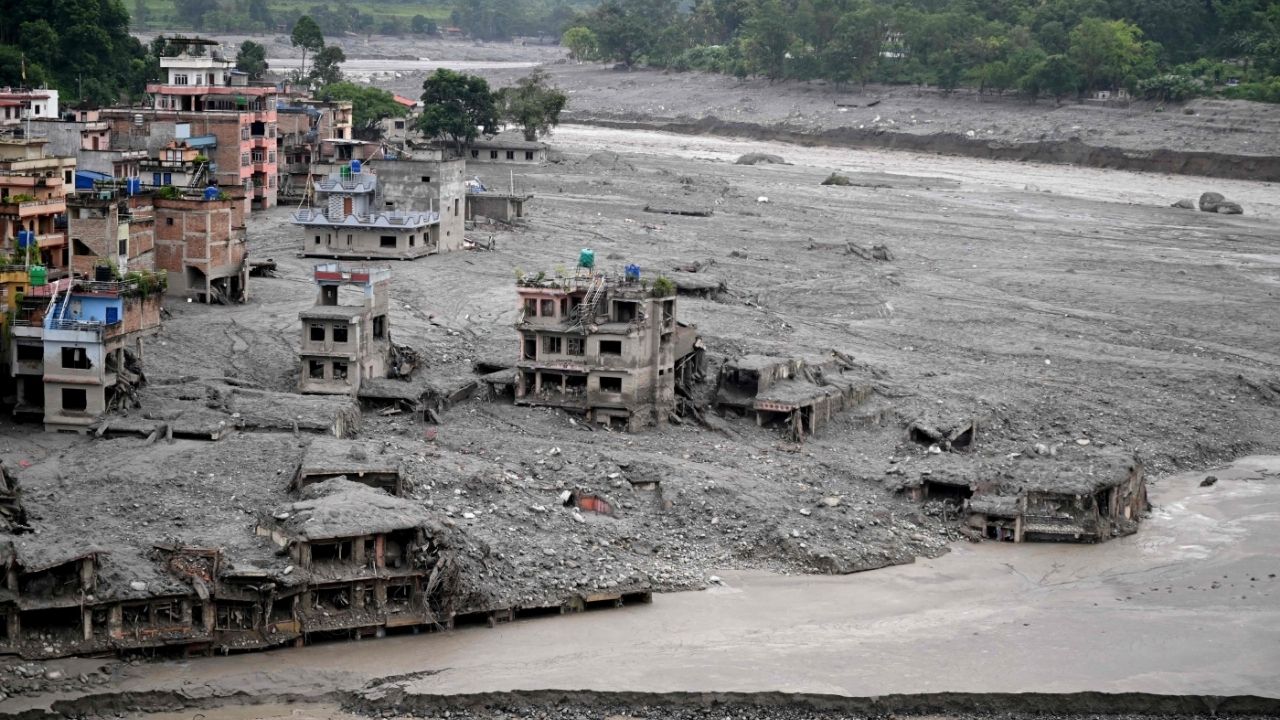

Nima Dorje Tamang was in Hakubesi, a hamlet south of Syafrubesi in Rasuwa, when the flood struck. He recalled hearing a thunderous roar before seeing waves taller than himself rushing toward the settlement, reports The Kathmandu Post.
Tamang and his family ran uphill, but the surge caught him. A rock struck his leg, fracturing it, and he was swept into the river. He managed to cling to a tree near the bank for nearly two hours until his father and brother pulled him to safety. For the next 24 hours, he slipped in and out of consciousness before a helicopter airlifted him to Kathmandu.
At Tribhuvan University Teaching Hospital’s orthopedic ward, Tamang told doctors his left foot hurt even when touched by air. The swelling persisted after surgery. From his hospital bed, he worried about his family. “We lost our uncle, aunt, sister, and brother‑in‑law,” he said. “And everyone says there will be a massive flood again.”
Like Tamang, communities and authorities were caught off guard when the glacier collapsed at 8:37am on 26 August. Scientists said predicting such an event was nearly impossible, and the flash flood surged so rapidly through steep terrain that warnings downstream were delayed. The disaster exposed a deeper problem: Nepal’s warning systems remain designed around single hazards, while disasters in the Hindu Kush Himalaya are increasingly complex, cascading and transboundary.

“There is no such thing as an early warning system in Nepal. Simply having sensors does not mean it’s a system; it has to be much more comprehensive,” said Anil Pokhrel, former chief executive of the National Disaster Risk Reduction and Management Authority (NDRRMA). He stressed that a true system requires risk assessment, real‑time observation, a communications plan, and preparedness measures.
Pokhrel said Nepal has invested heavily in sensors over the past decade, but without multiple sets monitoring different hazards across locations, as seen in Rasuwa, lives cannot be saved.



When the glacial collapse hit the Lhende valley near the Nepal‑Tibet border, Nepal’s Department of Mines and Geology recorded seismic activity at magnitude 4.4. “The frequency did not match that of an earthquake, which is our monitoring mandate, so we did not alert the public,” said Lok Vijay Adhikari, chief of the National Earthquake Monitoring and Research Center. The US Geological Survey later revised its assessment, attributing the seismic signal to the collapse itself.
Minutes later, rising water levels in the Bhotekoshi river could have provided another chance to warn communities. But at 8:50am, the flood swept away the gauge at Syabrubesi hydrological station. Designed to detect gradual rises, the equipment was ill‑equipped for high‑speed surges.
At 9am, the Rasuwa District Administrative Officer informed the Department of Hydrology and Meteorology (DHM). “We could not do much in Rasuwa because the flood destroyed communications towers, yet local authorities went door to door warning each other,” said Shanti Mahat, NDRRMA spokesperson. Downstream, alerts were sent through text messages, caller tunes, media broadcasts, and police loudspeakers.
By 9:15am, 38 minutes after the avalanche, people in Rasuwa, Nuwakot, Dhading, and Chitwan received text alerts advising them to move to higher ground. The messages listed hotlines for rescue assistance.
Such alerts are critical in Nepal, where over 95 percent of adults have mobile phones. But experts say vigilance and community action remain equally vital. Himanshu Thakkar of the South Asia Network on Dams, Rivers & People recalled the 2021 Chamoli glacier collapse in India, where a woman spotted the flood from a hilltop and warned her husband at a hydropower project downstream. Skeptical at first, he later saw the surge, alerted colleagues, and they escaped uphill.
The Rasuwa disaster has renewed calls for Nepal to build a comprehensive, multi‑hazard early warning system capable of saving lives in a region where glacial collapses, landslides, and floods are increasingly intertwined.