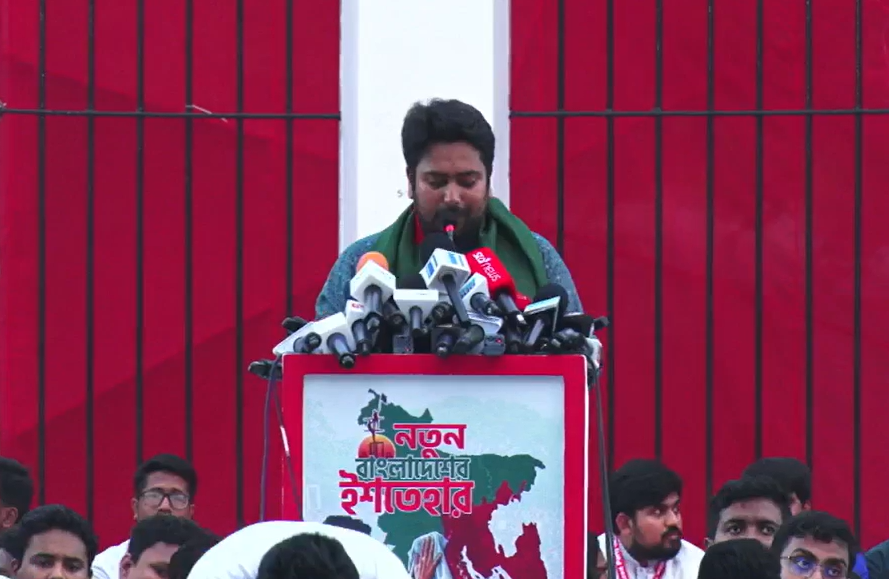



Following the historic mass uprising on 5 August 2024, National Citizen Party (NCP) had emerged as a new political force, led by student leaders who played a key role in the protests that toppled the Awami League government.
However, less than a year after its formation, the party has been shaken by its recent decision to join an electoral alliance with Jamaat-e-Islami and its allies, a move that has triggered internal unease. Several senior party members have already announced plans to step down, citing “ideological” and other concerns.
Analysts say the party, which had pledged to position itself as a strong third alternative while preserving a distinct ideological identity, now appears to be drifting from that course and edging back towards the country’s familiar pattern of political polarisation.
The decision has not only deepened rifts within NCP — which was formed on 28 February 2025 — but has also cast uncertainty over the future of the newly formed Democratic Reform Alliance.
The alliance was launched on 7 December by NCP, AB Party and Rastra Sanskar Andolan, with the stated aim of building a credible political bloc outside the long-dominant duopoly of BNP and Awami League.
However, NCP’s electoral agreement with Jamaat has pushed the alliance to the brink. Rastra Sanskar Andolan has clearly stated that it will not align with any major party such as BNP or Jamaat.
The biggest blow from the NCP’s political pivot has come from the party’s women leaders. In protest against the alliance with Jamaat and the perceived ideological shift, NCP senior joint member secretary Tasnim Jara has declared an independent candidacy.

NCP joint convener Tasnuva Jabin has left the party. Another woman leader, Monira Sharmin, has remained in the party but withdrawn from electoral candidacy.
The resignations and withdrawals of these women leaders have struck at the core of the party’s “progressive” and “inclusive” image.
Mir Arshadul Haque, NCP chief coordinator for Chattogram city and a central joint member secretary, has also left the party for the same reasons.
On Saturday, 30 NCP leaders sent a memorandum to party convenor Nahid Islam, describing the alliance with Jamaat as “worrying”.




According to them, if a party known as “centrist” suddenly shifts towards the right-wing pole, it risks upsetting its internal balance.
At a time when internal turmoil is at its peak, NCP Joint Chief Coordinator Md Arifur Rahman Tuhin described the decision as a “majority decision”.
Tuhin told TIMES of Bangladesh that 85 per cent of party members supported the move and that 122 leaders had given written consent.
He added, “A political party is not a private company to be run at will. When our core committee makes a decision, everyone must show loyalty to it.”
Professor Sabbir Ahmed of the Department of Political Science at Dhaka University views the NCP’s current predicament as a case of “political regression”. He said that in the present political landscape, where the BNP and Jamaat are the two dominant poles, the NCP has rendered itself insignificant by moving under Jamaat’s shadow.
Professor Sabbir told TIMES, “The NCP lacks experienced and steady leadership internally. They are themselves confused about which path to take. This uncertainty directly reflects their political immaturity.”
He added that for a political party to survive, it must have clear answers to three fundamental questions: what it wants, why it wants it and how it plans to achieve it.
Professor Sabbir cautioned, “If there is ambiguity in any of these areas, there is no realistic chance of success in politics. The NCP should have first built its credibility and independence, which it has failed to do.”
Sources say that while Jamaat is considering allocating 30 seats to the NCP, its long-tested ally Islami Andolan may receive at least 40 seats.
The NCP, which had been demanding more than 50 seats, being placed below another party is seen by many central leaders as political humiliation.
This has also reinforced perceptions that the NCP has yet to establish its prominence as a key ally even within Jamaat’s own alliance framework.
Much of the public expectation surrounding the NCP centred on two influential former advisers of the caretaker government, Asif Mahmud and Mahfuz Alam.
While Asif is yet to make any comment over the issue, in a Facebook post on Sunday night, Mahfuz Alam made it clear that he would not join the NCP, clarifying his position on several ongoing issues related to the party and its newly announced alliance with Jamaat.
Political analyst Professor Dilara Choudhury believes NCP’s crisis reflects ambiguity present at the party’s inception. According to her, when a party becomes election-focused before establishing a clear ideological foundation, internal splits are almost inevitable.
“During the July Uprising, young people united solely against Sheikh Hasina’s autocracy. But the NCP failed to translate that movement into a coherent political statement or narrative. The leadership never clearly articulated which ideology they represent.”
She also highlighted another crucial point: replacing Bangladesh’s entrenched power structure or ‘elite’ class is impossible without at least indirect support from parts of the state apparatus. NCP failed to secure such support or build a strong civic base.
“Before the party could consolidate itself, many leaders joined the government after the movement, weakening its organisational foundation. Ultimately, the NCP failed to meet the public expectations that emerged after 5 August,” she added.