





Bangladesh must ensure every international partnership serves its national priorities, economic sovereignty and the welfare of its people, Finance and Planning Adviser Rashed Al Mahmud Titumir said on Sunday.
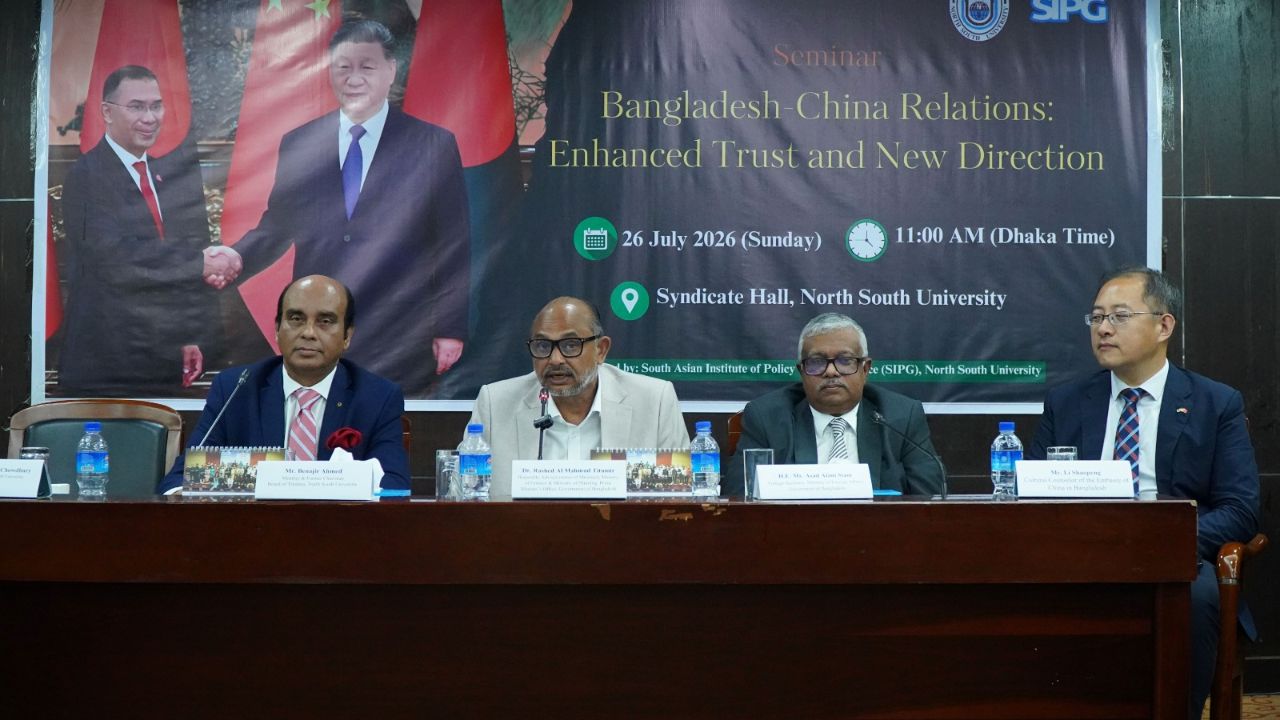
Speaking as the chief guest at the seminar, “Bangladesh–China Relations: Enhanced Trust and New Direction,” organised by the South Asian Institute of Policy and Governance (SIPG) at North South University (NSU), Titumir said international cooperation should always be guided by Bangladesh’s own development agenda.
“Partnerships are most meaningful when they reinforce national priorities, placing Bangladesh’s development, economic sovereignty and people’s welfare at the centre of every collaboration,” he said.
Referring to the principle of “Shobar Agey Bangladesh” (Bangladesh First), Titumir stressed that the country should pursue a self-reliant development path while deepening engagement with China on the basis of mutual respect, national interest and shared prosperity.
He welcomed Chinese cooperation in multimodal transport, the proposed Chinese Economic Zone in Chattogram, the expansion of Mongla Port and the proposed Kunming-Chattogram connectivity initiative. At the same time, he called for stronger people-to-people exchanges, cultural cooperation and educational partnerships alongside infrastructure development.
The seminar brought together policymakers, diplomats, academics, China experts, journalists and students to discuss how Bangladesh could translate the renewed momentum created by Prime Minister Tarique Rahman’s recent visit to Beijing into tangible outcomes in trade, investment, connectivity, education, technology and regional cooperation.
Foreign Secretary Asad Alam Siam said Bangladesh-China relations had entered a new phase marked by expanding cooperation across multiple sectors.
He highlighted recent progress in bilateral agreements, media cooperation and collaboration in agriculture, water resource management, supply chains, technology and multilateral affairs.
“The real challenge now is to convert diplomatic commitments into high-impact projects supported by strong institutional accountability and aligned with Bangladesh’s national interest,” he said.
Representing the Chinese Embassy in Dhaka, Cultural Counsellor Li Shaopeng described the prime minister’s visit to China as the beginning of a new chapter in bilateral relations.
“People matter more than infrastructure. Long-term people-to-people bonds matter more than physical connectivity,” he said.
Li underscored political mutual trust, international coordination and shared development as the foundations of bilateral cooperation, while highlighting the importance of vocational education, Chinese language learning and cultural exchanges in strengthening long-term ties.
Ambassador Mohammad Sufiur Rahman, Senior Research Fellow at SIPG, presented the keynote paper.
He argued that Bangladesh should move beyond a project-based approach towards China and instead adopt a long-term strategic framework encompassing geoeconomics, education, healthcare, research, technology, connectivity and mutual security.
The lead discussant, Dr Liu Zongyi, Senior Research Fellow and Director of the Centre for South Asia Studies at the Shanghai Institutes for International Studies (SIIS), China, shared his perspectives on the future direction of Bangladesh-China relations.
Speakers observed that bilateral ties had evolved beyond traditional development cooperation into a broader strategic partnership. They stressed that Bangladesh’s next challenge would be to translate diplomatic understandings into visible economic and social outcomes while safeguarding national interests, economic sovereignty and strategic autonomy.
Benjir Ahmed, a member of the NSU Board of Trustees, said Bangladesh-China cooperation should extend well beyond infrastructure and business.
“Friendship builds trust, trust creates opportunity, and opportunity shapes the future,” he said, calling for greater collaboration in higher education, research, agriculture, technology and student exchanges.
Professor Abdul Hannan Chowdhury, Vice-Chancellor of North South University, delivered the closing remarks, highlighting the growing importance of China-South Asia relations and urging Bangladesh to diversify and expand its exports to the Chinese market.
The seminar also explored broader regional issues, including the proposed Bangladesh-China-Myanmar connectivity framework (BCM+I), Teesta and northern river management, the Rohingya crisis, instability in Myanmar, Bay of Bengal geopolitics and strategic competition in the Indo-Pacific.
Speakers agreed that Bangladesh should continue engaging with all major partners on the basis of mutual benefit while avoiding excessive dependence on any single country and preserving its strategic autonomy in an increasingly complex global environment.
Professor Sk Tawfique M Haque, Director of SIPG, moderated the seminar and delivered the opening remarks, while S M Rubyat, Coordinator of CSCSS and Assistant Professor at NSU, concluded the programme with a vote of thanks.
The event reaffirmed SIPG and NSU’s commitment to promoting evidence-based policy dialogue on Bangladesh’s foreign policy, regional cooperation and strategic engagement in a rapidly evolving international order.


