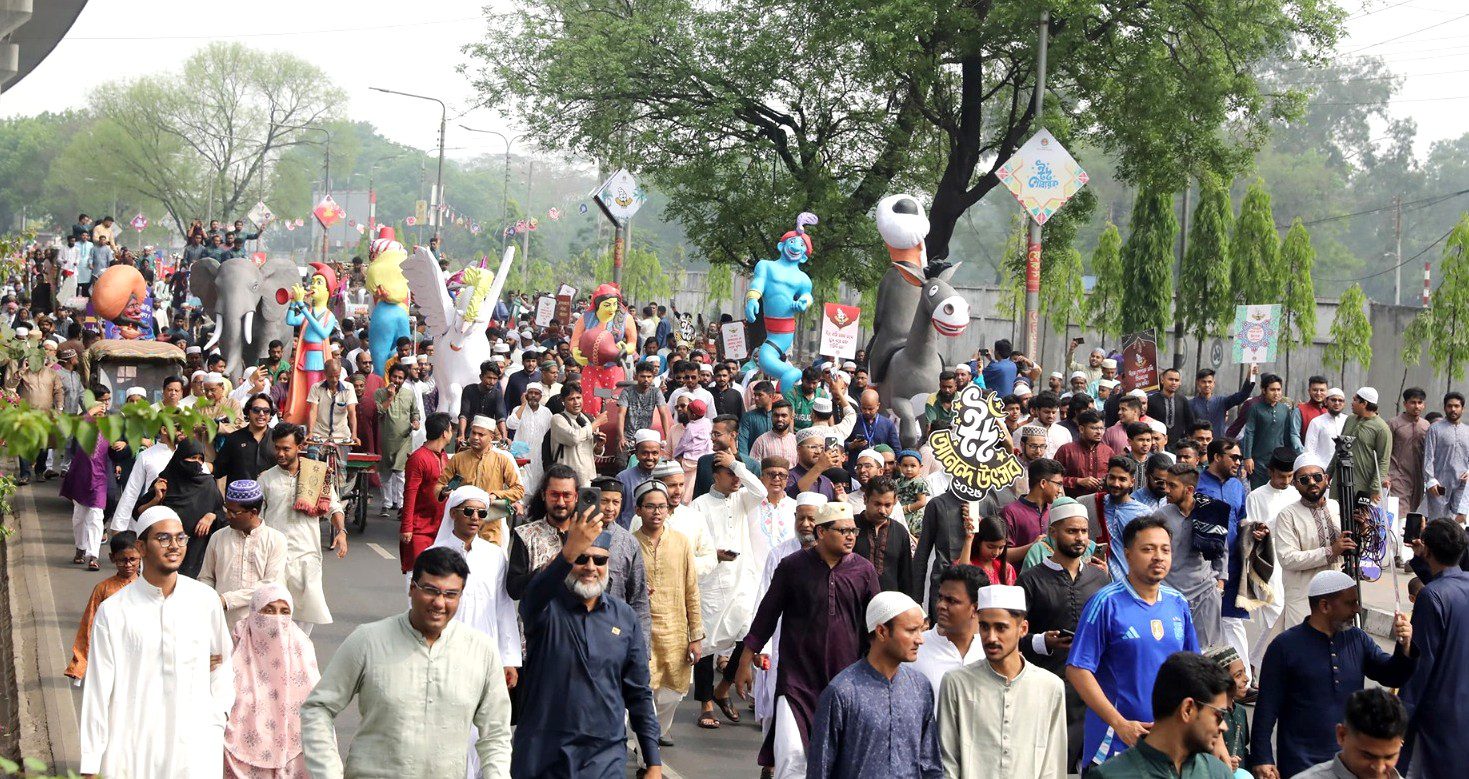



Staff Correspondent, Dhaka – A government-sponsored Eid-al-Fitr procession aimed at blending tradition with modernity has ignited criticism due to the inclusion of sculptures and figurines, which some scholars argue are not permissible in Islam.
Critics contend that the use of sculptures in religious or cultural events contradicts Islamic traditions, leading to widespread debate. Organized by the Dhaka North City Corporation, the Eid procession was reportedly inspired by Mughal-era customs and took place in the capital, Dhaka.
Held after the Eid prayers on Monday, the parade featured traditional music, horseback riding, and historical elements reminiscent of the Mughal period.
However, the inclusion of sculptures depicting various figures quickly became a subject of controversy. Beyond religious objections, concerns have also been raised regarding the design and quality of the sculptures.
Islamic groups such as Hefazat-e-Islam and Majlis-e-Tahaffuz-e-Khatm have openly opposed the initiative.

Social media platforms, particularly Facebook, have been flooded with satirical comments, including a widely circulated image of a sculpture depicting a man sitting backward on a donkey.
Some users speculated that the puppet of Nasiruddin Hodja sitting on the donkey resembled a political figure in Bangladesh, questioning its relevance to Eid celebrations.
The puppet artists and event organizers defended the portrayal of Hodja, explaining that the character was included to highlight the historical and literary heritage of Bengal and the broader Muslim world.
They emphasized that the puppet was primarily created for children’s entertainment.




The procession, held in Dhaka’s Agargaon area, featured five decorated horses, 15 horse-drawn carriages, a marching band, traditional musical performances, and puppets illustrating historical scenes from the Sultanate and Mughal eras.
At the event’s conclusion, participants were treated to traditional Eid sweets, such as vermicelli.
“After many years, we have revived Dhaka’s historic Eid procession,” said Asif Mahmud Sajib Bhuiyan, the local government advisor who led the initiative.
“Moving forward, we will celebrate Eid like this every year. Our festivities will now be more vibrant, with processions and fairs becoming a tradition.”
The Ministry of Culture has announced plans to expand the Eid processions nationwide for the upcoming Eid-ul-Adha. Shilpakala Academy will organize similar processions on Chand Raat (the night before Eid) in every district.
In an interview with a US-based media outlet on Tuesday, Cultural Affairs Advisor Mostofa Sarwar Farooki elaborated on how the initiative came to fruition.
“During Shilpakala Academy’s Chand Raat preparations, our LGED advisor Asif called me. He mentioned that historically, Eid processions were a part of our culture and wanted to revive that tradition. I supported the idea, as it aligns with our cultural policy in Bangladesh. So, we decided to move forward together.”
Addressing concerns over the sculptures, Farooki acknowledged that the program was organized hastily.
“This was primarily an initiative of Dhaka North City Corporation. The motifs in the Eid procession were created within a tight timeframe—we had only six to seven days to prepare. Naturally, there were some curatorial challenges. I am sure Dhaka North will learn from this experience, and next year’s procession will be more refined and culturally aligned with Eid.”
Despite these clarifications, the inclusion of sculptures in the Eid parade has continued to draw sharp criticism from religious groups.
Hefazat-e-Islam Bangladesh, an organization advocating for Sharia law in the country, condemned the Eid procession, accusing the Ministry of Culture of promoting idolatry.
In a statement on Tuesday, the organization’s Amir, Muhibbullah Babunagari, and General Secretary, Sajedur Rahman, expressed strong opposition to the event.