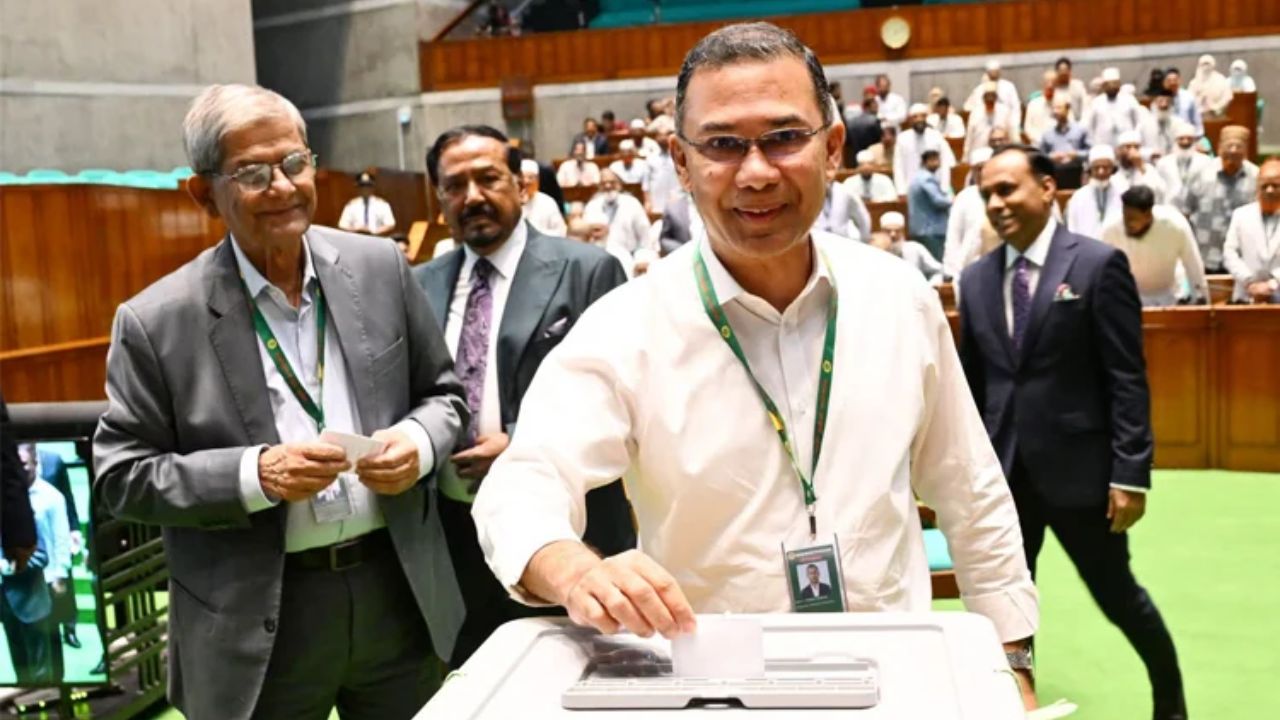



Direct voting for the 23rd presidential election of Bangladesh has commenced inside the parliament chamber of the Jatiya Sangsad. This historic ballot marks the first contested presidential election by members of parliament (MPs) in 35 years.
The electoral proceedings officially started at 2pm with a recitation from the Holy Quran. Following the recitation, the Chief Election Commissioner (CEC) and chief election official, AMM Nasir Uddin, presented the formal voting guidelines to the chamber, after which the casting of ballots began.
The first ballot was cast at 2:10pm by Acting President Major (retd) Hafiz Uddin Ahmed. Votes were subsequently cast by the Acting Speaker Kayser Kamal, Prime Minister Tarique Rahman, and the Minister for Local Government and BNP presidential candidate, Mirza Fakhrul Islam Alamgir.
Prime Minister Tarique Rahman and Minister Mirza Fakhrul Islam Alamgir had earlier arrived at the Jatiya Sangsad directly from the Secretariat to participate in the vote.

Because the Jatiya Sangsad is not currently in session, a separate, dedicated meeting of MPs was convened specifically to conduct the election. This meeting is being presided over and conducted by CEC AMM Nasir Uddin.
A total of 349 MPs are eligible to vote in the election. However, Parliament Chief Whip Nurul Islam Moni confirmed that BNP MP Mirza Abbas is unable to cast his ballot due to illness.
The BNP holds a decisive majority of 247 seats in the parliament, making Mirza Fakhrul’s victory virtually guaranteed. Nonetheless, because multiple candidates are in the fray, a formal vote is legally mandatory.


As an elected MP, Mirza Fakhrul is eligible to cast his own vote, whereas his opponent, Colonel (Retired) Oli Ahmad of the Jamaat-e-Islami-led 11-party alliance, does not have voting rights because he is not a Member of Parliament.

Unlike standard public elections, the presidential ballot is not secret. MPs must sign and write their full names next to their chosen candidate’s name on the ballot paper directly from their designated parliamentary seats.
Voting is scheduled to conclude at 5pm, and the counting of votes will begin immediately inside the parliament chamber. CEC AMM Nasir Uddin will declare the official results inside the chamber, which will be followed by the publication of an official government gazette notification later today.
The presidential vacancy was created following the resignation of former president Mohammed Sahabuddin on 24 July, who had been elected during the Awami League regime. Under the Constitution, a new president must be elected within 90 days of the post falling vacant, prompting the Election Commission to release the election schedule on 6 August.
This election is the first contested presidential vote since the parliamentary system was restored in 1991.
Although the inaugural vote under the restored system was contested in 1991, the subsequent seven consecutive presidents were elected unopposed. The decision of the opposition alliance to field a candidate has broken this 35-year streak of uncontested elections.
Following the declaration of results, the newly elected president is scheduled to take the oath of office at the Bangabhaban tomorrow, Friday (21 August 2026). Although some reports state the ceremony is scheduled for 7pm, the CEC has officially announced that the oath-taking will take place at 7:30pm.
According to the Constitution, Jatiya Sangsad Speaker is the authority who administers the presidential oath. However, following Sahabuddin’s resignation, Speaker Hafiz Uddin Ahmed assumed the role of interim president.
Consequently, Deputy Speaker Kayser Kamal took over the duties of Acting Speaker. The Ministry of Law has confirmed that Kaysar Kamal, as the current Speaker, is the legally designated authority to administer the oath to the incoming president.