
Information and Broadcasting Minister Zahir Uddin Swapon on Friday said journalists, media owners and the government are working together to build an independent, responsible and financially sustainable media system.
“The media acknowledges that there is no form of control over it. Rather, journalists, owners and the government are working together to build an independent, responsible and economically sustainable media system,” he said.
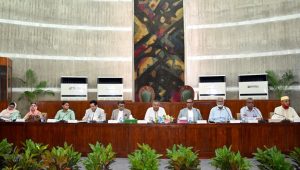
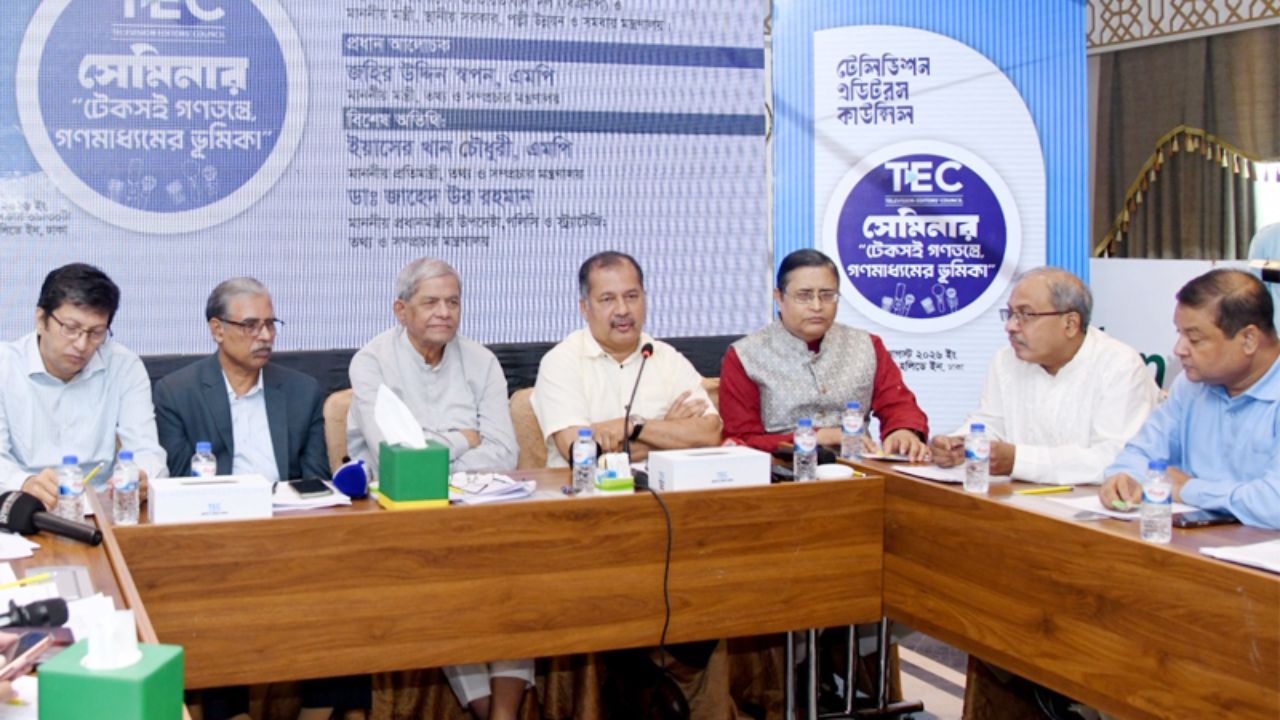
Swapon made the remarks as a special guest at a seminar titled “Role of Media in Sustainable Democracy”, organised by the Television Editors’ Council (TEC) at a hotel in the capital.
Local Government, Rural Development and Co-operatives Minister Mirza Fakhrul Islam Alamgir attended the seminar as chief guest.
The information minister said the government wanted to build a media ecosystem that strikes a balance among the interests of media owners, journalists, advertisers, the state and the public.

Such a system should allow journalists to perform their professional duties independently while ensuring their rightful status and financial security, he added.
Describing democracy and the media as complementary to each other, Swapon said an independent and responsible media was essential for sustainable democracy, while a strong media could in turn strengthen democracy.
He urged stakeholders to view the media not merely as a business but as one of the fundamental pillars of the state and society.

“Journalism and the media industry are different from any other sector. They constitute an undeclared but indispensable fourth pillar of the state and society,” he said.
Ensuring journalists’ professional independence, dignity and security was therefore an important responsibility of the state, he said, adding that the media industry must also have a strong economic foundation to achieve those goals.
Swapon said the industry could not be sustainable unless media owners had access to a fair business environment and reasonable profits. At the same time, he said, the advertising market could not expand without a strong private-sector production economy.
The minister said the media ecosystem had become increasingly complex as digital platforms, global technology companies and artificial intelligence became intertwined with traditional media.
Against this changing backdrop, he stressed the need for forward-looking policies and institutional reforms.
Swapon said the media should not be subject to “control”, but should instead operate within an appropriate “regulatory” framework that safeguards the legitimate rights of all stakeholders.
Without good governance and effective regulation, he warned, there could be a tendency in some cases to use media outlets as tools to advance business interests or gain bargaining leverage.
Such practices were harmful to both media freedom and credibility, he said.
Referring to the July mass uprising and the last national election, Swapan said new opportunities had emerged under the leadership of Tarique Rahman to reform the state and its institutions. He called on all stakeholders to work collectively to use that opportunity to bring reforms to the media sector as well.
Independent Television Chief News Editor Mostafa Akmal presented the keynote paper at the seminar. The event was chaired by Television Editors’ Council Convener and Banglavision Editor-in-Chief Dr Abdul Hai Siddique.
Chief Information Officer Syed Abdal Ahmad, Dhaka University Vice-Chancellor Prof ABM Obaidul Islam, Protidiner Bangladesh Editor Maruf Kamal Khan, National Press Club President Hasan Hafiz, Bangladesh Federal Union of Journalists Secretary General Kader Gani Chowdhury and Daily Wada Editor Shafiqul Alam also spoke at the seminar.
TEC Member Secretary and Somoy Television CEO Zubair Babu delivered the welcome address.