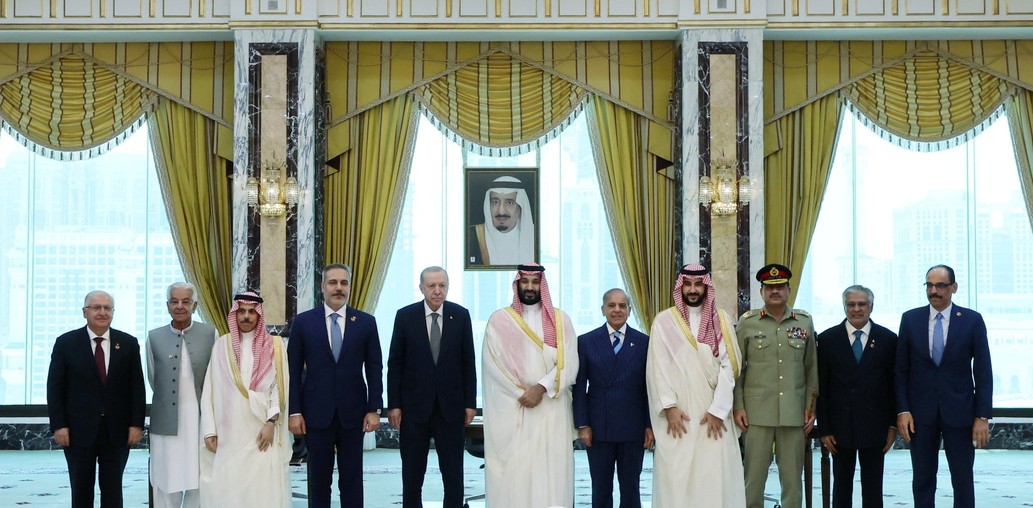



The signing of the Mecca Joint Defence Agreement by Saudi Arabia, Türkiye and Pakistan on 8 August 2026 marks a significant development in the rapidly changing security architecture of the Middle East. The agreement declares that an armed attack against one of the three countries will be regarded as an attack against all.
Turkish Foreign Minister Hakan Fidan has compared the principle to NATO’s Article 5, although the pact’s precise institutional and operational arrangements remain to be worked out. The agreement is explicitly described by its signatories as defensive and not directed against any particular country. Yet its significance goes beyond the text of the agreement. It reflects a deeper regional anxiety: traditional security arrangements in the Middle East are no longer regarded as sufficient.
The timing is hardly accidental. The continuing confrontation involving the United States, Israel and Iran has exposed the vulnerability of states caught between competing regional and global powers. Saudi Arabia, in particular, has faced attacks affecting critical infrastructure and maritime security, while the wider region has witnessed disruption to energy and commercial routes.
For decades, many Gulf states relied heavily on the US security umbrella. Saudi Arabia remains a major American security partner and, as recently as May 2025, Washington announced a defence package with Riyadh worth nearly $142 billion. Yet sophisticated weaponry and a close strategic relationship do not necessarily eliminate a country’s sense of vulnerability. The lesson increasingly drawn in regional capitals is not that the US is irrelevant, but that dependence on a single external guarantor carries risks. New defence arrangements need not replace the US; rather, they can provide additional strategic options. The Mecca Pact should therefore be understood as strategic diversification rather than a complete break with Washington.

The three members bring different strengths and anxieties to the table. Saudi Arabia is by far the economic heavyweight, possessing enormous financial resources, strategic energy assets and growing defence capabilities. But its vulnerability is equally clear: its economic transformation under Vision 2030 depends upon stability, uninterrupted energy exports and protection of critical infrastructure and maritime routes. Iranian capabilities and the Houthi threat have demonstrated how geography can turn economic strength into strategic vulnerability. Türkiye brings a different set of advantages. It is a NATO member, possesses one of the region’s most capable defence industries and has developed considerable indigenous capabilities, particularly in unmanned systems and other advanced military technologies. Yet Ankara faces its own security challenges, including the Kurdish issue and an increasingly complicated relationship with Israel. Its NATO membership also gives the pact an unusual connection to the Western security system. Pakistan contributes strategic depth, a large and experienced military establishment and, uniquely among the three, a nuclear capability. Its principal security preoccupations, however, remain closer to home – especially its longstanding rivalry with India and instability along its western frontier. Islamabad’s participation reflects an attempt to expand its strategic partnerships without being drawn directly into every conflict in the Middle East.
The common denominator is not identical threat perception but a shared desire for greater strategic autonomy. The pact could gradually alter Middle Eastern security calculations. Historically, Sunni-majority states have often pursued their security interests separately, allowing external powers to play a disproportionately large role. The Mecca Pact represents an attempt to overcome at least some of that fragmentation. The possibility of further expansion is already being discussed, with Egypt among the countries mentioned as a potential future participant. The UAE, Qatar and others could also become relevant, although each has its own diplomatic calculations. But expectations should remain measured. A declaration that an attack on one is an attack on all does not automatically create an integrated military alliance. The real test will be what happens when one member actually faces a serious crisis.




For Washington, the pact is both a challenge and an opportunity. It signals that regional partners want greater control over their own security, but it does not necessarily mean they are abandoning the US. Washington may ultimately benefit if regional partners become more capable of contributing to their own security. At the same time, America’s traditional influence could gradually diminish if regional states diversify their defence relationships too far. Israel is likely to view the emergence of a coordinated Sunni security grouping with caution, particularly amid its confrontation with Iran. Iran, meanwhile, may regard the pact as an additional layer of strategic pressure even though its members insist that the agreement is not directed against Tehran. The distinction between a defensive alliance and perceived encirclement can become blurred during a crisis. For India, the presence of Pakistan inside a new regional security arrangement creates an additional diplomatic complication. New Delhi’s expanding economic, energy and maritime interests in West Asia make it important for India to maintain constructive relations with Saudi Arabia, Türkiye, Iran and Israel simultaneously. The pact therefore adds another variable to India’s already complex West Asian strategy.
This development has particular relevance for Bangladesh because Dhaka has already joined the Saudi-led Multinational Maritime Defence Alliance involving 14 countries, including Saudi Arabia, Türkiye, Pakistan, Egypt, Qatar and others. Bangladesh’s participation is fundamentally understandable. Our economy depends heavily on uninterrupted international shipping, while millions of Bangladeshi citizens work in the Middle East and the country relies substantially on the region for energy supplies. Dhaka has also stressed the importance of freedom of navigation and uninterrupted maritime commerce in response to the Houthi threat. But the Mecca Pact makes Bangladesh’s diplomatic balancing act more delicate.
Bangladesh’s interest is not to choose sides in the Middle East’s geopolitical rivalries; it is to protect its citizens, energy security, trade routes and national economic interests. The best strategy is therefore principled strategic flexibility: remain committed to freedom of navigation and international law, deepen maritime cooperation where it serves Bangladesh’s interests, maintain constructive relations with Saudi Arabia and other Gulf partners, preserving diplomatic channels with Iran and avoiding unnecessary entanglement in regional military rivalries.
The Mecca Pact may or may not evolve into a Middle Eastern equivalent of NATO. That remains uncertain. But its emergence sends a clear message: regional powers are no longer prepared to leave their security entirely in the hands of external guarantors. For Bangladesh, the lesson is equally clear. In an increasingly fragmented international order, the smartest diplomacy is neither isolation nor bloc politics. It is the ability to build partnerships without becoming captive to them.
The views expressed in this article are solely those of the author
The writer is the Research Director with Osmani Centre for Peace and Security Studies (OCPASS)