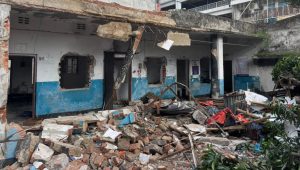
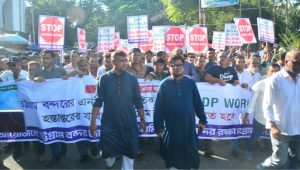
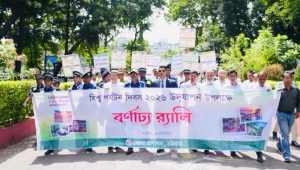
The “Matarbari Deep-sea Port” is under construction on the shore of the Bay of Bengal, with a bay terminal already ready to receive vessels. Chittagong Port Authority signboards mark the locations where land once belonged to fishing families.
Many have already left—displaced to distant cities, trading their homes, their ancestry, and their ancestral professions for a one-time payment. Those who remain in Dhalaghata union live in a landscape stripped of possibility: no health centres, no doctors, no jobs for their educated children, no land to grow crops.
The rhythms of survival are simple and harsh: deep-sea fishing, salt farming in the dry months, shrimp cultivation in the monsoon—all on lands now leased by the village’s privileged few. Extreme heat bears down. Cyclones return each year like clockwork.
At monsoon’s end, the village becomes an archipelago. Families live on small islands of elevated ground, surrounded by floodwater.

In the distance, the chimney of the 1,200-megawatt coal-fired power plant pierces the sky. At night, high-voltage lights illuminate the security perimeter protecting the multinational project. A paved highway connects to the plant, smooth and modern, but it ends abruptly at the village entrance, where the mud begins.
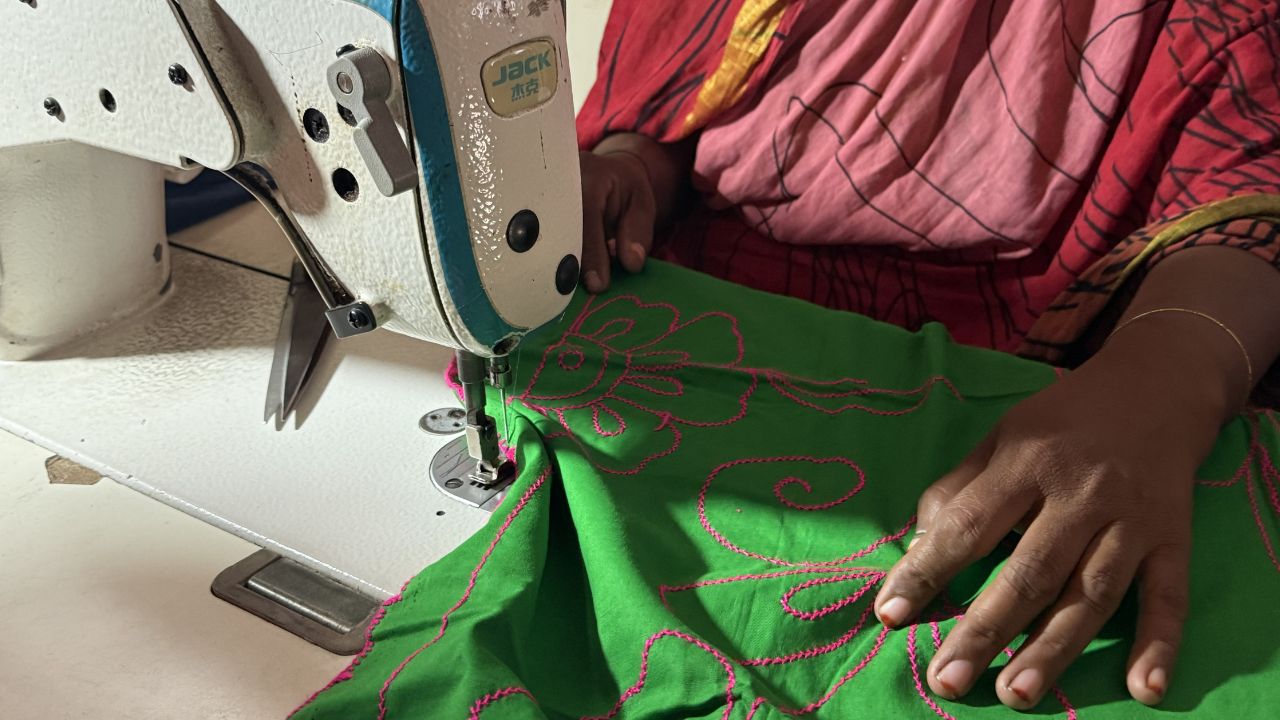
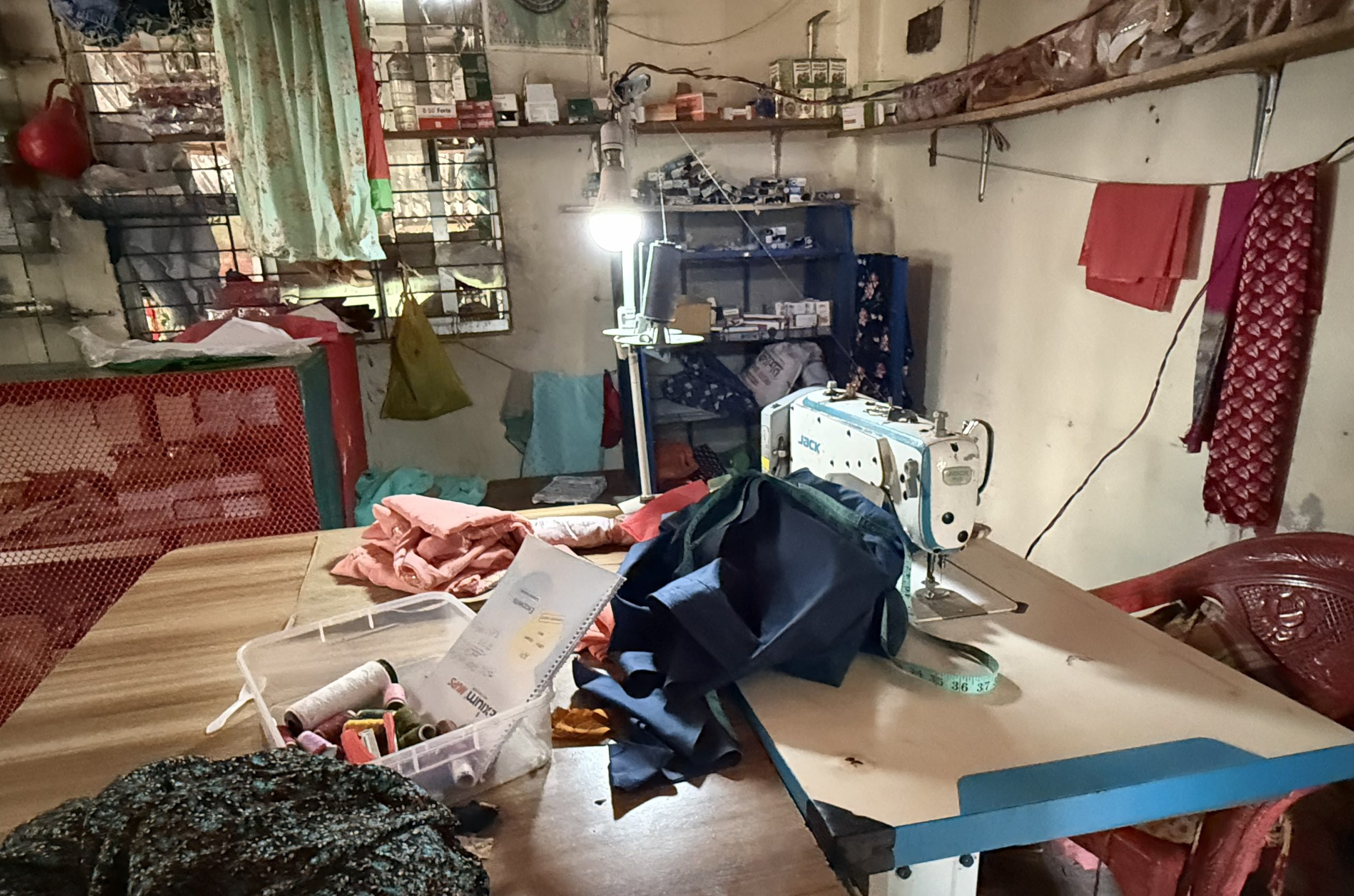
To improve the lives of affected people, the Centre for Sustainable Development (CSD) and Young Power in Social Action (YPSA) implement a project to empower women by providing training in Nakshi Kantha, a traditional Kantha design and stitching technique.
After the training, organisations offer materials such as clothing and yarn, along with supplementary support. After making the Kantha, the organisation collects the Kantha from the Beneficiaries in exchange for money.

For this project, women are empowering themselves and providing training to other local women. As a result, these women are receiving cash and can now spend it on their families and their children’s education, but the project has not continued.
Farzana Nipa Munni, 30, a mother of three children, and beneficiary of this project, living on the embankment of the Kohelia River, sat on her balcony, knitting the traditional Nakshi Kantha and drawing her dream on it because she had to pay her microfinance loan to the NGO.
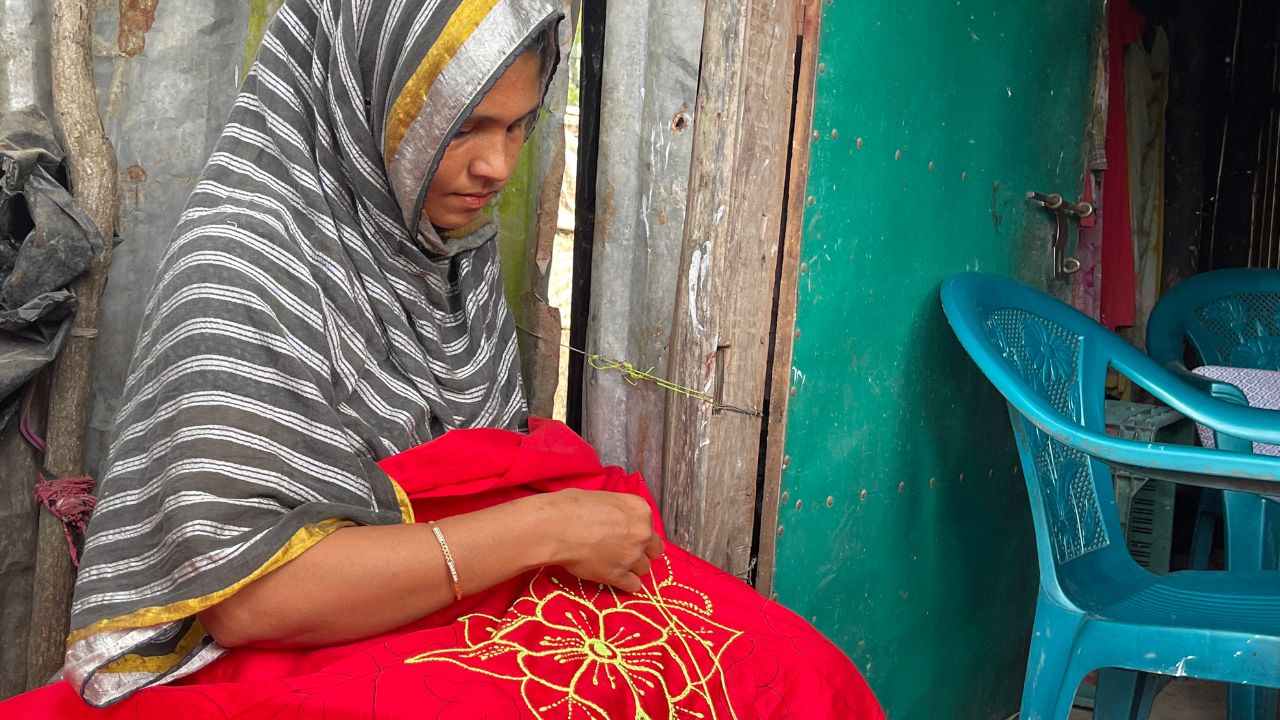
Before Farzana married, she dreamed of becoming a doctor to treat local people, but cyclones and river erosion dashed that dream, and the sea washed away her father’s land. She was forced to marry when she was 16.
Her husband is a fisherman on the Kohelia River. He regularly goes to the river to catch fish, but often returns with an empty bucket.




Farzana said, “Now he can’t provide support to the family. Prices are extreme; he failed to get fish in the river. Once, when we were married, the river was very active with many trawlers and fishing boats. During coal power construction, fishermen were not allowed to fish, and boats stopped coming regularly.”
She added, “YPSA trained 30 housewives in making Nakshi Kantha. They provided cloth and cotton, we worked in groups, and created ‘Matarbari Boutiques’—selling each kantha at Tk1,200. It gave us hope, but it didn’t get much attention or profit, and the programme closed. At least 20 kanthas remain unsold.”
“I thought this training would help me become a resilient woman, pay all loans, and be free from them.”
But the programme failed to continue growing as a business and earning profits. She lost hope of achieving success. Not Farzana is a single case in Matarbari; at least 15 locals were interviewed by the reporter from Dhalghata and Matarbari.
Humaira, 34, lives in Sairar Deil Asroyon Prokolpo near the Coal power project. She once lived on an embankment, kept cattle, and cultivated green vegetables; she and her family happily survived. But the coal power projects evicted all the villagers; she was one of the victims. After 5 years, she got a home with three rooms from the government. She opened a cosmetics and firewood shop in her one-room.
The government promised to provide better jobs; if the projects were completed, there would be jobs available for everyone.
Humaira said, “All are fake promises; they forced us to leave our ancestral lands.”
She added, “If we get customers, we can sell to larger consumers and survive. Also, team members have some energy to make more Kantha, but now it’s hard to sell a piece in two months. Our members are now taking microcredit loans from the NGOs. There are no jobs.”
“We gave our land to make a bright and economically worthy power project for the people of Bangladesh, but we feel now, who will provide us with at least a job to survive?”
Aziz Shikdar, Project Focal Person at YPSA, reported that between 2024 and 2025, YPSA established the ‘Matarbari Boutique’ initiative with CSD-ULAB support, targeting 30 women from families displaced by the Matarbari Coal Power Plant. Members received training in producing and marketing nakshi kantha (traditional embroidered quilts), obtained a Union Parishad trade license, and opened a joint bank account at Matarbari Krishi Bank with approximately Tk400,000.
Members received online and offline marketing training, including hands-on instruction on posting content and managing orders via a Facebook page “Matarbari Boutique”. However, limited digital literacy and education levels made it challenging to sustain online operations.
Land acquisition for the Matarbari coal-based power plant began under the Sheikh Hasina government, with promises to transform the area into a “Second Singapore”. An ActionAid study from around 2012 found that approximately 90,000 people out of Matarbari’s total population of 100,000 were directly or indirectly affected by the project.
A total of 2,880 acres of salt fields were acquired, affecting around 20,000 people, including salt farmers, shrimp farmers, and fish and crab cultivators. The union covers only 27 square kilometres of land plus 4 square kilometres of forest. For the power plant specifically, 1,608 acres of land—entirely salt fields—were acquired.
According to the Cox’s Bazar Salt Industry Development Office, the two adjacent unions of Dhalghata and Matarbari once had nearly 6,000 acres of salt fields, of which about 3,366 acres were acquired for the construction of the power plant and deep-sea port.
Jimran Mohammad Saiak, a local environmental activist, said, “Industrialization of Matarbari and Dhalghata has transformed a resilient coastal ecosystem into a high-risk industrial zone amid extreme climate vulnerability.”
SM Abu Haider, chairman of Matarbari UP, said, “We are facing discrimination; we, local people, are now jobless, we have traditional and ancestral professions like fishing from the sea and salt cultivating or shrimp farming, no one protect our professions, the government provides 44 families with homes as part of commitment to resettlement, but government just provides homes. We need a green and sustainable skill development project to empower our local people.”
M Zakir Hossain Khan, an expert on Natural Rights, Co-founder and Managing Director of Change Initiative, said, ‘Matarbari-based most of the projects are debt-dependent projects, previous regime tools that projects for the individual interest. The planners didn’t include or consider the local people’s prior opinions. All projects should require review and follow-up.”
Md Sarowar Alam, member of Moheskhali-Matarbari Integrated Development Initiative (MIDA) and additional Secretary, said, “We are a newly formed organisation. We have a plan to compensate those who will lose their jobs. We will conduct a baseline survey there and primarily plan to improve their livelihoods. Also, arrange proper skilled training for them.”
JICA and the Chittagong Port Authority promise to ensure sustainable resettlement. With less hope, people’s migration has not yet stopped. Residents are looking and struggling to find hope.