Bangladesh’s telecom sector is heading for a legal as local internet and infrastructure operators prepare to challenge the new licensing framework if their demands are sidelined.
Industry representatives say the overhaul will deepen market inequality, empower global operators, weaken local firms and push up broadband costs to hurt the sector that employs about 10 lakh people.
The warning came at a policy dialogue organised by Telecom and Technology Reporters Network Bangladesh (TTRNB) on Saturday, where Internet Service Providers Association of Bangladesh (ISPAB) President Aminul Hakim announced a possible legal challenge.
“If the policy is finalised in a way that threatens local companies, we will go to court,” he said.
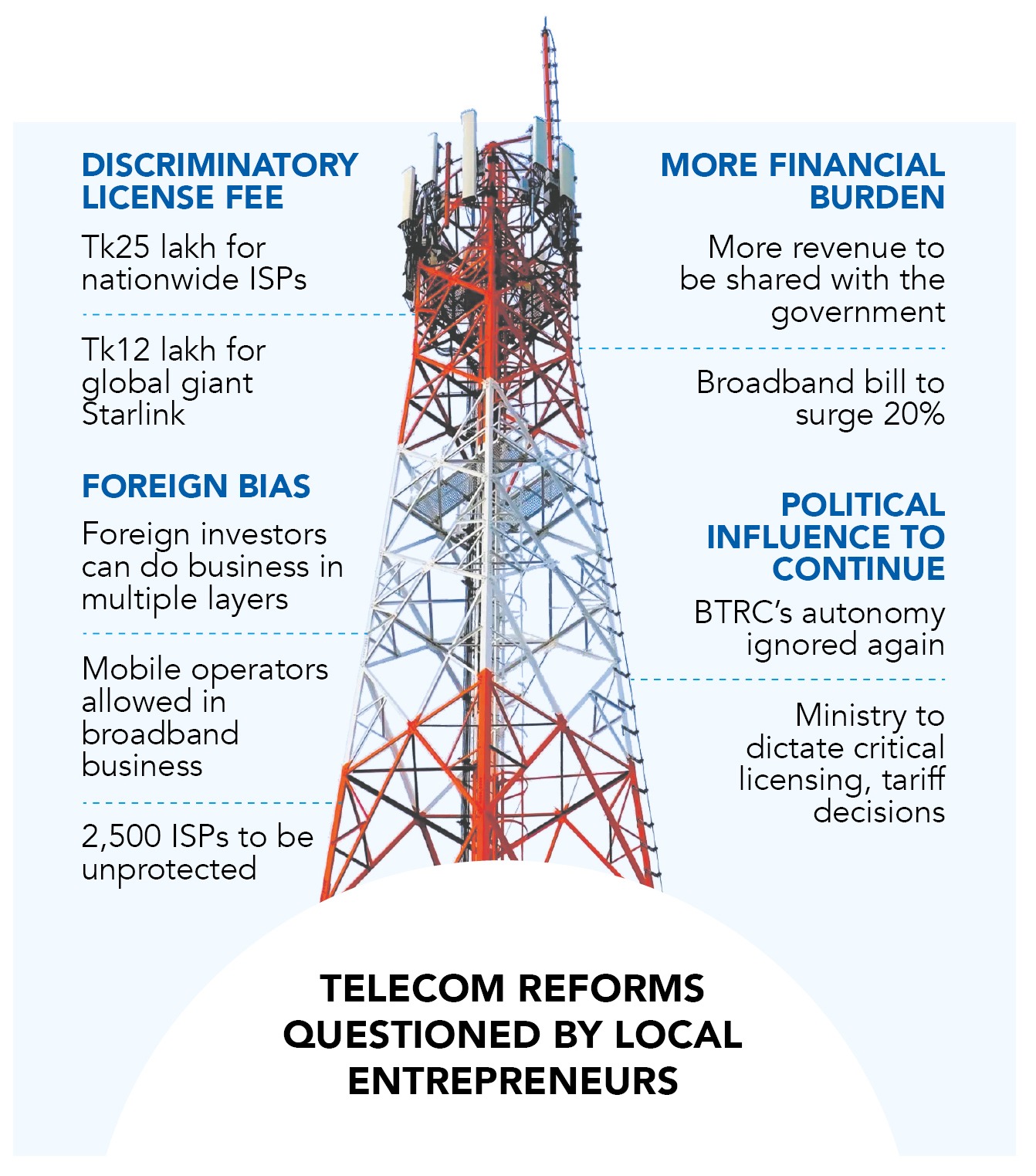
The local telecom entrepreneurs said the draft licensing rules set a Tk 25 lakh fee for nationwide Internet Service Providers (ISP), while global satellite operator Starlink’s fee is Tk 12 lakh.
Foreign operators are also being offered multi-layer business rights that will not be extended to domestic firms.

Industry leaders said the entry of mobile network operators (MNO) into the broadband segment, combined with the new fee structure, could destabilise competition and wipe out protections for more than 2,500 local ISPs that built Bangladesh’s last-mile connectivity, including in rural areas.
They warned that licence fees are being raised five times higher, and revenue-sharing obligations are increasing. They estimate a 20% jump in broadband prices if the policy is approved unchanged.
Bangladesh Telecommunication Regulatory Commission (BTRC) has drafted four separate licensing guidelines under the new telecom network licensing regime, which the local firms described as biased to the foreign operators.
TTRNB former president Rashed Mehedi chaired the dialogue and General Secretary Masuduzzaman Robin moderated the discussion.




Technology policy analyst Abu Nazm Muhammad Tanvir Hossain questioned the government’s priorities.
“Why is telecom reform being pushed before health and education? More regulatory changes have happened in the past 18 months than in the last 10 years,” he said.
He warned that the 2025 telecom ordinance has left the BTRC to an administrative office, keeping key decisions like licensing with a ministry committee.
Journalist Masud Kamal said the public-interest benchmark is now absent from the reform process.
Fiber at Home Deputy Managing Director Suman Ahmed Sabir contrasted the direction of the draft with past reforms.
“Countries are protecting domestic digital infrastructure in the name of cyber resilience. We are moving in the opposite direction,” he said.
Summit Communications Chief Technology Officer KM Tarikuzzaman said the market is being centralised again in a new format. “Transmission control is returning to one concentrated structure. The monopoly model is back in another form,” he said.
Bahan Limited Chief Operating Officer Rashed Amin Bidyut linked the debate to public expectations shaped by recent political shifts. “The July movement called for fairness. This framework reinforces foreign dominance and squeezes local enterprise,” he said.
Fiber at Home Chief Communications Officer Abbas Faruk urged unified resistance by the local industry, while Interconnection Exchange (ICX) leader M Nurul Alam warned the country risks losing domestic capacity.
International Internet Gateway Operators Forum (IIGOF) CEO Mushfiq Manzur pointed to Bangladesh’s pharmaceutical industry as a template for long-term protection and growth.
“Telecom requires the same long-term policy vision,” he said.
Governance concerns dominated the session as speakers warned that leaving licensing and tariff authority to the ministry, instead of BTRC, exposes commercial decisions to political influence.
In the keynote, Rashed Mehedi recalled the pre-2008 landscape when one foreign company controlled voice, bandwidth and transmission, pushing prices to Tk 10,000 for 1 Mbps.
“The 2008 reforms ended the monopoly. Reform must modernise the market, not restore concentration,” he said.