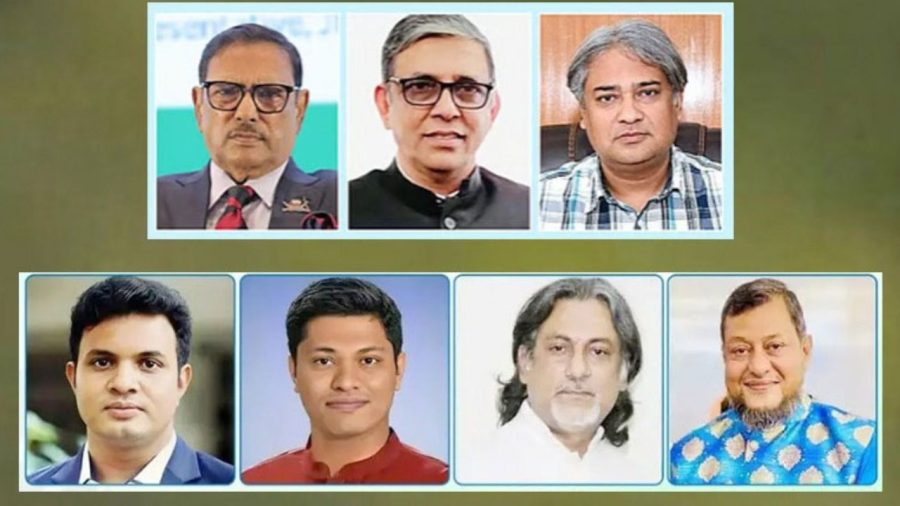

The International Crimes Tribunal has sentenced Awami League General Secretary and former minister Obaidul Quader and six other senior leaders of the party and its affiliated organisations to death for crimes against humanity during the July uprising.
The tribunal found individual responsibility and superior command responsibility proved against each of the seven accused. Tribunal-2, headed by Justice Md Nazrul Islam Chowdhury, delivered the verdict on Tuesday.
The other members of the three-member tribunal are Justice Md Manjurul Bashid and Justice Nur Mohammad Shahriar Kabir.
The other convicts are AL Joint General Secretary AFM Bahauddin Nasim, former state minister for information and broadcasting Mohammad Ali Arafat, Jubo League Chairman Sheikh Fazle Shams Parash, General Secretary Mainul Hossain Khan Nikhil, Chhatra League President Saddam Hossain and General Secretary Sheikh Wali Asif Enan.
The court also ordered the confiscation of half of the movable and immovable assets of five convicts, excluding Saddam and Enan. The money obtained from selling the assets will be used to compensate the families of those killed and injured during the July uprising, according to the order.
ICT Chief Prosecutor Md Aminul Islam expressed satisfaction with the verdict.
“I express gratitude to Allah for the verdict,” he said.
Defence lawyers M Hasan Imam and Israt Jahan, however, said they were not satisfied with the judgment.
This is the seventh verdict delivered by the International Crimes Tribunal in cases involving crimes against humanity allegedly committed during the Awami League government’s tenure and the July uprising.

The tribunal completed arguments from both sides before keeping the verdict pending on 17 August. During the hearing, the prosecution sought the death penalty for the accused, while the defence sought their acquittal.
The tribunal said in its verdict that Obaidul Quader, as a powerful minister in the then government and the AL general secretary, played an important role in planning, directing and implementing actions during the July-August events.
The court also found Bahauddin Nasim, Mohammad Ali Arafat and other leaders directly involved in the process.
According to prosecution, Quader held a phone conversation with Chhatra League President Saddam Hossain on 11 July 2024, during which he gave instructions to suppress the movement.
The prosecution said Quader told Saddam, “Why don’t you beat them? Why are you encouraging them?”




On 14 July, during a press conference at Ganabhaban, Sheikh Hasina referred to protesters as “children and grandchildren of Razakars”. The prosecution alleged that Quader’s presence at the event and his subsequent statements supported and encouraged actions against protesters.
The prosecution also placed before the tribunal Quader’s remarks at a press conference at the Awami League office in Dhanmondi on 15 July, where he said, “Chhatra League will respond to self-declared Razakars.”
It alleged that the statement encouraged Chhatra League activists to attack protesting students and people.
The prosecution further alleged that Quader instructed then state minister for Information and Communication Technology Zunaid Ahmed Palak to slow internet speed on 16 July to suppress the movement.
It also alleged that he instructed former Chattogram City Corporation mayor AJM Nasir Uddin to maintain control over Chattogram city and Chittagong University.
According to prosecution, following these instructions, armed activists of the Awami League and affiliated organisations carried out attacks across the country, killing and injuring protesters.
The prosecution alleged that more than 1,400 people were killed and more than 25,000 injured during the suppression of the movement using lethal weapons.
The prosecution alleged that Bahauddin Nasim supported and encouraged actions against protesters by attending a press conference at the Awami League office in Dhanmondi on 15 July, where Quader made remarks against the movement.
It alleged that Nasim played a key role in implementing decisions to suppress the movement through party activists and law enforcement agencies.
Mohammad Ali Arafat, who was the state minister for Information and Broadcasting during the uprising, was accused of making provocative statements and using his position to influence actions against protesters.
The prosecution alleged that Arafat supervised attacks around Mohakhali rail crossing and nearby areas on 19 July, where several protesters were killed.
It also alleged that he ordered the suspension of broadcasts of several television channels over reports on violence during the movement.
The prosecution accused Sheikh Fazle Shams Parash of directing Jubo League activists to suppress the movement. It alleged that Jubo League cadres attacked protesters using firearms and locally made weapons.
Mainul Hossain Khan Nikhil was accused of leading attacks in Mirpur and encouraging Jubo League activists to resist protesters.
Chhatra League leaders Saddam Hossain and Sheikh Wali Asif Enan were accused of directing and supervising attacks by armed cadres of the organisation.
The prosecution alleged that Saddam threatened protesters at a Chhatra League rally at Dhaka University’s Raju Sculpture on 11 July and later instructed activists to confront the movement.
It alleged that Enan made provocative remarks and issued instructions to resist protesters.
The tribunal took cognisance of the prosecution’s formal charges on 18 December last year and issued arrest warrants against the seven accused.
As law enforcement agencies failed to arrest them, state-funded lawyers were appointed to represent them.
Under the law, the trial continued in the absence of the accused.
The tribunal framed charges against the seven accused on 22 January.
The prosecution presented testimony from 28 witnesses and submitted call records, documentary evidence, reports from the United Nations and international media reports to the tribunal.
After completion of arguments from both sides, the tribunal kept the verdict pending on 17 August.