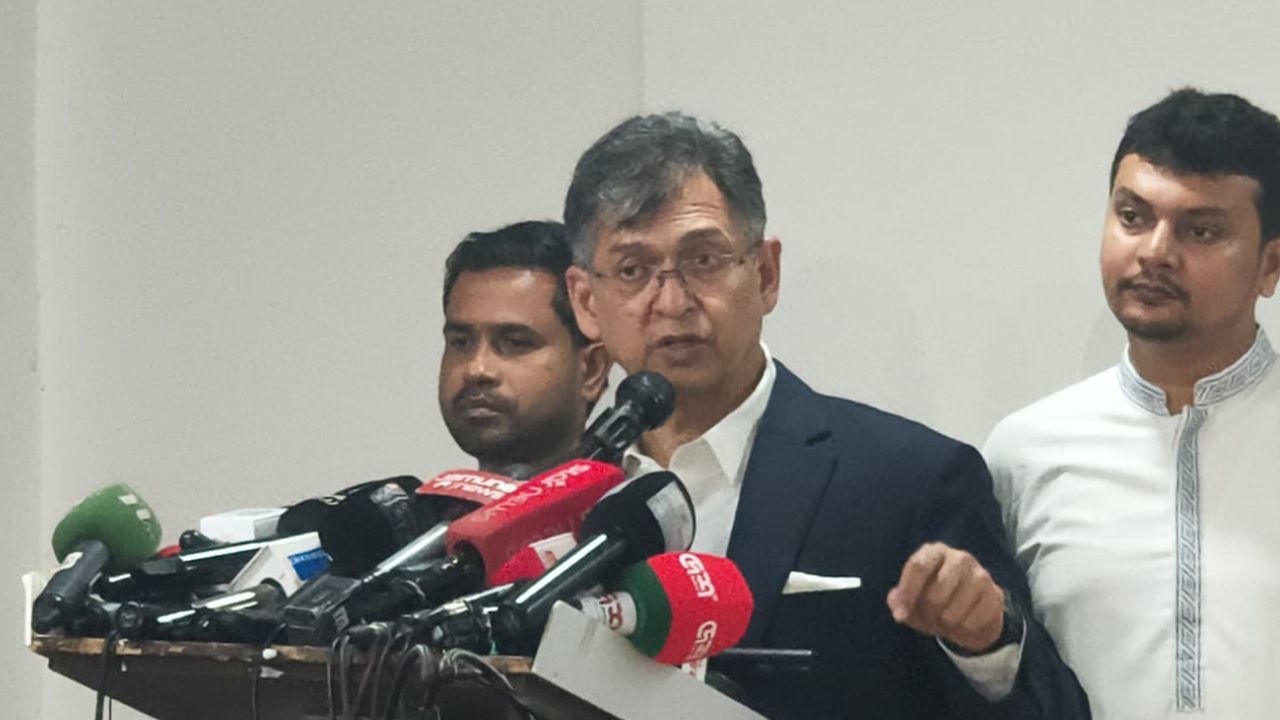



Home Minister Salahuddin Ahmed on Sunday said the July mass uprising was a collective achievement born of years of struggle and sacrifice and should not be claimed or politically exploited by any single party.
“July belongs to everyone. No one should do politics by trading on the spirit of July. The spirit of July alone cannot sustain politics indefinitely,” he said while addressing a discussion at the National Press Club in Dhaka.
The event, titled “Bloody July: Context, the Debt of Blood and Which Way Bangladesh?”, was chaired by Gono Odhikar Parishad President and State Minister for Expatriates’ Welfare and Overseas Employment Md Nurul Hoque.
Salahuddin Ahmed said the gains of the July mass uprising were the result of a prolonged democratic movement, sacrifices and bloodshed, and warned against turning those achievements into partisan political capital. He also called for preserving national unity against authoritarianism.
Referring to judicial reforms, the minister said establishing the rule of law requires not only sound legislation but also an effective, accountable and independent judiciary.
Although the judiciary now enjoys a high degree of independence, he said the legacy of politically influenced decisions by some judges in the past continues to affect public confidence.

He alleged that sections of the judiciary had played a role during the July uprising by facilitating politically motivated cases against opposition figures and supporting controversial electoral processes, underscoring the need for broader institutional reforms.
On constitutional reform, Salahuddin Ahmed said the government has already undertaken legal and constitutional initiatives in line with its democratic reform agenda.
Most ordinances issued by the interim government have already been enacted into law, he said, adding that constitutional amendments would be essential to make the reforms permanent.




A constitutional reform committee has been formed, and its recommendations will be finalised after consultations with journalists, lawyers, academics, judges, constitutional experts and other stakeholders, he added.
Responding to criticism from opposition parties, the minister said it was unreasonable to stay away from the constitutional reform committee and later accuse the government of excluding differing opinions.
He said the government seeks to implement reforms through national consensus.
On the issue of a referendum, he said Article 142 of the Constitution allows referendums only for specific constitutional amendments.
According to him, the recent referendum was conducted under a presidential order rather than as a constitutional referendum, raising questions about its legal validity.
He argued that any referendum on the proposed July Charter should be based on specific questions put before the public.
The minister also criticised some commissions formed during the interim government’s tenure, claiming that certain bodies had been created to accommodate particular individuals rather than address institutional needs.
He said the government is preparing a law to prevent enforced disappearances, which will define the offence, prescribe punishments and clearly outline judicial procedures and jurisdiction.
Any future human rights legislation, he added, would be aligned with international standards while taking into account Bangladesh’s social, cultural and religious realities.
Highlighting the significance of the July movement, Salahuddin Ahmed said the political change on 5 August was the outcome of 17 years of struggle, the sacrifices of countless martyrs and the participation of ordinary citizens, not the achievement of any individual or political force.
He also urged those advocating a “new political settlement” to clearly present their political vision to the public, saying slogans and emotions alone cannot sustain politics.
Warning against divisions among democratic forces, Salahuddin Ahmed said weakening anti-authoritarian unity could pave the way for the return of authoritarian rule.
He called on all democratic parties to remain united on national issues and work towards building a democratic, equitable and law-based state.