


US President Donald Trump has declared that he will formally designate the Strait of Hormuz as an American territory “pretty soon”.
The declaration comes amidst an ongoing diplomatic and military impasse over the highly strategic waterway, which handles the transit of approximately one-fifth of the world’s petroleum and natural gas supplies, reports Al Jazeera.
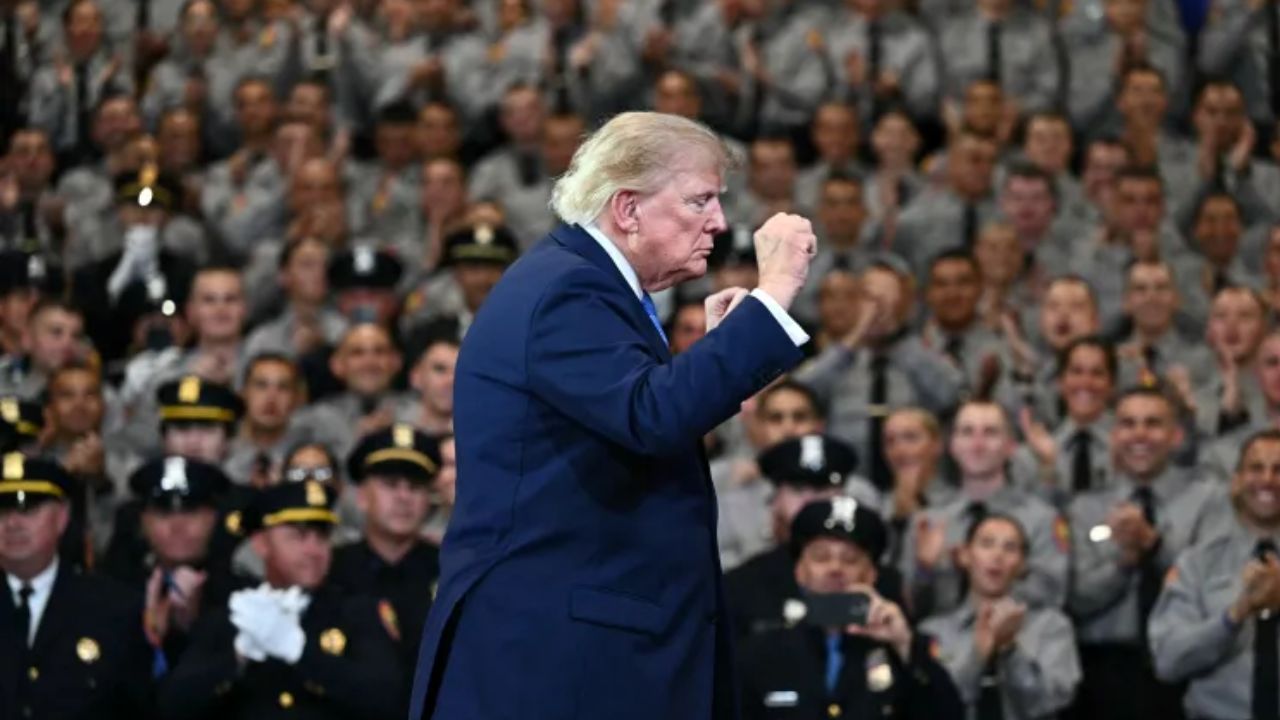
Addressing an audience at a police academy in Garden City, New York, President Trump went so far as to assert that the strait is already functionally US territory.
“Essentially, that’s what it is,” Trump remarked, referencing the active American naval blockade. “We have the blockade. No ships get through unless we want them to”.
Despite these assertions, maritime tracking data indicates that multiple ships have successfully navigated the strait regardless of the blockade.
Analysts and reporters observed that Trump laughed during these remarks, suggesting he may not view the proposal as a realistic policy but rather as an intentional effort to provoke Tehran. The comments provoked immediate anger from Iranian leadership.

The head of Iran’s judiciary labelled the US president “criminal and feather-headed,” dismissing his claims as “nonsense” and reiterating Iran’s sovereignty over the waterway.
Iran’s Deputy Foreign Minister, Kazem Gharibabadi, similarly rejected the rhetoric, declaring that control over the Strait of Hormuz “cannot be seized by tweet, nor by aircraft carrier, nor by issuing an order, nor by an election speech”.
Gharibabadi added that the passage “has been Iranian, is Iranian, and will remain Iranian,” warning that it would only open or close under Tehran’s explicit command.
The diplomatic friction arrives just as a bilateral memorandum of understanding (MoU), signed in June, is set to expire this Sunday. Iranian Foreign Minister Abbas Araghchi stated that any potential reopening of the passage is a separate issue from the expiring MoU.



Araghchi insisted that Washington must first deliver on its June promises, which include dismantling the naval blockade and lifting economic sanctions on Iran. These demands, which were initially Iran’s terms for ending the war entirely, have now been reframed as baseline requirements merely to allow shipping to resume.
In tandem, Iran has been negotiating with Oman – the only other nation bordering the strait – to establish a joint framework for managing maritime traffic, with Araghchi noting that these bilateral talks “may reach a conclusion soon”.
International legal scholars and domestic experts have strongly disputed the legality of any unilateral US annexation.
Bruce Fein, who served as associate deputy attorney general during the Reagan administration, pointed out that the US Constitution requires either a Senate-ratified treaty or a federal statute to acquire territory, as was done with the Louisiana Purchase, the annexation of Hawaii, the Panama Canal, and the acquisition of Puerto Rico and the Philippines.
Fein warned that unilateral annexation would “constitute the crime of aggressive war under international law, including the UN Charter”.
Natalie Klein, an international law expert and associate dean at the University of New South Wales, added that the only plausible legal path to such control would be for the US to act as an occupying power, which would necessitate direct military control over Iran or its coastal regions.
Under international conventions like the United Nations Convention on the Law of the Sea (UNCLOS), even coastal states do not have unrestricted sovereignty over strategic international straits.
UNCLOS restricts a coastal nation’s territorial waters to 12 nautical miles (22km) and protects the unimpeded right of transit passage for international vessels.
Because the Strait of Hormuz is only 21 nautical miles (39km) wide at its narrowest point, the territorial waters of Iran and Oman overlap. While neither Washington nor Tehran has formally ratified UNCLOS, its provisions regarding international straits are widely accepted as customary international law.
Domestically, the armed conflict with Iran, which commenced on February 28, remains deeply unpopular with the American public. A Reuters/Ipsos poll indicates that only 35 per cent of Americans approve of the war.
This public dissatisfaction poses a significant challenge for the Trump administration as it seeks to protect slim Republican congressional majorities in the upcoming November mid-term elections.
The administration is also grappling with severe domestic economic and logistical strains, including petrol prices exceeding $4 a gallon and shortages of essential military supplies, such as Patriot anti-missile interceptors.
US Vice President JD Vance recently acknowledged these pressures, stating that mitigating domestic fuel costs has surpassed halting Iran’s suspected nuclear weapons development as the administration’s primary wartime objective.
In the wider region, Tehran has launched military strikes against its Gulf neighbours. Analysts believe these actions are designed to pressure regional powers into forcing Washington back to the negotiating table.
Paul Musgrave, an associate professor of government at Georgetown University in Qatar, described Trump as a reality television “showman” who tends to use theatrical rhetoric. Musgrave suggested that while declaring the strait a US territory is both physically and legally impossible, the threat signals Trump’s determination to maintain a hard line and refuse to acknowledge defeat in the ongoing war.