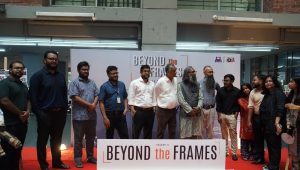
Indira Gandhi Cultural Centre, High Commission of India held a special commemoratory event on November 20, marking the birth centenary of the renowned auteur and visionary filmmaker Ritwik Ghatak. The event paid rich tribute to Ghatak’s enduring legacy by screening his film, ‘Meghe Dhaka Tara’.
Speaking at the occasion, High Commissioner Pranay Verma remarked that Ritwik Ghatak’s cinema captured the shared histories, emotions and aspirations of the people of India and Bangladesh. He spoke about Ghatak’s significant contribution to Cinema and mentioned that Ghatak was a filmmaker, playwright, teacher and cultural thinker whose life and works continue to influence generations of filmmakers worldwide. His films are marked by a rare blend of realism and poetic expression, combining powerful social commentary with deep emotional resonance.
Ghatak believed that cinema could heal, awaken and unite. Each of Ghatak’s films stands as a bold, innovative and deeply humane work that has secured his place as one of the greatest filmmakers of the Indian subcontinent. Ghatak’s Cinematic Vision stands as a cultural bridge between the two nations.
‘Meghe Dhaka Tara’ is a masterpiece that reflects the human condition with unmatched poignancy. Ghatak’s exploration of displacement, sacrifice and identity in this film, continues to resonate deeply across generations, particularly across India and Bangladesh, whose intertwined histories he portrayed with such empathy and honesty.
The event was honored by the presence of Producer Habibur Rahman Khan, who collaborated with Ghatak on ‘Titash Ekti Nadir Naam’, a film made in 1973 that remains one of the most powerful cinematic collaborations between Bangladesh and India. He spoke with a mix of affection and awe. “My creative friendship with Ritwik Ghatak cannot be told in a single evening,” he said. “We had a love-hate relationship, but he was like a child laughing, unpredictable, yet impossible to leave.”
A special message was conveyed by Actor Abul Hayat, who made his debut in ‘Titash Ekti Nadir Naam’, called Ghatak “madly brilliant.” He said, “We were students when we fell in love with his films. His spontaneity and creativity were unmatched. ‘Titas’ has become a textbook in cinema history and I feel lucky to have been a part of it.”