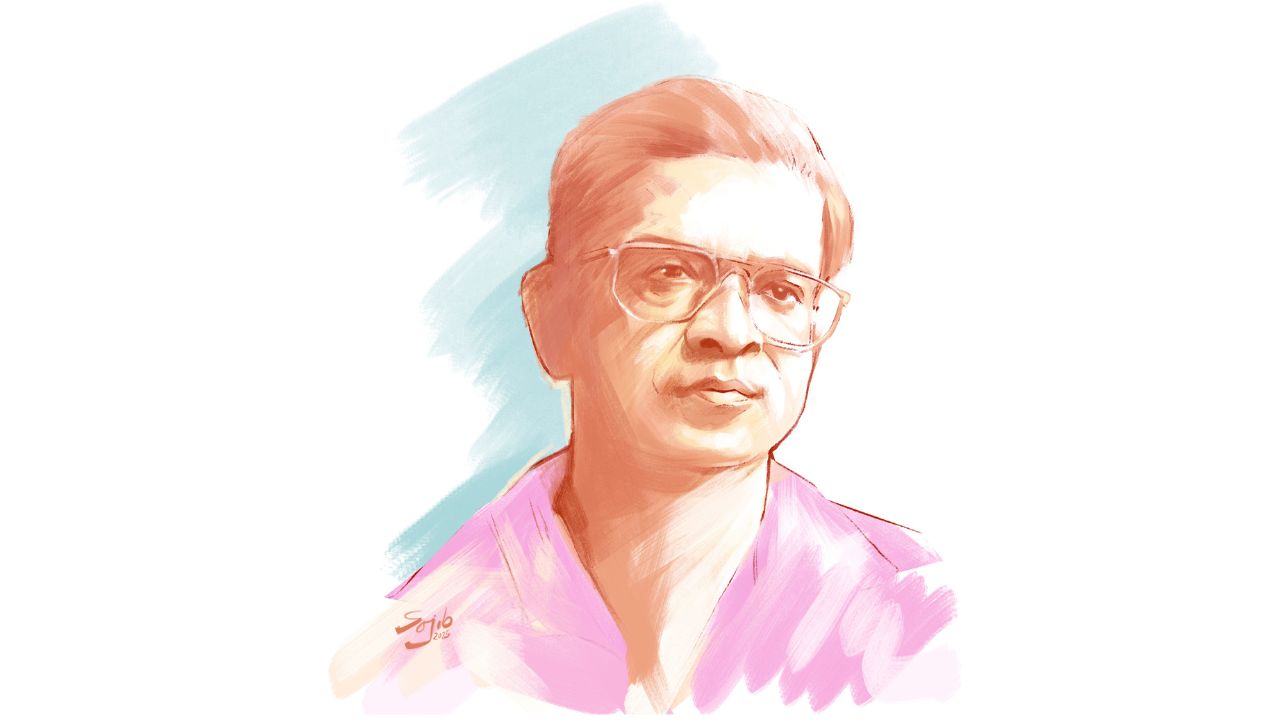



Humayun Ahmed did more than redefine Bangla literature. He changed the way Bangladesh watched television. Through stories rooted in ordinary lives, he gave viewers characters they recognised, conversations they repeated and memories they still cherish.
As the nation marks his 14th death anniversary, veteran producer Nawazish Ali Khan looked back on the creative journey that helped shape a golden era of Bangladeshi television.
Speaking to Page Three in a recent interview at ATN Bangla, he shared the story of Prothom Prohor the first Humayun Ahmed drama to be aired on Bangladesh Television (BTV) and recalled the partnership that produced some of the country’s most celebrated television dramas.
In the late 1980s, Humayun Ahmed first wrote a script featuring a boarding house resident named Mohim, who wore a dhuti. Although BTV officials liked the story, it could not be produced. Nawazish recalled that after playwright and director Abdullah Al Mamun adapted a Rabindranath Tagore story for television, the then information minister, Shah Azizur Rahman, reportedly objected, leading to an unofficial restriction on characters wearing dhuti on television. Humayun was asked to rewrite the script.

He then returned with Elebele, but production challenges forced another setback.
“At that time, BTV had very limited capacity for outdoor shooting,” Nawazish said. “We also did not have enough lighting equipment to illuminate an entire forest. So we had to abandon that script as well.”
Humayun Ahmed responded by writing Prothom Prohor overnight.




“The third story was comparatively weaker than the earlier ones, but we eventually produced that drama,” Nawazish recalled.
Centred on a principled government employee in a middle-class family, Prothom Prohor marked the beginning of a remarkable collaboration. Together, Humayun Ahmed and Nawazish Ali Khan created iconic serials including Eishob Din Ratri, Bohubrihi and Ayomoy, alongside more than a hundred single-episode dramas, including Nimful, Gachh Manush and Jononi.
Nawazish also revealed the story behind Bohubrihi’s famous line, “Tui Razakar.”
“At that time, it was not easy to use the word Razakar openly,” he said. “Humayun and all of us discussed how we could include it without creating problems. We finally decided to have a bird deliver the dialogue symbolically. That reduced the risk of getting into trouble.”
He added that the late cultural icon Mustafa Monwar encouraged the creative decision.
Although Humayun wanted Nawazish to produce all of his television dramas, Nawazish introduced him to producer Mostafizur Rahman. Later, Barkat Ullah also directed several dramas based on Humayun Ahmed’s stories and screenplays.
Their professional partnership soon became a close friendship. Nawazish recalled gathering at Humayun Ahmed’s home almost every week. Those evenings came to an end after Humayun’s second marriage because of family circumstances, but their mutual respect never faded.
Reflecting on his longtime friend, Nawazish said Humayun Ahmed possessed a rare gift for finding extraordinary meaning in ordinary life. He also believed every successful producer needed a touch of “madness” something, he said, he experienced time and again while working alongside the legendary storyteller.