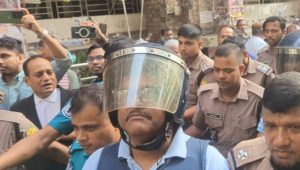
A Dhaka court has observed that deposed prime minister Sheikh Hasina abused her power to secure plots in Purbachal and committed fraud in the process. The judge also said she rewarded corrupt officials instead of taking action against them.
Judge Mohammad Abdullah Al Mamun of Special Judge Court-5 made the observation on Thursday, after sentencing Hasina to 21 years in prison in three cases filed over corruption in securing plots in Rajuk’s Purbachal New Town Project.
In one of the cases, the court sentenced Hasina’s son Sajeeb Wazed Joy to five years’ rigorous imprisonment and fined him Tk1 lakh. In another case, Saima Wazed Putul was handed five years’ rigorous imprisonment. Several other accused were also sentenced to different jail terms.
‘Fraud and deception’
In his observations, the judge said Sheikh Hasina applied for plot allocation but did not initially submit an affidavit. Rajuk later asked her for the document, and she submitted one, but the affidavit did not mention an existing plot already allotted in her husband’s name.
The court described this omission as “a form of fraud and deception”. The judge added that her husband, the late Dr Wazed Miah, “a greatest scientist,” was also drawn into this wrongdoing.
The judge noted that the affidavits submitted by Hasina bore no signature from any lawyer, notary public or magistrate. No one could present such verification, and the court termed this as a clear irregularity.

He said Hasina submitted two affidavits, but “neither had any legal value”. Rajuk later sought correct information, which the court said proved corruption and fraud.
He added that she did not stop there and “wrongfully allotted plots to her son Sajeeb Wazed Joy and daughter Saima Wazed Putul.”
The judge further said Hasina told officials that even if they committed wrongdoing, she would reward them. As Rajuk functions under the housing ministry, the then state minister was aware of these irregularities but did not intervene.



“Corruption has seeped into every layer of the system,” the judge observed, adding that corrupt individuals were rewarded while those who refused to join misconduct faced threats to their careers.
He said the verdict should set an example so that genuine applicants receive plot allocations.
The court added, “Sheikh Hasina has greed for assets. If she did not want the plot, she could have rejected the papers. She could have consulted her legal adviser or the law minister. Instead, she accepted the Purbachal plot.
“Rajuk, the housing ministry and Sheikh Hasina have committed offences. Hasina committed fraud.”
Journos helped expose irregularities
Addressing journalists present in court, the judge said their work had helped expose irregularities and contributed to the country’s recent “revolution”. He said it was also a reminder for them not to engage in corruption in future.
In the three cases, there are 47 chargesheets but 23 individuals were accused.
The first case includes 12 accused individuals including Hasina, the second lists 17 accused individuals including Hasina and Joy, and the third includes 18 accused including Hasina and her daughter Putul.
Rajuk’s former administrative officer Md Saiful Islam Sarker was acquitted. Former member of Rajuk (estate and land) Mohammad Khurshid Alam was given one year’s imprisonment in each case.
Alam was the only accused in custody after surrendering, and the court fixed Thursday for delivery of the verdict following closing arguments on Sunday. The remaining accused, who are absconding, did not present arguments and could not claim innocence during self-defence.
The Anti-Corruption Commission filed six cases in January over alleged corruption in plot allocation. Chargesheets were later submitted in all cases. Trial has concluded in three of them.
Arrest warrants remain issued for Hasina and 22 others who are absconding. Testimony in the three cases involving the Hasina family concluded on 10 November. On 17 November, Khurshid Alam pleaded not guilty during self-defence.
Earlier, on 31 July, the court framed charges against 23 accused including seven members of the Hasina–Rehana family in the six cases. Other accused include Sheikh Rehana’s daughter Tulip Rizwana Siddiq, her son Radwan Mujib Siddiq and daughter Azmina Siddiq.
Additional accused include former state minister for housing Sharif Ahmed, former principal secretary to the prime minister Salahuddin, former housing secretary Md Shahid Ullah Khandaker, additional secretary (administration) Kazi Wasi Uddin, administrative officer Md Saiful Islam Sarker, senior assistant secretary Purabi Goldar, former Rajuk chairman Md Anisur Rahman Miah, member (administration and finance) Kabir Al Asad, member (development control) Tanmoy Das, member (estate and land) Md Nurul Islam, former member (planning) Mohammad Nasir Uddin, former engineer Shamsuddin Ahmed Chowdhury (retd), Rajuk ex-director (estate and land-2) Sheikh Shahinul Islam, deputy director Md Hafizur Rahman and Habibur Rahman.
According to the chargesheet, Hasina abused power entrusted to her as head of government along with members of her family.