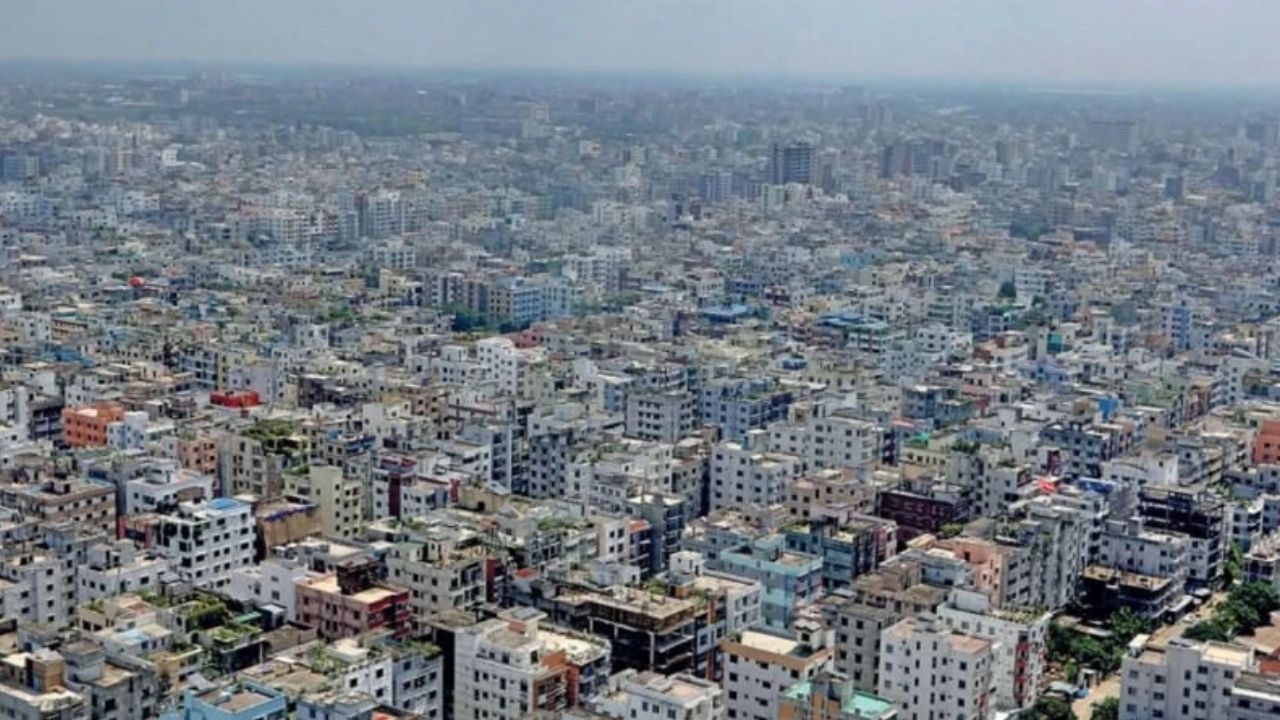

Dhaka has surged into the global spotlight, now ranked as the world’s second largest city. Yet behind the milestone lies a sobering reality: the capital is projected to become the largest city on Earth by 2050.
This incredible climb demonstrates the swift urban change that is occurring throughout South and Southeast Asia, says the latest World Urbanization Prospects 2025 report, released by the UN Department of Economic and Social Affairs.
Three decades ago, Dhaka’s population stood at just 6 million. In the span of a single generation, that figure has tripled. The city serves as Bangladesh’s administrative, commercial, political, and cultural hub and has become one of the most densely urbanised regions on the planet, according to a report of the World Bank’s Metro Dhaka Transformation Platform.
However, the UN report reveals that Indonesia’s Jakarta now leads as the most populous city with 41.9 million people, displacing Tokyo to third place with 33.4 million. Dhaka, demonstrating explosive growth, has surged from ninth to second place with a population of 36.6 million.
This expansion is largely driven by significant migration from rural areas, as people seek economic opportunities or are displaced by environmental challenges like flooding and sea-level rise exacerbated by climate change.

The study notes a global boom in megacities – urban centres with over 10 million people. The number has swelled to 33, a dramatic rise from just eight in 1975, with 19 located in Asia.
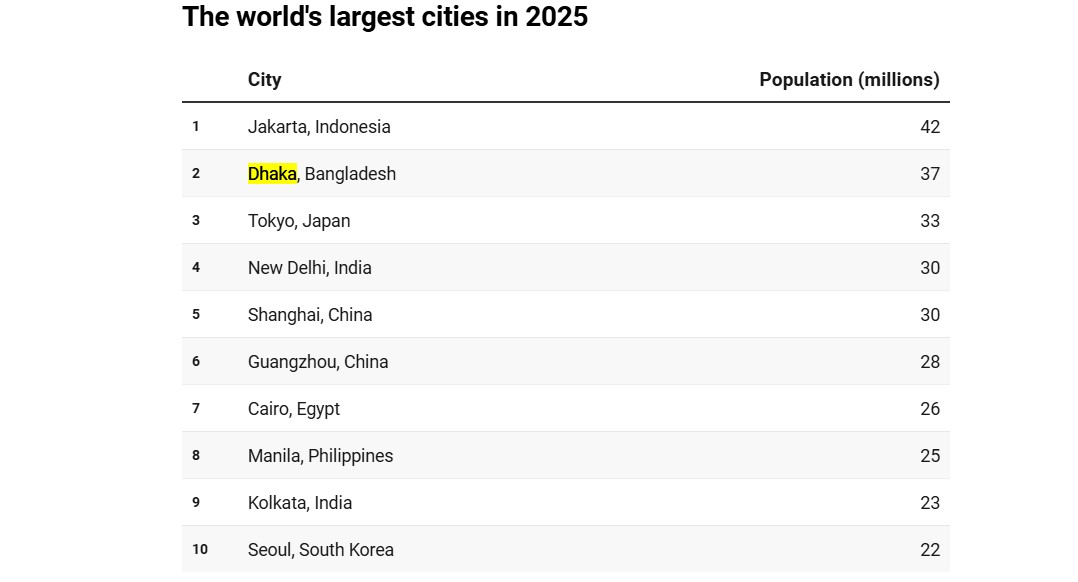



The top ten list includes several other Asian hubs: New Delhi, India with 30.2 million people; Shanghai, China with 29.6 million; Guangzhou, China with 27.6 million; Manila, Philippines with 24.7 million; and Kolkata, India, and Seoul, South Korea, each with 22.5 million.
Cairo, with 32 million, is the only non-Asian city in the top ten.
The UN projects that this trajectory will make Dhaka the world’s largest city by 2050, a mere 25 years from now.
Imagining a livable future for 2050
This rapid growth presents immense challenges. The World Bank’s Metro Dhaka Transformation Platform (MDTP) has highlighted that the city, which has tripled in size in a single generation, now struggles with traffic gridlock, poor air quality, and inadequate services.
A 2019 symposium, “Dhaka in 2050,” convened urban thought leaders to spark a conversation about shaping the city’s future.
In the report, WB Country Director for Bangladesh and Bhutan Mercy Tembon said, “Dhaka itself faces immense challenges, but also holds immense untapped potential. Dhaka can become an even bigger miracle than Bangladesh. But the time to act is now.”
Stakeholders shared a collective vision for a transformed city. Former Mayor Md Atiqul Islam envisioned a city that ensures “dignity, well-being and safety of all citizens,” with integrated transport and healthy neighbourhoods.
Rubana Huq imagined a “people-first city” where daily life happens within walking distance, with vibrant public spaces for community gathering.
Hossain Zillur Rahman highlighted pathways to change, including redefining the informal sector as the entrepreneurial class and transcending sectoral approaches to problem-solving.
The symposium concluded that the city must quickly move from dialogue to action, leveraging strong leadership and a clear, shared vision to harness its potential and navigate its unprecedented growth.