Fisheries and Livestock Adviser Farida Akhtar has announced that the leasing of haors will be stopped to protect indigenous fish species. She stated, “We have stopped the leasing of baors. Discussions are ongoing with the Ministry of Land to stop the leasing of haors.”
She further said, “To prevent the extinction of native fish, several new water bodies have already been declared as sanctuaries. The new Fisheries Policy-2025 will be finalised soon. We are working on protecting open water bodies and recognising the rights of small-scale fishers over these water bodies.”
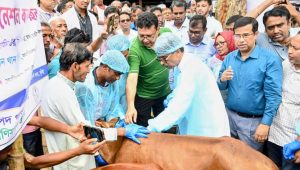
She made these remarks while speaking as the chief guest at a policy dialogue titled “Fundamental Policies of the Fisheries and Livestock Sector: Implementation Challenges and Solutions,” held at the CIRDAP auditorium in the capital on Monday. Adviser Farida Akhtar also informed that 40,000 women fishers have been provided with “fisher identity cards” in the past year.

Farmer representative Mostafa Kamal joined the seminar from Wazeghat in Sylhet. He urged the government to refrain from commercially leasing the water bodies (bils) of the haor region to large businesspeople. Kamal said, “Businesspeople use machines to pump out and dry up the water from the bils. As a result, indigenous fish species are becoming extinct.”
Farmer representative Md Mahiuddin from Chuadanga called upon the government to monitor the feed given to fish in pond farming to make it healthy. Additionally, he demanded that measures be taken to ensure highway police do not create obstacles during the transportation of fish for sale.



The keynote paper at the seminar was presented by Ahmed Borhan, research director of the Center for Social Research (CSR). It was stated there that antimicrobial-resistant bacteria are present in samples from two-thirds of the fish and chicken meat in the country. Over 90% of poultry farms use antibiotics indiscriminately.
The livelihoods of nearly 20 million people in the country are directly or indirectly dependent on the fisheries sector. Despite this, mismanagement alone has led to a decline in native fish species from the country’s freshwater. A 2023 report by the UN Food and Agriculture Organization identified 64 out of 253 fish species in Bangladesh as endangered.
The Managing Director of PKSF, Md Fazlul Kader, said, “36 per cent of the country’s cancer patients are associated with the agriculture profession.” He blamed the use of toxic pesticides and antibiotics in agriculture for this.
The Representative of the Food and Agriculture Organization (FAO) in Bangladesh, Dr Shi Xiaokun, called for strengthening the activities of NGOs concerning research on fisheries conservation.
Others who spoke at the event included the Director General of the Bangladesh Livestock Research Institute, Dr Shakeela Farooq, the Deputy Director of the Wave Foundation, Kaniz Fatema, the Convener of the Agroecology Coalition Bangladesh, Mohsin Ali, and the Executive Director of Barguna’s NGO Nazrul Smriti Sangsad, Shahabuddin Panna, among others.
The policy dialogue was jointly organised by Agroecology Coalition Bangladesh, Palli Karma-Sahayak Foundation (PKSF), the Germany-based development partner Welthungerhilfe (WHH), Wave Foundation, and FIVDB.