
For eight decades, Germany’s postwar political order rested on an unspoken rule: no mainstream party would ever hand power to the far right. On Monday, that rule looked more fragile than at any point since 1945.
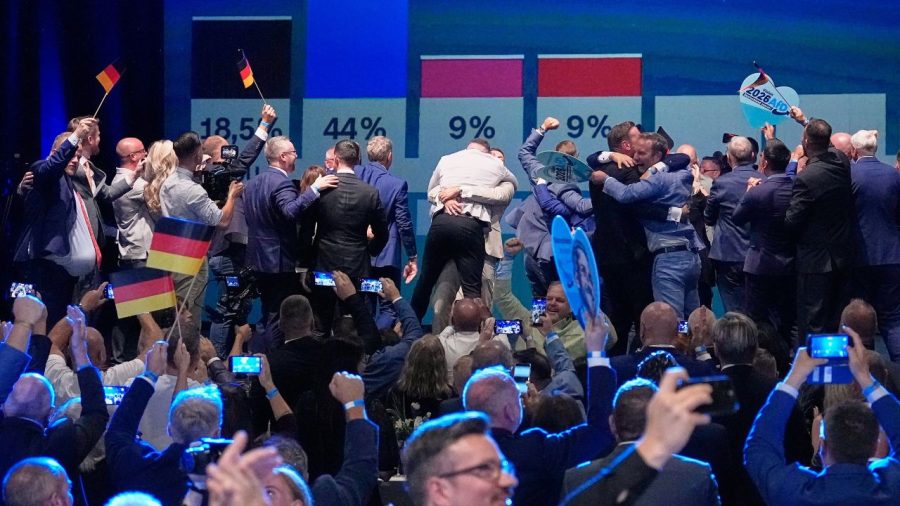
The Alternative for Germany (AfD) swept Sunday’s state election in Saxony-Anhalt with 43.8 per cent of votes – more than double its 2021 showing – putting the anti-immigrant, pro-Russia party within touching distance of governing a German state for the first time. It fell just short of an outright majority, taking 39 of 83 seats, but the result has thrown the country’s so-called “firewall” against the far right into crisis.
Chancellor Friedrich Merz’s Christian Democrats (CDU), who had governed the state for 24 years, saw their support cut in half to 17.2 per cent – losing tens of thousands of voters directly to the AfD. Turnout surged to 77.8 per cent, suggesting the AfD also pulled in voters who had previously stayed home.
A government within reach
AfD co-leader Tino Chrupalla is now openly pressing CDU lawmakers to break ranks. National co-leader Alice Weidel called the result a milestone and said the party is aiming for 40 per cent nationally by the 2029 federal election.

The arithmetic is uncomfortably simple. The AfD needs only three defecting lawmakers to cross the threshold for a majority, and it already has an unlikely partner: the hard-left, Russia-friendly BSW party, whose leader Sahra Wagenknecht has denounced any attempt to freeze the AfD out as an “affront to voters.”
Blocking the AfD entirely would require CDU, the Social Democrats, the Greens, the Left Party and BSW to govern together – a five-way coalition widely seen in Berlin as unworkable.
Under Germany’s federal structure, a Saxony-Anhalt government led by AfD candidate Ulrich Siegmund would gain a seat in the Bundesrat, the upper house of parliament, and sweeping control over education, culture and domestic security in the state.



The party’s “Vision 2026” manifesto sets out a state-level deportation drive, a ban on rainbow flags in schools, restrictions on gender-affirming care for minors, and a rollback of Ukrainian refugees’ protected status.
Why the alarm is spreading beyond Germany
The result has rattled Germany’s neighbours and financial markets alike, in part because the AfD favours pulling Germany out of the euro. Analysts warn the currency’s long-term stability could be at stake if the sentiment spreads to national politics.
World reaction has split sharply along ideological lines. From Paris, French Finance Minister Roland Lescure called the outcome “a very, very worrying signal,” warning that Europe faces “a major challenge in the face of a populist wave.”
France’s European Affairs Minister Benjamin Haddad went further, describing the vote as “a very grave moment for Europe” and insisting that “nationalism and xenophobia will never be the answer.” Poland’s Foreign Minister Radoslaw Sikorski called the near-majority “a very worrying sign,” while Polish Prime Minister Donald Tusk was blunter still, writing that only “idiots or traitors” could celebrate the result.
Europe’s far right, by contrast, treated the win as vindication. Spain’s Vox leader Santiago Abascal called it “great hope for Germany and Europe,” and Portugal’s Chega leader André Ventura hailed an “historic victory.” Former Hungarian premier Viktor Orbán called it “a huge night for Germany and Europe” and predicted it was “just the beginning.”
The reaction from Washington and Moscow added an unmistakable geopolitical edge. Elon Musk posted a one-word congratulation in German – “Gut gemacht!” – to which Siegmund replied by inviting “strong and constructive cooperation,” adding that “Germany would then once again be a place worth investing in.” Former US Ambassador to Germany Richard Grenell called it “a new day for Germany.”
President Trump shared the results without comment. In Moscow, Kremlin-linked investment envoy Kirill Dmitriev described Siegmund as “the voice of reason” and framed the vote as a rejection of what he called “warmongering” EU politics.
A weakened chancellor, a fragile firewall
For Merz – already the least popular chancellor in Germany’s postwar history, according to polling – the loss is a direct rebuke. He had pledged to blunt the AfD’s rise; instead, the party has doubled its support on his watch. With similar state elections looming later this year, Saxony-Anhalt may prove less an isolated setback than a preview of what’s coming.
Whether the firewall holds now depends less on Berlin’s principles than on the loyalty of a handful of local lawmakers – and on whether Germany’s mainstream parties can agree on anything at all.