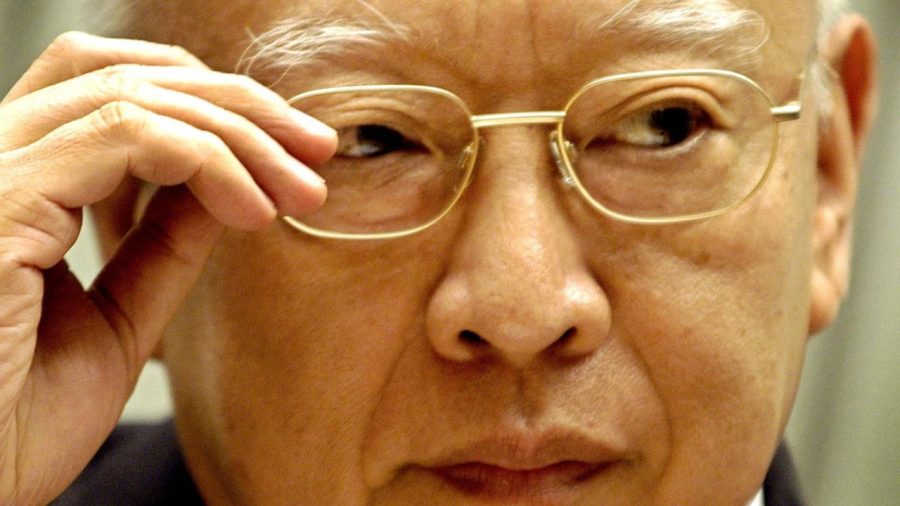

Tung Chee-hwa, Hong Kong’s first leader after the territory’s return to Chinese sovereignty, has died aged 89.
Tung died on Tuesday night surrounded by his loved ones, according to local media reports. His office described him as a man “devoted to his country and its people”, saying in an official statement that “his noble character and integrity will live on forever in our hearts”, reports BBC.
Tung took over as Hong Kong’s leader from Chris Patten, the last British Governor, in July 1997, when the United Kingdom handed the territory back to China, ending more than 150 years of British rule.
Born in Shanghai in 1937, Tung obtained a degree in mechanical engineering from Liverpool University in the UK before moving to the United States, where he worked for General Electric for nearly a decade.
He returned to Hong Kong in 1969 to join his father’s shipping conglomerate, Orient Overseas, and eventually took control of the company in 1979.

During a global downturn in the mid-1980s, state-run Chinese banks helped rescue the family business, contributing to Tung’s reputation as a Beijing loyalist.
His political career began in 1992 when he was appointed to Governor Patten’s executive council. Despite having limited political experience, Beijing was widely believed to have selected Tung to lead Hong Kong following the handover.

Beijing’s support was publicly signalled at a reception at the Great Hall of the People in January 1996, when China’s then-president Jiang Zemin crossed a crowded room to shake Tung’s hand. The widely photographed gesture was seen as an indication of Beijing’s backing for him to take the top post.
Tung’s tenure was marked by the Asian Financial Crisis, two major epidemics and large-scale protests that drew widespread criticism of his administration.
The Asian Financial Crisis hit soon after he assumed office, causing property prices in Hong Kong to plunge.
His administration later faced serious public health challenges, including a bird flu outbreak that lasted from 1997 to 2002 and the 2003 outbreak of Sars, or Severe Acute Respiratory Syndrome.
Tung faced his biggest political challenge in July 2003, when about half a million Hongkongers took to the streets to protest against a proposed national security law.
Protesters feared the legislation would threaten their civic rights. Following the mass demonstrations, Tung’s administration abandoned the proposed law.
The controversy contributed to Tung stepping down in March 2005. Poor health was cited at the time, although some observers believed he had been pressured by Beijing to resign.
China eventually imposed a national security law on Hong Kong in 2020, with authorities arguing that it was necessary to maintain stability. Critics, however, described the measure as “the end of Hong Kong” and said it had created a climate of fear in the city.
Tung made his final public appearance in July 2021 at an event marking the 100th anniversary of the founding of the Chinese Communist Party. He underwent heart surgery several months later, according to reports.
He is survived by his wife and three children.