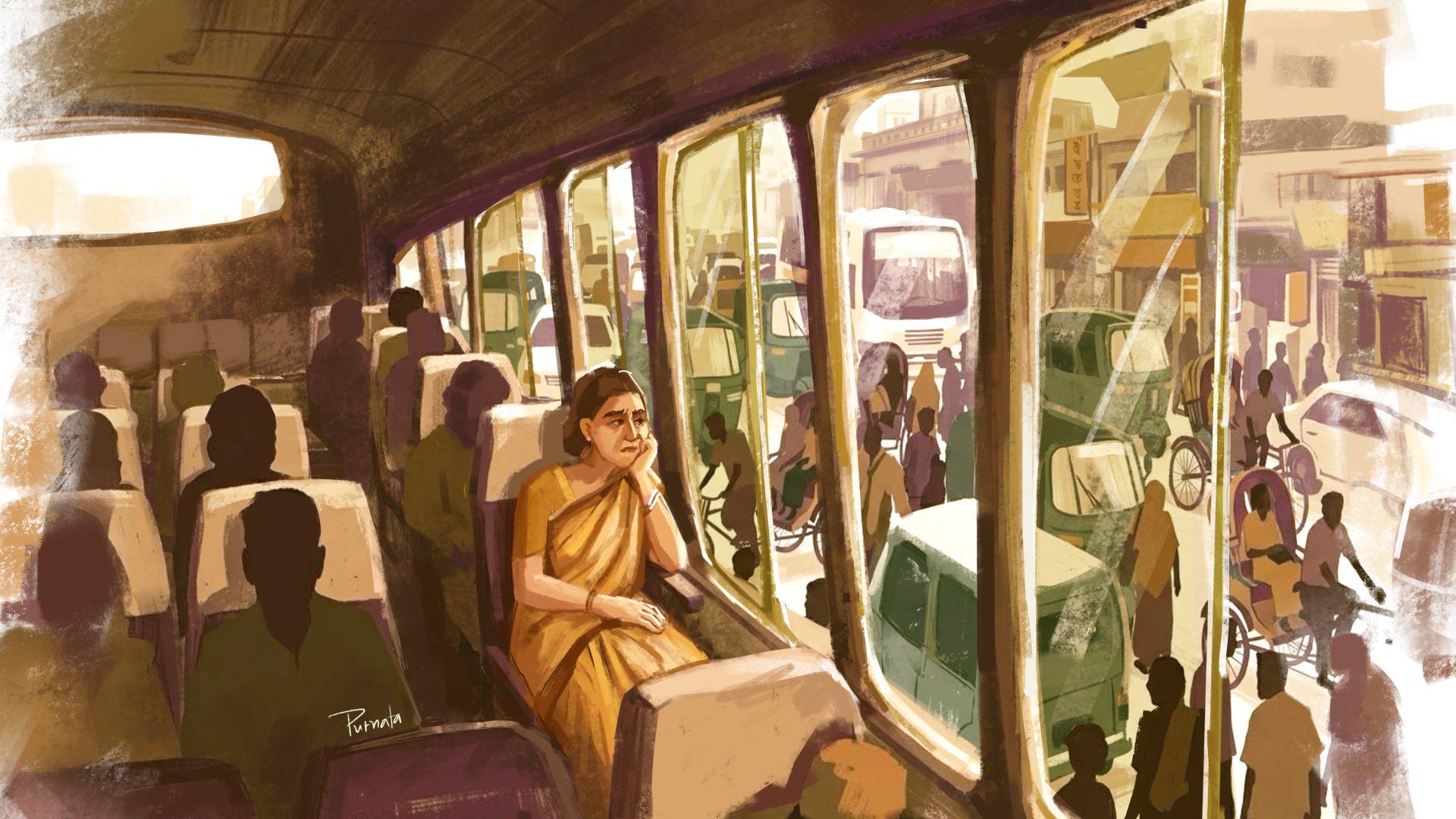

In 1974, at ten years old, Oliullah Pradhan began learning to weave alongside his brother in Jampara, rising over the decades from assistant to master weaver. Yet after 50 years at the handloom, he was astonished when first asked to make sarees from muslin yarn, needing three to four months of retraining because muslin yarn is far more fragile than the sturdy jamdani yarn he knew.
Even the yarn count was a mystery to him. “The officers say it is 700 count. We don’t measure count; we don’t understand it. Whatever the officers say, we repeat that,” he says, smiling.
Behind one man’s astonishment lies a nation reclaiming a lost glory. Dhakai muslin – once described as “woven air” and extinct for two centuries – is once again being turned from thread into fabric on Bangladeshi soil.
The quest begins
The project, “Reviving the Technology of Muslin – Golden Heritage of Bangladesh,” was launched by the Bangladesh Handloom Board. Project director Md Ayub Ali, the Board’s Chief of Planning and Implementation, describes it as an undertaking that at first seemed almost impossible.
Researchers began by examining fabrics 150 to 200 years old at the Folk and Craft Museum in Sonargaon, the National Museum, and the lanes of Rupganj-Sonargaon-Araihazar in Narayanganj, to see whether the lost textile could be revived. By early 2013, a feasibility study found the textile side achievable but the botanical challenge far tougher. That task fell to Professor Monjur Hossain, Professor Firoz Alam, Rezaul Karim of Rajshahi University’s Botany Department, and Professor Mostafizur Rahman of Agronomy, already researching muslin with Japanese collaborators, who agreed to join despite a limited honorarium.
On 7 January 2016, a joint team of Rajshahi University, the Cotton Development Board, the Bangladesh University of Textiles and the Handloom Board was formed to find the soul of muslin: Phuti Carpinus cotton. A clue emerged in Swedish botanist Carl Linnaeus’s Species Plantarum, which noted that Dhaka muslin used Phuti Carpinus cotton: Gossypium arboreum, variety Nigeli.
Working from a morphological sketch, and on the assumption that a species usually takes 300 years to fully vanish (muslin had disappeared only 200 years earlier), researchers collected samples nationwide, from the hill districts to Kapasia in Gazipur, Tunirhat in Dimla, Nilphamari, Mogolhat in Lalmonirhat, Kapasia in Rajshahi, Manda in Naogaon, and Bagerhat. DNA testing identified six cotton varieties grown under British rule.
Eventually, in Hayeljor village, Kapasia upazila, Gazipur, the long-sought Phuti Carpinus was found. Its DNA and chloroplast DNA were matched against yarn from authentic muslin cloth preserved at the National Museum, confirming the discovery of cotton lost for two hundred years.

The spinners and the loom
Finding the cotton was only the beginning. True muslin needs extraordinarily fine hand-spun yarn. The team travelled to Chandina, Cumilla, where nearly 3,500 spinners worked with khaddar, narrowing the field to 100, then 40, then 10, and finally six master spinners.
Spinning finer than 80 metric count initially seemed impossible, until Operations Manager Manjurul Islam redesigned the traditional charkha, pushing capacity past 300 metric count. Spinner Mohsina reached 557 and then 457 count and became a trainer herself; further training in Rampur village, Debiddar upazila, Cumilla, produced 22 women spinning above 500 count, including Ayisha (731) and Ajuha (750).
Spinning alone does not make muslin, however. Separate research covered seven pre-weaving stages: Mercerisation, winding, spooling, warping, beaming, draft preparation and twisting. When standard mercerisation failed on such delicate thread, rice husk from puffed rice proved to help the yarn absorb treatment. The hardest problem, frequent breakage of warp threads, was solved only after prolonged trial and error.
The researchers ultimately recovered every missing technology: The cotton, the spinning method, the weaving technique, and the pre-weaving steps. The achievement earned Dhakai Muslin and the Phuti Carpinus cotton, seed and plant, Geographical Indication status, and in 2021 the project won the Public Administration Award.
The path was not smooth. Ayub Ali says the second phase was delayed by about eighteen months amid obstacles at various levels. “There were many hurdles. The researcher who did the textile part under me was transferred to Tangail. My accountant was also transferred to Tangail. And I alone wrote the cheques, I alone wrote the notes, and I alone signed them off. I had to work alone,” he says. Approval eventually came under the interim government, and he believes the current administration is also sincere about the work.
The second phase now focuses on refining the plant itself, which remains wild: More seed, less fibre, growing 13–14 feet tall. The aim is to boost fibre, reduce seed, and shorten the plant for practical cultivation.




Heritage in their hands
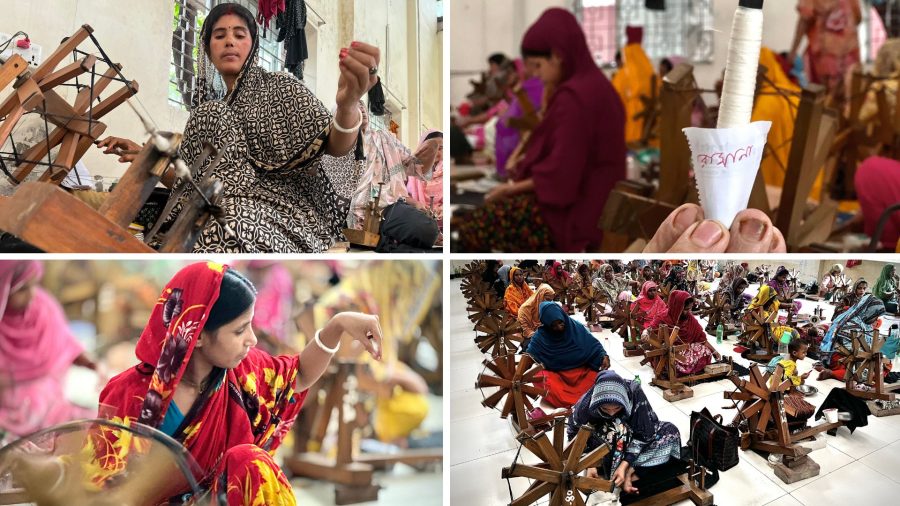
Beyond the laboratory, another story unfolds daily between 7am and 3pm in small workstations in Tarabo and Rupganj, Narayanganj, through more than a hundred women’s hands.
Mukta spins with her four-month-old son, Jubaye Islam, in her lap, earning around Tk18,000 a month after three years here. “I manage the child and spin. When the child sleeps, I don’t just sit idle; I keep my hands busy and spin,” she says. Mahmuda Akhter Sonali once left the job but returned; men do not spin or weave here. Mohsina Akter recalls a difficult closure when women were forced into other work.
“It was closed. There was nothing to do; it was up to the government. We are bringing this back through research. You will also do it. I feel proud,” she says.
At the centre of this effort is Mohsina Akter herself, from Karambpur village, Chandina, who joined when muslin work began in 2018. “At that time, I had never seen, heard of, or known yarn as fine as muslin. I did not understand it. I was simply astonished,” she says. She later moved to Rupganj with 14 colleagues, rose from supervisor to in-charge, and has personally trained around a hundred women.
She describes the toll the work takes: The slightest carelessness or a minor skin problem can snap the yarn; sweat makes it cling; long hours cause back pain; constant focus strains the eyes. The three fingers of her left hand are her essential tools, protected with night jelly, lotion, powder and Meril cream through the seasons. “Even though it’s hard, the interesting thing is that we women are doing this to preserve Bangladesh’s heritage. We are earning a little for our families, and we can live well with our husbands and children,” she says.
A daycare centre was attempted but abandoned; separating mothers from children lowered yarn counts, while keeping children close improved them. Warping, meanwhile, needs two women working face to face to guide 2,600–2,800 threads through the loom’s com; Ayub Ali recalls weaver Asiya’s team successfully spinning and weaving cloth from lotus fibre.
More than three hundred women work directly on the project, which Ayub Ali says could not run without them. Many, once entirely dependent on their husbands’ income, now earn for themselves, a shift he calls a social safety net. He tells of Jharna, whose husband was paralysed and left without income, and who, after training, now supports her family through the work.
None of the women is government employees; all are daily-wage contractual workers paid Tk700 a day under Ministry of Finance guidelines, with no bonuses and no pay when there is no work. A roughly 18-month shutdown before the change of government brought real hardship. “It was closed for a long year and a half; we struggled a bit to get by,” one worker said.
Oliullah Pradhan, on the same Tk700 daily wage, earns about Tk17,000–18,000 a month, not quite enough for his family, yet he will not leave. “Even if it doesn’t cover the costs, I hold on because of the work, because of the attachment. I can’t give it up,” he says. When the project ends, so will his role, and he will return to jamdani weaving, though he hopes a permanent government post might one day bring the same benefits as other government employees. Mohsina agrees: “Let the work continue. If it stays under the government, we women can move forward a little better; we can educate our children a little better.”
To preserve the skill, around 160 spinners in Cumilla now train in rotating ten-day shifts, so their hand skills do not lapse before the technology eventually passes to private entrepreneurs. “They are being kept in practice so that they don’t forget, so that they can retain their skills,” Ayub Ali says.
Spinning dreams out of yarn
Muslin is now edging toward the market. In the first phase, a heavily designed muslin jamdani saree cost Tk7–8 lakh and took seven to eight months; a mid-range design cost Tk5–6 lakh and took six months; a plain saree took around four months. In the second phase, better warping has cut yarn breakage and improved spinners’ skills – a gram of bobbin yarn that once took three days can now take one or two – reducing both production time and cost, with some sarees now made in three to four months at Tk1–2 lakh less.
Ayub Ali sees room for further improvement in hand-spinning technology and believes private-sector involvement could cut costs more, with work currently tracked via CCTV and digital face-recognition attendance. Still, he doubts muslin will ever become everyday cloth. “It won’t come down very much. Maybe from seven to six, or eight to seven,” he says, calling it a historically elite garment destined to remain high-value and specialised.
Some fabric will eventually be sold with permission, while research samples are preserved at the project’s display centre and museum; the Varendra Museum has also proposed preserving a piece in recognition of Rajshahi University’s role. Several experiments run in parallel — three spinning lines each working on the “MO” type, the “MT” type, and a cross-bred variety of Phuti Carpinus — each tested for fibre strength and quality before weaving. Bangladesh has no dedicated textile museum yet, but one floor of the under-construction ten-storey Tanti Bhaban in Mirpur will house one.
When a master weaver from a remote Cumilla village relearns, from scratch, a technique that vanished two centuries ago – and a mother like Mukta, child asleep in her lap, spins some of the finest yarn in the world – the revival of muslin reveals itself as more than the story of a fabric. It is a story woven from science, patience, women’s labour and the promise of future commerce, its final shape still sitting on the loom, waiting to be completed.