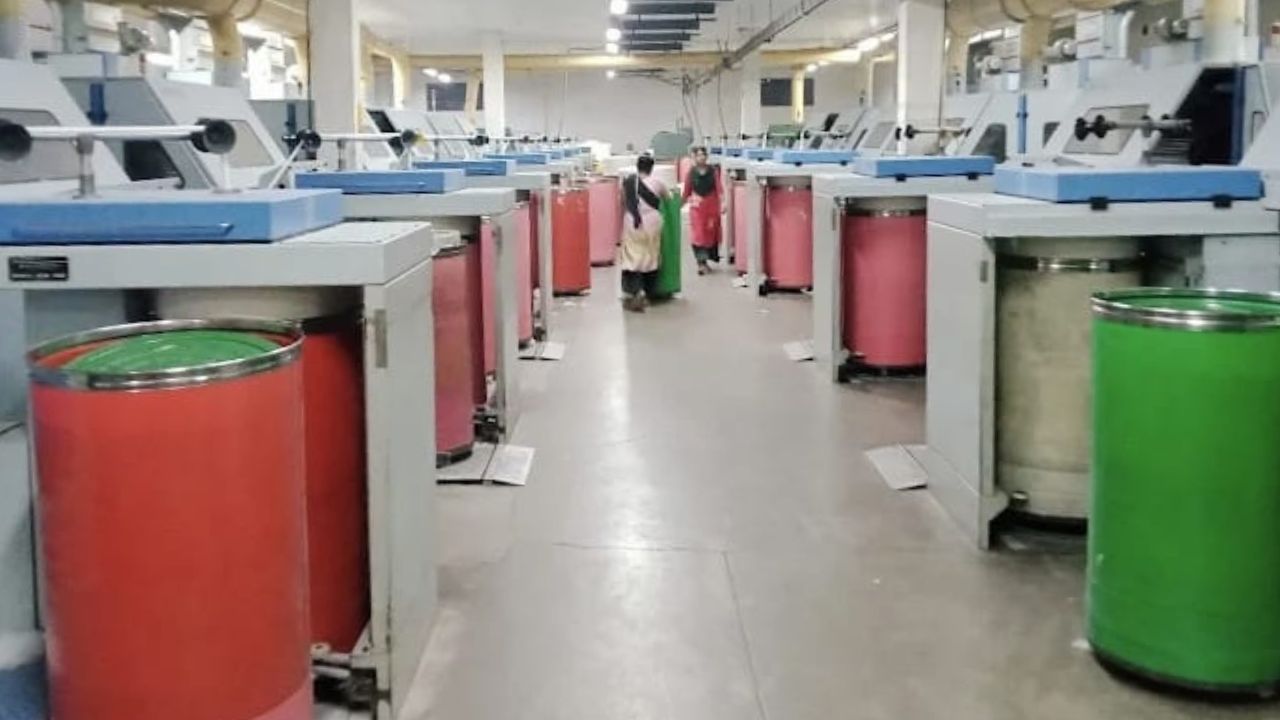



Ongoing low gas pressure in the Bhaluka industrial area of Mymensingh has severely disrupted production, triggering an impasse across industrial factories. Complete suspension of the gas supply has forced two factories to halt operations entirely, while gas-dependent units of five other factories have been partially shut down.
According to local sources, Russel Spinning Mill, an enterprise of the Osman Group located in the Kathali area of Bhaluka, began sending its workers on leave last Wednesday, before suspending production across the entire unit on Thursday.
Meanwhile, Excellent Tiles has also halted production due to the crisis in its gas-dependent production system.
Industrial Police sources revealed that the closures have left over a thousand workers unemployed, putting their livelihood in jeopardy.
Russel Spinning Mill employed 672 workers in the affected unit, while Excellent Tiles had 372, bringing the total number of affected workers across the two factories to 1,044.
Additionally, thousands of other workers in the region are facing deep anxiety due to reduced working hours and temporary leaves.

The five factories where gas-dependent units are partially closed are Excellent Ceramics, Saudi Bangla Feeds, Akbar Cotton, Denis Multipurpose, and Tallu Spinning Mill. However, the Industrial Police reported that Fancy Yarn, a factory owned by the Shepherd Group, resumed operations on Sunday after being closed on Saturday due to the gas crisis.
Sujon Miah, a local worker, stated that normal production has been impossible for a long time due to low gas pressure. “If this low pressure persists, production will decline further, and there is an apprehension that more factories will shut down,” he said.
He warned that closures put workers at risk of job loss.




“We rely on daily earnings to support our families. If work stops, we will face extreme uncertainty. Thousands of workers in the Bhaluka industrial zone could become unemployed. The gas pressure must be normalised quickly to keep production running,” he urged.
An official of a local factory, speaking on condition of anonymity, stated that the prolonged low gas pressure is severely hammering production across the industrial zone, with gas-dependent sectors like spinning, textiles, and ceramics suffering the most.
“Due to inadequate pressure, many factories cannot maintain normal production. Some have reduced output, while others have been forced to shut down their gas-reliant units,” the official said.
The low pressure has not only hit production but also made it difficult to keep machinery running, secure regular working hours for labourers, and meet scheduled production targets.
“This has led to reduced work hours and temporary leaves, escalating anxiety and uncertainty among the workforce,” the official added.
Another factory official warned that the gas supply situation is deteriorating day by day, intensifying anxiety among owners, officers, and workers alike due to the lack of visible improvement.
“If the gas supply is not normalised quickly, more factories in the Bhaluka industrial area face closure,” the official cautioned, adding that such closures would severely impact both the production and supply chain and the livelihoods of thousands of workers, pushing their families into financial crises.
The official also noted that Bhaluka is one of the country’s most critical industrial hubs.
“Disruptions here will not remain confined locally; they could have a negative impact on national production, the supply chain, and export sectors. Thus, effective steps are urgently needed to normalise the gas supply,” the official urged.
Ansar Uddin, Police Superintendent of Industrial Police-5, confirmed that gas pressure in the Bhaluka area has not increased significantly and remains low. “There is no notable improvement in the gas supply situation.
Spinning mills, in particular, are facing an extreme crisis, leading to a drastic fall in their production,” he said.
Shamim Hossain, Manager (System Operations) of the Bhaluka Regional Office of Titas Gas Transmission and Distribution Company, explained that gas is supplied to the Bhaluka area through two separate pipelines with capacities of 140 and 50 PSI (pounds per square inch).
However, the supply lines recorded a gas pressure of only 60 PSI on Sunday and 90 PSI on Monday.