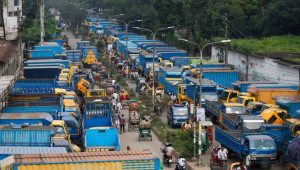



Worsening gas shortage left CNG drivers stranded for hours, households struggling to cook and factories shut on Friday as disruptions at the country’s two LNG terminals in Moheshkhali sharply reduced supplies.
The crisis spread across Dhaka and other parts of the country, with long queues forming at CNG stations and gas pressure falling sharply.
The Summit terminal was expected to resume operations on Friday evening, with Rupantarita Prakritik Gas Company officials telling TIMES of Bangladesh that gas unloading was under way at 5:15pm.
But the disruption had already caused widespread hardship.
In Dhaka, CNG auto-rickshaw and private car drivers spent hours waiting at filling stations. At Eureka Enterprise CNG Filling Station in Mohakhali, drivers had been standing since before dawn, with the queue stretching beyond the railgate.
Drivers said they were receiving only around half of their usual fuel allocation. Low pressure meant they could travel only a few kilometres before having to return to queues.
At Shanto CNG Refuelling Station in Mugda Bishwaroad, driver Anwar Hossain said he had been waiting since dawn but had not received gas even after 11am.
“I came to get gas and start working quickly. But I have been standing here since dawn,” he said.

Several stations in the capital shut down completely and displayed “No Gas” signs.
The shortage also halted industrial production in parts of Habiganj. Gas supply was completely cut to 171 factories in Madhabpur, Shayestaganj and surrounding areas from Wednesday after weeks of partial supply.
More than 150,000 workers have been left idle, according to local industry officials.
At Jamuna Industrial Park, around 30 million cubic feet of daily gas demand went unmet from Wednesday afternoon, leaving around 16,000 workers across six factories without work.
Badsha Pioneer also lost its remaining gas supply from Wednesday midnight after already receiving far below its approved allocation.




Households in several districts faced severe shortages.
In Cumilla, residents endured a third consecutive day of little or no gas. Golam Kibria of Nazrul Avenue said his family had gone without gas for more than 31 hours and had been forced to buy food from restaurants.
Nasrin Sultana of Police Lines said she had started buying firewood.
“We are being forced. We have no other option,” she said.
Bakhrabad Gas Distribution Company said reduced LNG supplies had affected Cumilla, Noakhali, Chandpur, Feni, Lakshmipur and Brahmanbaria.
Jamalpur also faced a severe shortage, leaving thousands of CNG vehicles off the road. The district has around 3,000 registered CNG auto-rickshaws, in addition to vehicles entering from neighbouring areas.
“There was no gas for a long time yesterday too, and none since this morning. How will we run our vehicles? If we don’t drive, what do we eat?” driver Tara Mia said.
There was some relief in Sirajganj, where gas supply resumed at the city’s only CNG station after a 43-hour outage.
Albatross Energy in Diar Boidyonath resumed supply around 6am on Friday, drawing hundreds of vehicles into a queue stretching about half a kilometre.
Driver Saiful Islam said he had been unable to earn for three days.
“Got gas after three days, feels great. That’s our only source of income,” he said.
Two terminals disrupted
The immediate supply shock came from Moheshkhali, where Bangladesh receives a major share of its imported LNG.
The country’s two floating storage and regasification units (FSRUs) were disrupted simultaneously. The Summit-operated terminal remained offline from Thursday to Friday as an LNG carrier could not dock due to rough weather.
Petrobangla Senior General Manager Engineer Saiful Islam Sarkar said wind speeds reached around 38 knots, above the safe berthing limit of about 20 knots.
The Excelerate-operated FSRU was affected by a mechanical problem that reduced its output by around half. It had earlier suffered a major disruption on 21 July after a fire during an LNG ship-to-ship transfer cut around 450 million cubic feet of gas from the national supply.
Bangladesh currently produces around 1,600–1,900 million cubic feet of gas daily from domestic fields. Total supply stands at around 2,600–2,700 million cubic feet against demand of nearly 3,800 million cubic feet.
The two Moheshkhali FSRUs normally provide around 1,000 million cubic feet daily, making any disruption a major blow to transport, households and industries.
With Summit preparing to resume operations, some relief is expected, though authorities remain uncertain whether supplies will immediately return to normal.
Our correspondents Mahfuz Nantu from Cumilla, Saimum Sabbir Shovon from Jamalpur, Akhlas Ahmed Priyo from Habiganj and Wasim Sheikh from Sirajganj contributed to this report.