
Faridpur, renowned for its “golden fibre”, is witnessing a dramatic surge in the economic value of jute sticks (patkathi), once treated as negligible waste.
Although jute fibre production costs have escalated faster than market prices this season, leaving growers with slender profit margins, strong demand for jute sticks is helping farmers recover their financial losses.
Previously restricted to cooking fuel, household fencing, vegetable garden trellises, and betel vine (pan boroj) shading, jute sticks have emerged as a high-value commodity in domestic and international markets.
The byproduct is now converted into charcoal powder, board, ink, carbon paper, computer printer and photocopier ink, fireworks, facewash ingredients, mobile phone batteries, cosmetics, air coolers, water filters, toxic chemical neutralising medicine, life-saving drugs, tooth-cleaning medicine, and agricultural fertiliser.

According to the Department of Agricultural Extension (DAE), approximately 90 per cent of farmers in the district are involved in jute cultivation this season, with crops planted across 87,402 hectares of land.
The agriculture department anticipates total jute stick sales to reach around Tk4,000 crore this year, with an average yield of Tk15,000 worth of sticks generated per hectare.


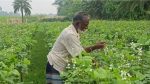
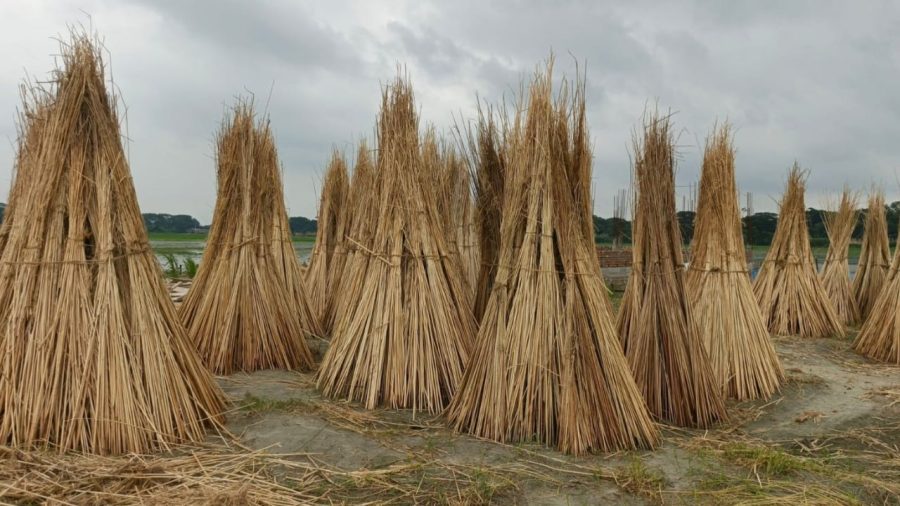
Jute production is highest in Saltha and Nagarkanda upazilas. Across villages, paved roads, and open fields, intensive work is underway to dry, process, and stack jute sticks.
Depending on grade, 100 mutha (bundles) of jute sticks are currently selling between Tk800 and Tk1,200.
In Sakpaldia village under Nagarkanda upazila, farmer Jiban Krishna Das reported selling his jute sticks in three distinct categories: long and strong sticks fetched Tk2,000 per 100 mutha, medium-sized ones brought Tk1,200, and short, soft ones sold for Tk800.
Another farmer from the same village, Jamal Sheikh, noted that growers are drying and stacking their sticks while buyers sent by wholesalers (mahajans) negotiate purchases daily.
In Rasulpur village of Saltha upazila, female farmer Saheda Khatun, who manually extracted and sun-dried her crop, sold 100 mutha for Tk1,600.
The industry has also created vital employment for local women. Majiron Nesa, a female farmer from Rasulpur, explained that women from farming families carry out fibre extraction and drying, while landless women earn extra income working as hired labourers to dry and stack the sticks after the fibre is taken to market.
Local trade has expanded significantly, attracting agents and traders from major commercial companies directly to rural areas. Momin Matubbor, a trader from Mirakanda village, stated that jute sticks now offer a promising source of income compared to past years.
Trader Mostafa Sheikh, who has traded jute sticks for seven years, observed that the establishment of local carbon factories in Faridpur has pushed demand and prices so high that meeting factory requirements locally leaves little surplus for outside buyers.