Tasnim Jara – physician, researcher, YouTuber, entrepreneur, and now politician – has long been a popular face in Bangladesh for her health awareness videos. But her entry into politics in February 2025 as senior joint secretary of the National Citizen Party (NCP) unleashed an organized wave of online harassment.
What was once scattered trolling has evolved into an orchestrated campaign using manipulated images, deepfake videos, and fake advertisements.
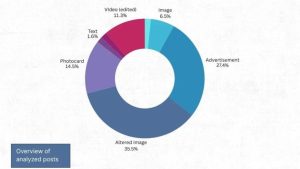
A Dismislab investigation reviewed 62 Facebook posts circulated between March and August 2025. Collectively, these were shared nearly 30,000 times, viewed over 7.4 million times, and drew almost half a million reactions, most of them derogatory.
The content ranged from sexually suggestive memes to fabricated photocards impersonating mainstream news outlets.
Sexualized abuse through doctored photos
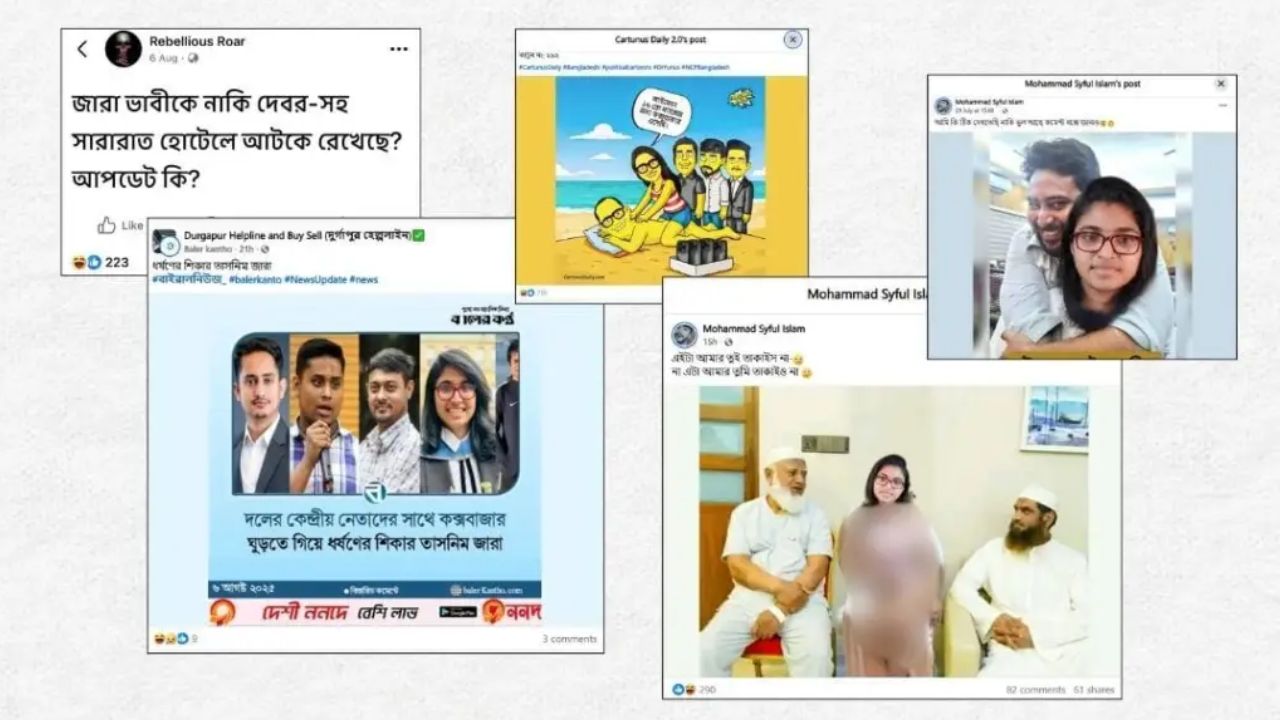
The abuse escalated after Jara’s party leaders, including her husband Khaled Saifullah, visited Cox’s Bazar on August 5. The following day, edited photos surfaced on Facebook placing Jara in compromising situations with male colleagues.
One falsely portrayed her embracing NCP leader Nahid Islam, while another replaced another woman’s face with hers.
Of the 62 posts examined, 20 used manipulated images, and 23 attached defamatory captions to her genuine photos. August alone saw 20 such posts, making it the peak month of abuse. A Facebook group calling itself “Dr Tasnim Jara Friends Club–DR Tasnim Jara,” with nearly 11,000 members, even circulated a doctored image with a caption advertising a “course on sexual intercourse.”

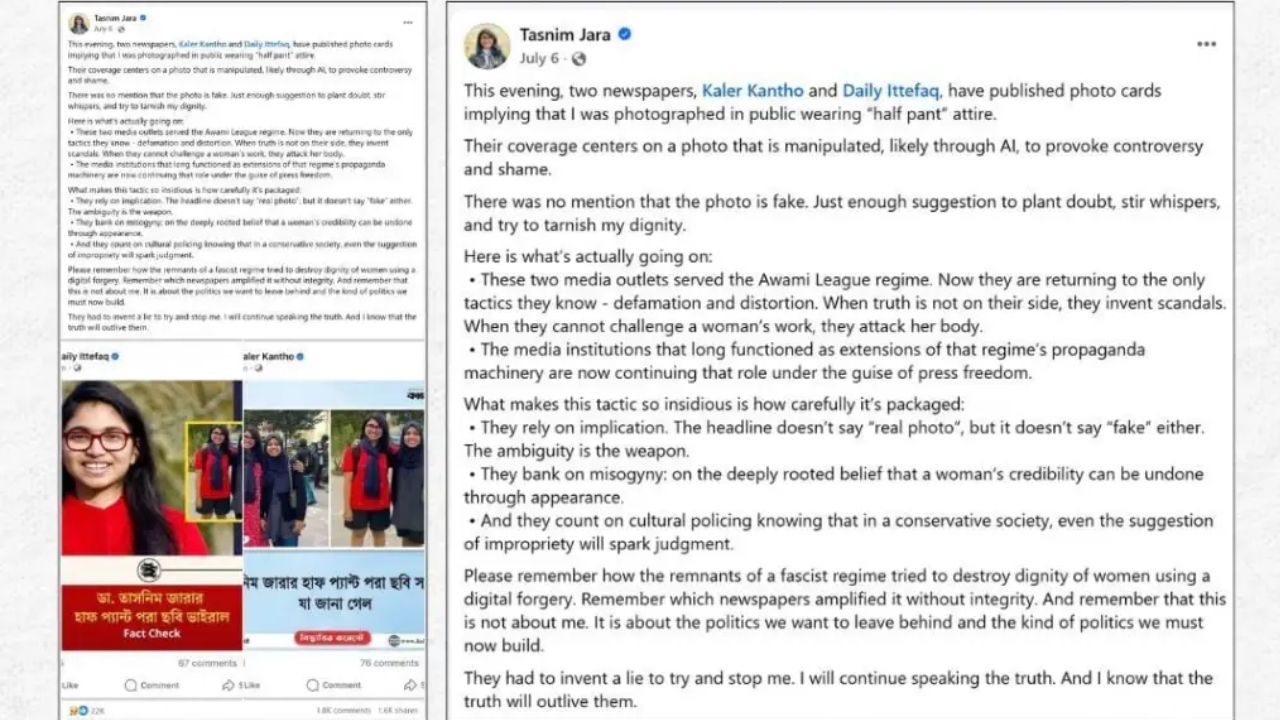
Some images claimed to show Jara in shorts with religious references attached—later debunked as AI-generated. Yet mainstream dailies like Ittefaq and Kaler Kantho amplified the disinformation with misleading headlines that failed to clarify the photos were fake.
Jara herself condemned the coverage as degrading and politically motivated.
Fake media photocards fuel disinformation
Fabricated photocards bearing the logos of Samakal, Jugantor, Channel 24, and Jamuna TV were widely shared to spread sexualized claims. One card, impersonating Samakal, alleged that Jara had been gang-raped in Cox’s Bazar. Another mimicked Kaler Kantho, suggesting she was assaulted by party colleagues. None of these claims were supported by the outlets’ verified platforms.
Even authentic media content was twisted. A legitimate DBC News photocard about Jara’s Cox’s Bazar trip was stripped of its caption and reposted with insinuations about sexual misconduct.




Videos and deepfakes intensify smear
Beyond images, videos of Jara were also weaponized. In one case, audio was manipulated to make her appear to quote a price for intimacy. The original footage, from her YouTube channel, was about pregnancy health. Another splice falsely implied she promoted sexual activity for political gain.
Deepfake technology added a darker layer. One AI-generated clip showed Jara in a swimsuit with the watermark of Pixverse AI still visible. Another depicted her in a fabricated kissing scene with Jamaat-e-Islami chief Shafiqur Rahman, betrayed by telltale AI flaws such as six fingers on her hand.
Fake audio recordings also circulated, including a 12-minute clip billed as a “secret phone call” with an alleged extramarital partner. While the content never mentioned names, the video paired her photo with that of Sadat Rahman, the award-winning child rights activist, further proving its fraudulent nature.
Exploiting Jara’s identity for fake drug ads
Seventeen of the 62 posts were advertisements falsely using Jara’s name and image to endorse dubious medicines—ranging from male sexual health “cures” to piles and weight-loss treatments. Between April and August, these misleading ads reached more than half a million views.
Meta’s Ad Library showed that at least 14 Facebook pages ran such campaigns, six of which directly used Jara’s identity. This follows a familiar pattern: Jara’s photos have previously been exploited to sell fake health products, prompting her to publicly denounce the scams as “fraudulent.”
Analysis also found that 133 admins managed 57 of the abusive pages, with most based in Bangladesh, and others in Malaysia, the UK, Saudi Arabia, and beyond.
Women in politics under attack
Jara’s ordeal is not isolated. Female politicians in Bangladesh face disproportionately sexualized harassment online. During the 2024 general election, actress-turned-politician Mahiya Mahi was relentlessly targeted with sexual innuendo.
Experts say such abuse reflects entrenched patriarchy. Professor Gitiara Nasreen notes that attacking a woman’s “character” is a recurring weapon to delegitimize her. A 2021 study by the International Foundation for Electoral Systems similarly found that online violence often distorts the personas of politically active women to discourage participation.
Maliha Tabassum of Bangladesh University of Professionals calls the harassment a “structural process” designed to undermine women’s political agency. “This poses a severe threat to democratic representation,” she warns, as half the population’s perspectives risk exclusion.
Platforms failing to enforce their own rules
Most of the abusive posts targeting Jara violate Facebook’s own hate speech and harassment policies, which ban sexualized slurs and gender-based stereotypes. Meta’s advertising policies also forbid using public figures’ images to sell products without consent. Yet enforcement remains lax.
Speaking about the disinformation and sexualized campaign against Tasnim Jara, she said, “This is not just a personal attack. It is a structural process that undermines a woman’s political agency and seeks to push her back into the private sphere.”
Jara herself told Dismislab that harassment has grown “completely different in scale and nature” since she entered politics. “Now there is an organised campaign aimed at portraying me as unethical,” she said. She added that while male politicians face attacks on corruption, women are primarily targeted with sexually suggestive defamation.
Despite repeatedly reporting abusive posts, Jara said she has received little support from platforms. “Facebook and YouTube make huge money from Bangladesh, yet they often avoid responsibility,” she noted.
Dismislab methodology
Dismislab’s four-member team collected 62 posts between March and September 2025 using targeted social media searches based on keywords. Profiles and pages posting the abusive content were often found to align with Awami League sympathisers.
The case of Tasnim Jara underscores how disinformation, sexualized abuse, and digital manipulation intersect to silence women in politics. It is not only a personal attack, but a broader assault on democratic inclusion.