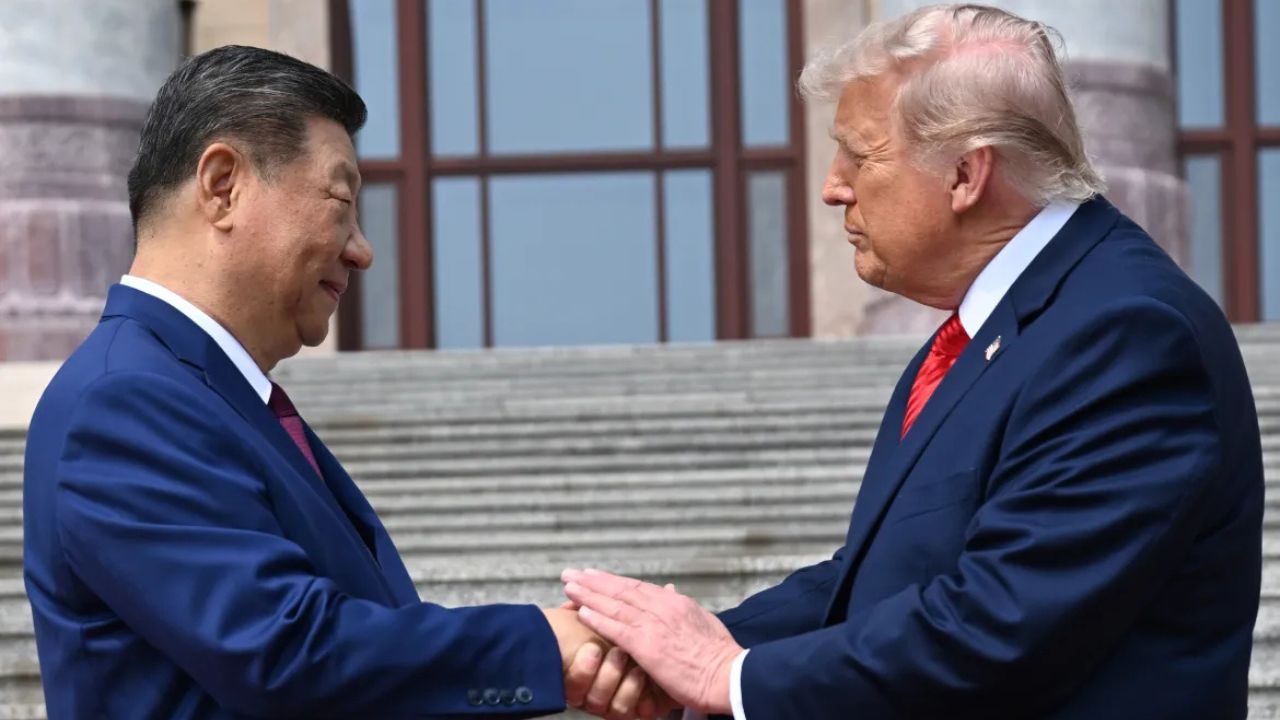



Chinese President Xi Jinping has arrived in Washington, for a three-day state visit – the first by a Chinese leader in more than a decade – for high-stakes talks with United States President Donald Trump covering trade, artificial intelligence (AI), Taiwan, and international conflict.
In a rare gesture underscoring the significance of bilateral relations, Trump personally greeted Xi on the tarmac at Joint Base Andrews outside the US capital. This marked the first time in 11 years that a US president has met a foreign leader at the base upon arrival.
The ceremonial welcome included handshakes, conversation, a military band performance, cannon fire, and a flyover by a B-1 military bomber.
Following his arrival, Xi said through the state-run Xinhua news agency that China and the US should be partners rather than rivals, noting that “the great rejuvenation of the Chinese nation and making America great again can go hand in hand, complement each other and benefit the world.”
Extension of trade truce
The Trump administration announced an extension to the 11-month trade truce previously agreed upon in South Korea, known as the Busan Agreement.
US Treasury Secretary Scott Bessent told Fox News that he had met with Chinese Vice Premier He Lifeng ahead of the visit to assess possibilities for a broader deal rather than a series of smaller agreements.
Consequently, the Busan Agreement – which was scheduled to expire on 10 November 2026 – has been extended to 10 January 2027.
Yun Sun, a senior fellow and director of the China Program at the Stimson Center, described the summit as “unprecedented”, noting there is no prior precedent in US-China history of the top leaders of both countries visiting each other within a single calendar year, following Trump’s visit to Beijing in May 2026.
Sun added that the short truce extension indicates both powers require technical time to negotiate a wider scope of trade commitments.

Tariff landscape and escalation history
The trade friction escalated after Trump returned to office in January 2025, imposing a 10 per cent duty on Chinese goods over fentanyl and immigration concerns.
Beijing retaliated with levies on US coal, liquefied natural gas (LNG), crude oil, and motor vehicles, alongside export restrictions on five metals critical for defence and clean energy.
By April 2025, the tariff conflict intensified significantly, with US levies on Chinese imports reaching 145 per cent and Chinese tariffs on US goods reaching 125 per cent, accompanied by controls on rare-earth exports.
According to a Congressional Research Service report, as of July this year, Chinese goods entering the US faced an average tariff rate of 36.5 per cent, while US exports to China carried an average rate of 31 per cent.
Effective rates vary substantially across specific product categories. For US import duties on Chinese goods, copper and copper products faced an effective rate of 73.6 per cent as of June 2026, aluminium items 65.2 per cent, iron and steel about 50 to 58 per cent, and motor vehicles and auto parts 44.4 per cent.
Regarding Chinese duties on US goods, China maintains a 10 per cent additional duty above normal tariffs, subjecting US crude oil to 20 per cent, LNG to 25 per cent, soya beans to 13 per cent, and US beef to up to 77 per cent.




Bilateral trade contraction vs overall deficits
Data from the US Census Bureau reveals that tariffs have led to a sharp contraction in bilateral trade. Total US-China trade fell 29 per cent from $584 billion in 2024 to $415 billion in 2025.
In the period from January to July 2026, bilateral trade stood at $222 billion, representing a 14.5 per cent decline compared to the same period in 2025 and a 31 per cent drop from January–July 2024.
This decline is primarily driven by shrinking US imports of Chinese goods, which fell from $194 billion in January–July 2025 to $156 billion in January–July 2026, marking a 34.6 per cent drop relative to the corresponding period in 2024.
Conversely, Chinese purchases of US products remained virtually unchanged year-on-year at $65 billion for the first seven months of 2026, down roughly 20 per cent compared to 2024.
Consequently, the bilateral US goods trade deficit with China narrowed from $297 billion in 2024 to $203 billion in 2025 and stood at $91 billion for January–July 2026.
However, the broader US global goods trade deficit has continued to widen under Trump administration. In 2024, the US goods-and-services trade deficit was $1.201 trillion; in 2025, during Trump’s first year of his second term, it rose 2.8 per cent to $1.235 trillion.
Between May and July 2026, the combined US goods trade deficit reached $325 billion, up 17.4 per cent from $277 billion during the corresponding period in 2025.
Monthly deficits in 2026 were recorded at $105 billion in May compared to $92 billion in May 2025, $101 billion in June compared to $84 billion in June 2025, and $119 billion in July compared to $101 billion in July 2025.
China’s global export expansion and surplus
While trade with the US contracted, Chinese exporters successfully redirected goods to other international markets. According to China’s National Bureau of Statistics, total Chinese goods exports grew 6.1 per cent in 2025 to $3.77 trillion.
Exports to Association of Southeast Asian Nations (ASEAN) member states grew 14 per cent in 2025 to about $660 billion, making ASEAN Beijing’s largest export market, while exports to European Union (EU) countries grew 9 per cent to about $560 billion.
In the first half of this year, Chinese exports expanded by 13.4 per cent, registering an 11th consecutive quarter of growth.
China-ASEAN bilateral trade reached $744 billion in the first seven months of 2026, up 24.7 per cent year-on-year.
China recorded a global goods trade surplus of $1.2 trillion in 2025. By August 2026, Beijing’s trade surplus had already reached approximately $820 billion.
Chinese monthly global exports stand at roughly $400 billion, with the US share of those exports declining from approximately 15 per cent to 10 per cent.
Technology rivalry and strategic leverage
The trade conflict extends beyond tariffs into sanctions, entity lists, investment restrictions, and research restrictions. Both nations hold distinct strategic leverage.
In terms of critical minerals, China controls almost 90 per cent of global processing and refining capacity for rare earths, which are essential for semiconductor manufacturing, artificial intelligence, electric vehicles, and defence equipment, leading Beijing to restrict exports of key metals and rare earths in response to US measures.
Conversely, Washington maintains restrictions on China’s access to advanced semiconductors and chipmaking equipment, with the US government recently initiating a trial against Chinese technology firm Huawei over alleged technology theft.
Recent retaliatory actions include US bans on imports of Chinese-made humanoid robots, sanctions on Chinese shipping operators over alleged handling of Iranian fuel, and threatened sanctions against Chinese AI firms.
In response, Chinese countermeasures include sanctions on US firms and export restrictions on drones and drone technology to the US.
Washington summit agenda
During his three-day visit, Xi’s schedule includes a state dinner with leaders of the US tech industry, a military ceremony at the White House, and a visit to the National Archives.
Key agenda items for bilateral talks include structuring a broader long-term economic agreement beyond the 10 January 2027 truce extension, as well as discussing a US proposal to establish an AI “hotline” notification mechanism to report significant national security risks associated with artificial intelligence in either country.
Additionally, Beijing is expected to seek to halt or stall a $14 billion arms package approved by the US Congress earlier this year that the Trump administration has not yet advanced, while discussions will also encompass geopolitical issues surrounding the US-Israel war on Iran.