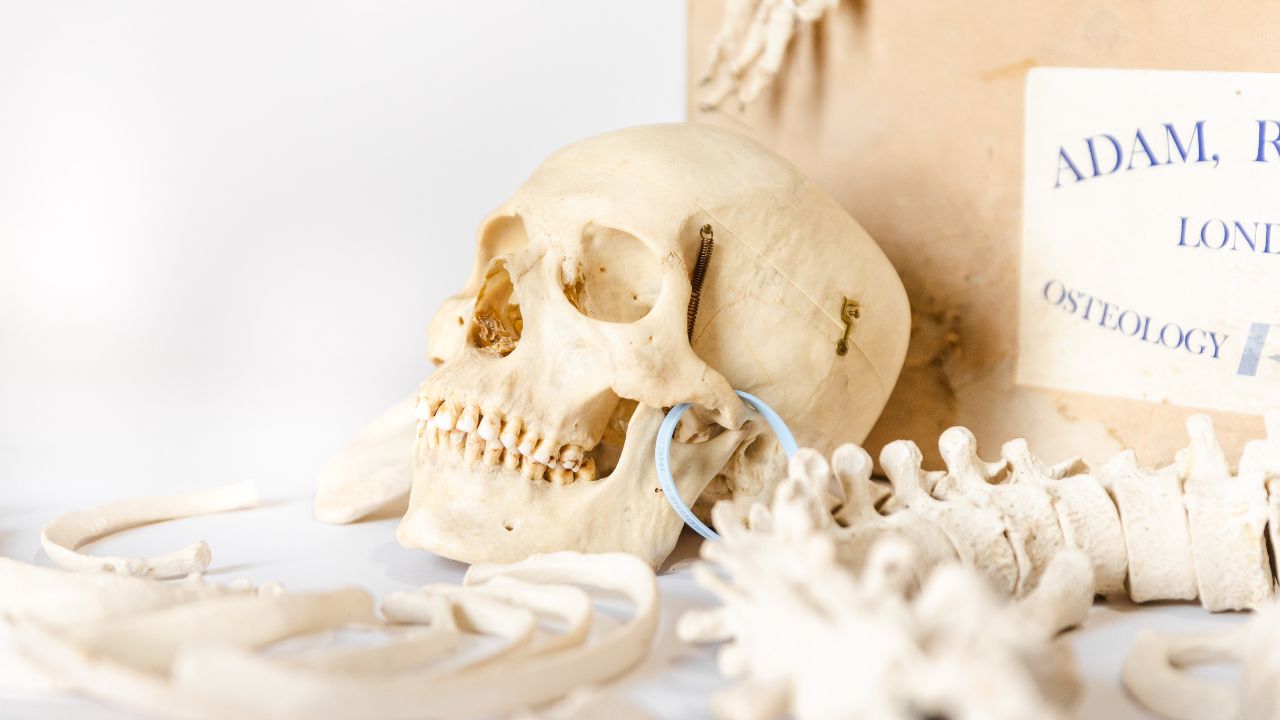



Medical students need skeletons soon after enrolling in medical colleges and universities. Juniors often buy them from seniors, while worn-out sets create demand for replacements. Although several thousand skeletons are used for teaching across public and private institutions, their sources remain unclear.
Full-body skeletons are available through “bones banks” for Tk40,000–Tk45,000, but sellers do not disclose where they come from.
Bangladesh has 110 medical colleges — 37 public and 73 private — along with five public medical universities. Every year, several thousand local and foreign students need skeletons for anatomy courses in their first and second years. Dental students also require parts of the human skull and teeth.
Asked how students obtain skeletons, Dhaka Medical College Department of Forensic Medicine assistant professors Fahmida Haque and Soheli Munjuri Tanvi said students acquire them in various ways, including by purchasing them, but the students themselves would be better placed to explain how they source them.
Skeletons are frequently stolen from graves across the country, and thieves have been caught on several occasions. They are also openly available online and offline. With no legal avenue for obtaining new skeletons, questions persist over the sources of those used in medical education.
Kamrul Ahmed, burial service officer at Anjuman Mufidul Islam, told TIMES of Bangladesh that 2,014 unidentified bodies were buried between January 2023 and June 2026, mainly at Jurain and Rayerbazar Boddhobhumi graveyards.
“We receive bodies from hospitals with proper documentation and deliver them to the graveyards. Once the bodies are handed over, responsibility rests with the graveyard authorities. We do not monitor them,” he said.
According to the yearly figures, 490 unidentified bodies were buried in 2023, 570 in 2024, 644 in 2025 and 310 through June 2026.

Dhaka Medical College morgue in-charge Ramu Chandra Das said unidentified bodies are generally kept for three days after post-mortem examinations before burial, depending on arrangements by Anjuman Mufidul Islam.
On 16 July, he said there were 10 unidentified bodies at the morgue, including five from Shahbagh Police Station.
Shyamal Lal, a morgue assistant at Sir Salimullah Medical College and Hospital, said unidentified bodies are buried after being kept for two to seven days. Asked how students obtain skeletons, he said they “manage” them.
Maksudur Rahman, head of the hospital’s forensic department, said he did not know how students currently sourced skeletons, though he had obtained one from a “bones bank” as a student.
There are allegations that unidentified bodies kept in morgues for extended periods are chemically processed, with the skeletons later preserved and sold.
Longstanding allegations of involvement in the trade have also been made against Dhaka Medical staff member Sekendar, his brother Babul, a peon, and Ramu, though they have denied them.
Several police officials said many bodies recovered from rivers or after train accidents remain unidentified. Fingerprints and DNA samples are preserved before burial.
A Sikder Medical College Hospital student bought a skeleton from a senior for Tk45,000 and sold it four years later to a junior for Tk35,000. Skeletons are sold as complete sets or in separate parts.
A Dhaka Dental College staff member said skeletons are also smuggled across the Indian border. A used full-body skeleton can be bought for Tk35,000. An assistant at Shaheed Suhrawardy Medical College morgue gave similar information.
Sold through ‘bones banks’
More than 50 Facebook pages, including “Premium Bones”, “Bones BD Buy/Sell”, “Bones Bazar of Bangladesh” and “Medical Bones Buy and Sell”, advertise human skeletons and bones.
New bone sets sell for Tk35,000–Tk40,000, while used sets cost Tk10,000–Tk30,000. Dental bone sets are advertised for Tk13,000–Tk20,000, while individual bones sell for Tk800–Tk1,500.
Most sellers use pseudonyms and ask buyers to contact them through Messenger. None contacted agreed to disclose the sources of the bones.
Stolen from graves
Bones recovered when old graves are reopened are also sold, with grave diggers and organised groups allegedly involved. Separate bones are sometimes assembled into full skeletons before being sold to medical students.
Nine skeletons were stolen from Tekibari Chanpur Central Graveyard in Kaliakair, Gazipur, on the night of 16 July.
Local resident Anwar Hossain said, “Everything was fine at around 10:00pm. Later, the skeletons of several villagers were found to have been stolen.”
In recent years, skeletons have also been stolen from graveyards in Manikganj, Mymensingh, Thakurgaon, Panchagarh, Sirajganj and Savar.
In 2020, 42 skeletons were stolen from two graveyards in Dinajpur, while 22 were stolen from a graveyard in Mirzapur, Tangail.
Such groups are also alleged to operate around Azimpur, Jurain, Rayerbazar and Mirpur graveyards in Dhaka, selling skeletons for up to Tk45,000–Tk50,000.
Md Hafizul Islam, imam and senior mohorar at Azimpur Graveyard, said police and the CID had investigated allegations of skeleton theft but found no evidence.
Officials at Jurain and Rayerbazar graveyards also denied that skeletons were stolen from their premises.
Skeleton thieves caught
In March this year, police arrested four alleged skeleton thieves in Tejgaon and Uttara with 47 human skulls and a large quantity of bones.
Police said the group was linked to an online network of around 700 members and had long been stealing skeletons from graveyards in Mymensingh, Sherpur, Jamalpur and Gazipur.
The skeletons were allegedly stolen five to seven months after burial, processed and sold to medical students for Tk15,000–Tk20,000.
Earlier, in October 2021, a man named Hannan was caught with three human skulls while allegedly stealing skeletons from Kalshi Graveyard in Pallabi.
In November 2020, the alleged ringleader of an organised trafficking group was arrested in Mymensingh with a large quantity of human skulls and skeletons.