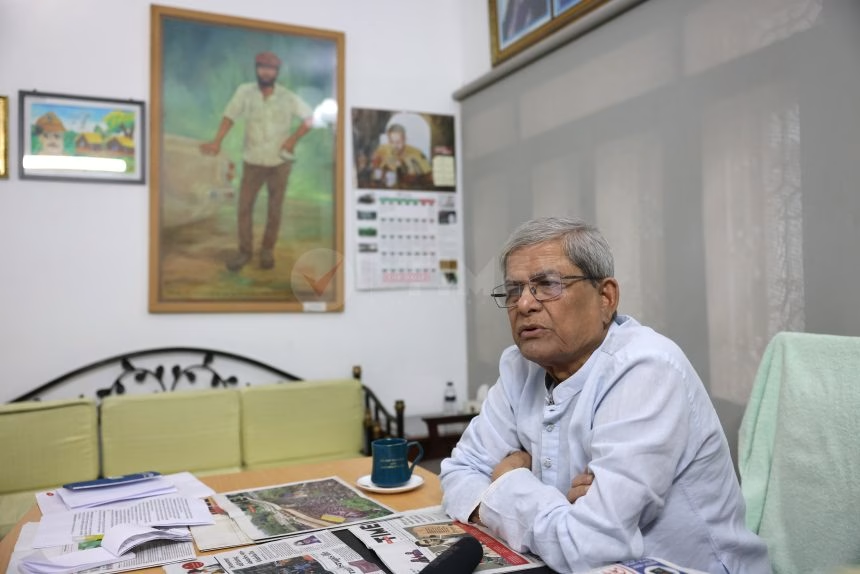

Mirza Fakhrul Islam Alamgir, the secretary general of Bangladesh Nationalist Party (BNP), the presumptive winner of the next general elections likely to take place in February next year, in a recent interview with TIMES of Bangladesh expressed his frustration about the spate of mob violence which was considered as one of the impediments to Bangladesh’s democratic transition after authoritarian Sheikh Hasina’s ouster through a mass upsurge.
He spoke about the national elections, a government on national consensus, mob violence, the political trajectory of Sheikh Mujibur Rahman and Sheikh Hasina, demolition of Dhanmondi 32 residence of Mujib, Khaleda Zia’s leadership in BNP and Tarique Rahman’s coming home. The newspaper’s Managing Editor Amlan Dewan and Special Correspondent Mosharraf Bablu interviewed Fakhrul at BNP chairperson’s Gulshan office.
The full interview follows…
TIMES: BNP has been opposing the Awami League government for 17 years but had failed to achieve success. Despite being in the opposition party, why has BNP’s movement not gained any momentum until the July-August 2024 student-led uprising?
Fakhrul: Even though the BNP had been running a movement against the Awami League government for 17 years, it truly gained momentum during the student-led mass uprising in July-August 2024.
On August 5, through that mass uprising, Sheikh Hasina was overthrown, and she was ultimately forced to flee the country.
TIMES: Why did it take so long to overthrow the Sheikh Hasina-led regime?
Fakhrul: The Awami League is an old political party with a strong foundation. After the formation of Pakistan, there was the Muslim League, which later transformed into the Awami League.
The leader who became the prime minister was Sheikh Mujibur Rahman’s daughter. Whether it was due to popularity or inherent advantages, she had it all. Initially, they started working and fulfilling their election promises.
But soon they became extremely unpopular in a short period of time and began oppressing the people. Their financial corruption and looting became apparent to the public. They started changing laws, and abolished the caretaker government system.
Particularly, the creation of the Digital Security Act led to strong public backlash.
Historically, in all successful movements against autocracies in Bangladesh, youth involvement played a key role. As a political party, we, as the opposition, resisted, but we faced persecution from the very beginning.
Later, extrajudicial killings became rampant, which created obstacles for the movement. That is why it took so long. However, as soon as the students hit the streets, the government fell.
TIMES: Do you see any political differences between Sheikh Mujibur Rahman and Sheikh Hasina?
Fakhrul: I do not see much difference between the two. They both have very similar characteristics. Both are authoritarian and have elevated themselves to the highest position. Their party has helped them grab that kind of power.

The 1971 Liberation War began around Sheikh Mujibur Rahman, although he was not present at the end as he left for Pakistan. What happened afterward, you know. From 1972 to 1975, Sheikh Mujib gradually turned into an autocratic ruler.
Just like Mujib, Sheikh Hasina is a shrewd leader. She brought partisanship into the administration and took full control of the state machinery. As a result, the state machinery supported her. During that time, she also gained control over the army.
Hasina committed genocide in Bangladesh but has not expressed any remorse for it. She has never even apologised to the people. She has failed to become a popular leader because she prioritised her party, not the people.
TIMES: What is the way out of the politics of killing?
Fakhrul: The biggest problem in Bangladesh is the lack of democratic practice. However, this cannot be fixed overnight; it will require a democratic process. The parliament must be formed through elections and must be made effective.
There must be discussions and debates in parliament. If democracy is practiced and parliament functions well, political leaders will gain more respect. Unfortunately, politicians have been sidelined by the bureaucrats, who have taken full advantage of the situation.
As a result, democracy has never been properly practiced in Bangladesh.
TIMES: We talk about corruption in Sheikh Hasina’s government, but now, allegations of corruption have been raised against several advisers in the interim government. Some even say that more corruption has occurred in the last year than in the previous 15 years.
Fakhrul: No, no, that is not correct. This propaganda is being spread deliberately. I will not say that there is absolutely no corruption. It is happening, but it is controlled.
I cannot speak on behalf of everyone, but 90 per cent of them are honest and wish to run their ministries honestly. There may be issues in a few ministries, and that is because bureaucrats control them.
Due to their inexperience, politicians are dependent on bureaucrats, and that gives bureaucrats the chance to exploit the situation. Big media houses are controlled by businessmen. There is no freedom there.



The owner tells you what to say and write. Some media outlets are fueling mobocracy. Social media has added to this problem.
TIMES: Can this be called a political culture?
Fakhrul: No, this is not a culture. This is a sub-culture. When democracy is practiced, people may debate with each other, but if done using obscene language, it is not culture.
There are certain individuals, whom I prefer not to name, such as some YouTubers, whose language is unbearable
TIMES: The ‘mob’ violence led to the demolition of Sheikh Mujibur Rahman’s residence at 32 Dhanmondi. Is this acceptable?
Fakhrul: Whether this is acceptable or not, I decline to comment. I consider this to be political violence, which I do not support. I support liberal democracy. Whether it is right to destroy something or not, it is up to the people to decide.
However, if they are instigated, what can you do? Publicly, they are told to attack and destroy. We wanted democracy, but now we are living in a mobocracy.
TIMES: The fall of the Awami League regime was achieved through a major movement. However, within a year, those involved in the movement have started to show division. What is the reason for this?
Fakhrul: This is the natural character of the people of Bengal. Do not take it personally, but Bengalis are not very good at staying united. If you put four people in one place, they will divide into three groups. This is our characteristic problem.
TIMES: Will this division pave the way for Awami League’s return?
Fakhrul: It is possible. It will depend on how political parties operate in the coming days. If the government fails to act properly at the right time, this risk will increase. Awami League will get the chance to regroup, and they will be ready to attack, which is expected.
TIMES: After the meeting in London between BNP’s acting chairman Tarique Rahman and the Chief Adviser Muhammad Yunus, it seems that the election will be held in February. Yunus has also confirmed this in his speech. However, despite this, why is there growing doubt among the people about the polls?
Fakhrul: Remarks made by some political leaders and advisers are causing this confusion. As a result, people are becoming disillusioned. The Election Commission sometimes says good things, but most of the time, they also create confusion.
The Bangladeshi people have been deprived of democracy for 15 years. They could not vote, and there is always doubt in their minds.
TIMES: If the election is delayed due to comments from political leaders and advisers, what do they stand to gain?
Fakhrul: I believe no one will benefit. Delaying the election will harm everyone, and it will harm the nation.
TIMES: BNP’s 31-point manifesto promised the formation of a national government. After the change of government on August 5, why has a national government not been formed?
Fakhrul: We did promise the formation of a national government in our 31-point plan. However, there is a misunderstanding here. We said after a national election, if BNP wins, we will form a national government with all parties. We want to work with the elected parties.
TIMES: Many BNP leaders and activists have been expelled for breaching party discipline. There are more allegations against party members. Why is the situation still uncontrollable?
Fakhrul: Such allegations are common in large parties. They have existed before. However, saying that it is uncontrollable is not correct. You cannot expect a paradise to form overnight in the country.
TIMES: The activities of the Awami League are currently banned. Yet, they still wish to participate in the election. If they are not allowed to participate, wouldn’t the election be one-sided?
Fakhrul: That is not our responsibility. It is the Awami League’s responsibility. The interim government has banned them. How will they interpret that? Political parties are participating in the election.
We believe that if BNP and other parties participate, there will not be any significant problem.
TIMES: The political parties are hurling blames at each other regarding justice and reform. You claim that a certain quarter is involved in various conspiracies. If this continues, will the election take place on time?
Fakhrul: Both justice and reform are happening simultaneously. They have the right to speak. But I have already said that if the election is delayed, it will cause the greatest harm to the country, and the nation will suffer.
TIMES: Sheikh Hasina has been accused of crimes against humanity by the International Tribunal. Do you think she can be brought back to face trial in the country?
Fakhrul: Sheikh Hasina has been accused of genocide and human rights violations. Her trial is inevitable. We have suffered terribly under her rule. Many of our leaders and activists were killed.
False cases have been filed against them, and they were jailed. People were forcibly disappeared and killed.
TIMES: What are the main challenges for BNP going forward?
Fakhrul: BNP faces many challenges. The biggest challenge right now is ensuring proper party nominations for the election. We are already working on making the party fully focused on the upcoming election.
TIMES: BNP is now the country’s largest political party and is capable of coming to power. How will it govern the country if it wins the election?
Fakhrul: We have already started homework on how to manage the country in the future. We became united to remove fascism. We want to form a national government with the winning parties in the polls. That is the direction we are moving in.
TIMES: There are differences among political parties over the July Charter, with some calling for the Charter to be prioritised over the Constitution. Some are saying elections should be held under the PR system. How will the July Charter be implemented under these circumstances?
Fakhrul: Where there is democracy, there will be disagreements. Otherwise, all political parties would have turned into one communist party or a group like Jamaat-e-Islami, where there is no room for disagreement.
In our party, differences are openly discussed. This is a democratic country, and it is not unusual.
TIMES: Ahead of the February polls, are you having discussions with like-minded parties and alliances?
Fakhrul: We are optimistic that the election will be held in February. We are holding discussions with those who were part of the movement against the previous government. As I have already mentioned, we want to form a national government with our allies.
TIMES: If BNP forms the government, what will be the role of BNP Chairperson Khaleda Zia? Will she be able to contest the elections?
Fakhrul: There is no obstacle for Madam Khaleda Zia to contest the election. However, she is very ill and faces difficulty moving around. It will be up to her and the doctors to decide what course of action to take.
TIMES: There are no cases against BNP’s Acting Chairman Tarique Rahman. Why is he not returning? When can he return?
Fakhrul: I hope that Tarique Rahman, our acting chairman, will return to the country soon.
TIMES: Thank you for your time.
Fakhrul: Thank you as well.