


There is a moment, just before someone leaves, when a home becomes strangely quiet. The bags are packed, documents are checked one last time. Someone offers advice that has already been given twice. Someone else pretends not to be worried. Soon, the door will close.
The person leaving will become a name on a phone screen, a voice on a late-night call, a monthly transfer of money sent back home. For the people left behind, that absence becomes part of everyday life. For the person who leaves, the journey is only beginning.
People leave for different reasons. Some leave for work, some flee war or persecution, and a changing climate pushes some out. Others leave because they believe there is a better life somewhere beyond the next border. Together, their journeys form one of the defining movements of our time: the great migration.
Migration is often described in the language of movement: borders crossed, passports stamped, workers recruited, boats intercepted, asylum applications filed. At a distance, it looks like an enormous global flow of people moving from one place to another.
Up close, it looks very different. It looks like a mother folding clothes into a suitcase. A son promising his father that he will return. A husband sending money home every month. A child growing up knowing a parent mostly through a phone screen. A family leaving everything they own because staying has become more frightening than leaving.
The world is moving, and not everyone is moving for the same reason.
There are now 304 million international migrants worldwide, according to the latest UN estimate. The number has nearly doubled from 154 million in 1990. But behind that enormous figure are millions of entirely different stories.

For many, migration is not an ambition; it is an escape. The distinction matters. A migrant worker who boards a plane for Dubai and a family fleeing a war zone may both cross an international border, but the forces pushing them across it are fundamentally different.
One may carry a work contract, while the other may carry whatever fits in a bag.
Today, 117.8 million people are forcibly displaced, according to UNHCR data. Around 45 million are children. Millions more are seeking asylum, waiting for someone, somewhere, to decide whether the place they escaped from is dangerous enough to deserve protection.
For some children, displacement begins before they can understand the word. An estimated 2.4 million children are born as refugees every year. Imagine beginning life without a home you can safely call your own. No memory of the house that was left behind. No childhood photograph taken in the room where you were born. Only the story your parents tell you: this was where we lived, this is why we left, this is what happened.



The geography of displacement can therefore become part of a family’s inheritance. Children can inherit countries they have never lived in, languages they may never speak fluently, homes they may know only from stories.
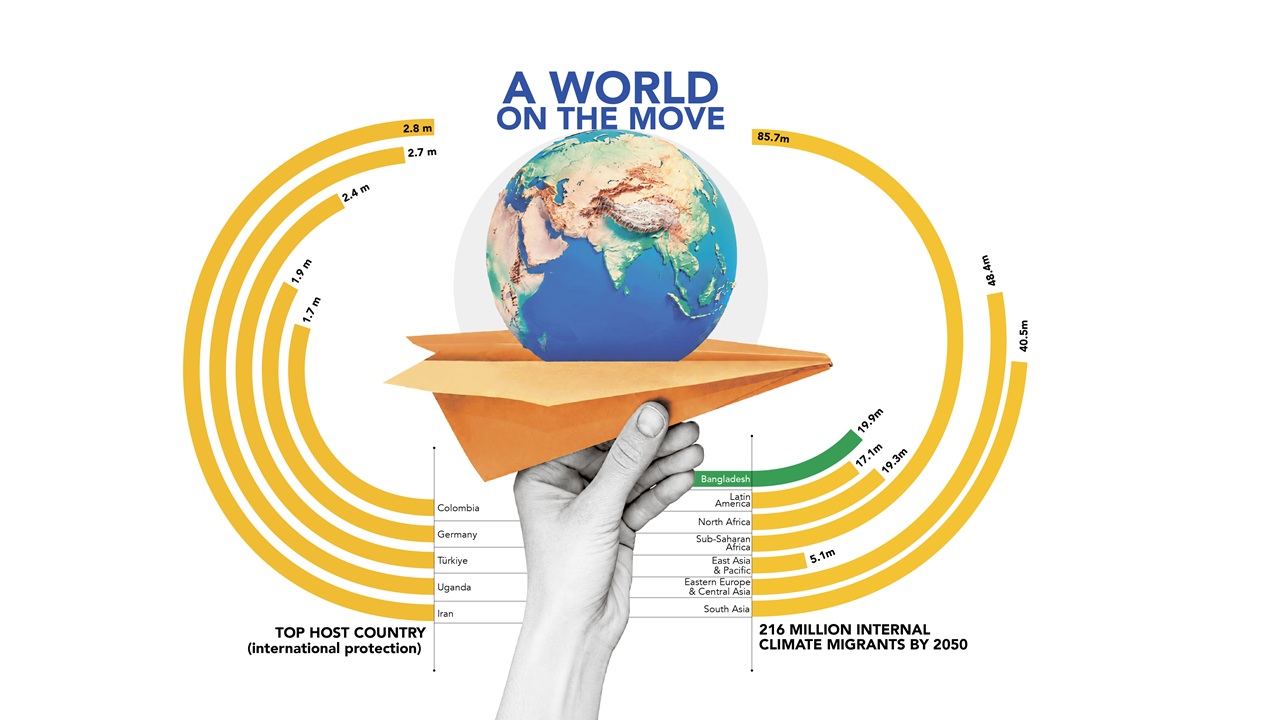
The largest refugee and other international-protection populations are concentrated among people from just a handful of countries: Venezuela, Ukraine, Syria, Afghanistan, Sudan. Together, they account for a huge share of people requiring international protection.

Their circumstances are different, but the question at the centre is often the same: How much can a person endure before leaving becomes the only option?
War answers that question brutally, so does persecution and hunger. So does the collapse of a place that once felt permanent. Yet there is another side of the migration story that is easy to overlook. Most migrants are not living in refugee camps. They are working, studying, raising families and trying to build lives somewhere other than where they were born.
The United States is home to around 52.4 million international migrants, more than any other country. Germany follows with 16.8 million, while Saudi Arabia, the United Kingdom and France also host millions.
These numbers tell a story about opportunity as much as displacement. People move because labour markets move. Sometimes the most practical way to support a family is to leave that family for a while. This contradiction is one of migration’s quietest tragedies.
A person can leave home precisely because they love the people at home. Every month, somewhere in the world, a migrant sends money back. It might pay for groceries, school fees, roofs, medical bills, a younger sibling’s university education, a piece of land and a future.
Now another force is beginning to reshape where people can live: climate change. The first signs may be subtle. A river that reaches farther into a village than it used to, a storm that arrives stronger, a coastline slowly disappearing. Families move inland, then again and again. Eventually, movement becomes adaptation.
The World Bank projects that climate change could generate up to 216 million internal climate migrants by 2050 across six regions. South Asia alone could account for as many as 40.5 million under the modelled scenario.
For Bangladesh, the projection is particularly striking: up to 19.9 million internal climate migrants by 2050, as rising seas, river erosion and extreme weather redraw the map of where life remains possible.
Then there are the journeys where even arrival is uncertain. In 2025, at least 7,667 migrants died or went missing on migration routes worldwide, according to the International Organization for Migration (IOM). The routes are different: the Mediterranean, the Atlantic toward the Canary Islands, the Horn of Africa towards Yemen and the Gulf, the Darién Gap and the wider migration routes through the Americas and across Asia.
The reasons for travelling them vary, so do the dangers. But the end can be the same. It could be a journey that ends without a body, a funeral or an answer. The statistics record the dead and missing. They cannot record the silence left behind. Perhaps that is the hardest thing about migration to understand from a distance.
We like to imagine movement as a line, like Point A to Point B. But real migration is rarely that simple.
People leave and return. They send money home. Some bring children over; some become citizens somewhere else while remaining emotionally tied to places they left decades earlier. Some never intended to stay but do, while some intended to stay but are forced to leave. Some spend years trying to reach a place that will accept them, and some spend the rest of their lives wondering whether they made the right decision.
Migration is sometimes called a crisis, sometimes an opportunity. Sometimes it is treated as a political problem, an economic necessity or a humanitarian emergency. It is all of these things.
But before it becomes a statistic, migration is a deeply human decision. War pushes people out. Work pulls them elsewhere. Money travels back. Climate changes the places people call home. And when safe routes disappear, desperation creates dangerous ones.
That is the real story behind the world’s movement. Not millions of arrows crossing borders. Not numbers rising and falling on a chart. But people carrying pieces of one home into another, trying to preserve belonging even as the ground beneath it keeps changing. The great migration is not simply about leaving. It is about the enduring hope that somewhere, beyond the journey, home can be rebuilt.