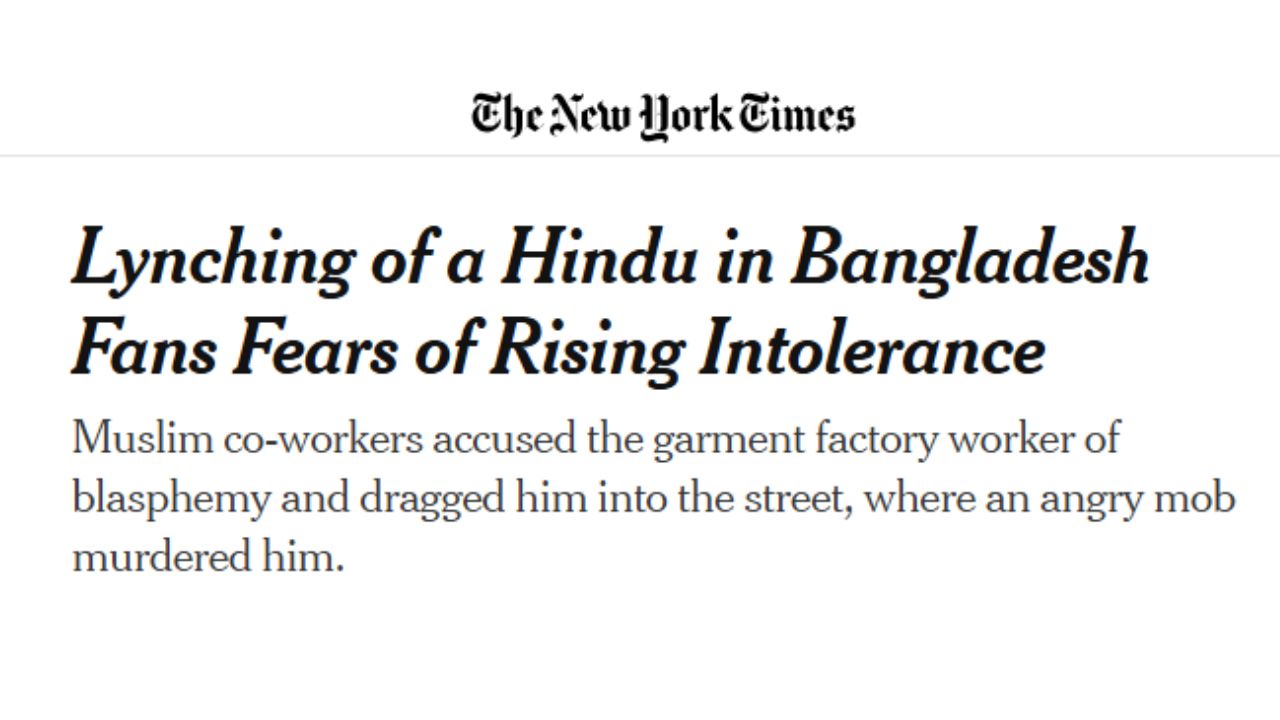



The killing of garment worker Dipu Chandra Das over false allegations of hurting religious sentiments has raised fears of growing religious intolerance in Bangladesh, according to a report in The New York Times.
The report was jointly prepared by Bangladesh correspondent Saif Hasnat and South Asia bureau chief Mujib Mashal.
Dipu, 27, was an employee of a garment factory in Mymensingh, where he worked 12-hour shifts inspecting production of trousers and shirts for international high-street brands.
According to accounts from colleagues and police, the violence erupted on Thursday following a discussion at the factory floor. After Dipu made a remark during a debate near an inspection table, several Muslim co-workers accused him of blasphemy, the report said.
He was forcibly dragged out of the factory and into the street as rumours spread that he had made derogatory comments about Islam’s Prophet Hazrat Muhammad (PBUH). An angry crowd quickly gathered and lynched him, later tying his body to a tree and setting it on fire.

By Monday, law enforcement agencies had detained 12 people including two of Dipu’s colleagues in connection with the killing.
Police said no evidence was found to prove that Dipu had made derogatory remarks about religion. Work is ongoing to determine the motive behind the murder and to arrest others involved.
The savage nature of the murder has sent shockwaves through the country, coming at a time when Bangladesh is witnessing sporadic outbreaks of mob violence and unrest. Analysts and rights activists point to a leadership vacuum that emerged after the fall of former prime minister Sheikh Hasina, who was ousted in student-led protests and fled to India in August 2024.




Security forces have struggled to maintain order in several areas, while human rights organisations warn that extremist groups are exploiting the fragile situation, particularly ahead of the 13th national election scheduled for February 2026. Religious minorities, they say, are increasingly vulnerable.
The killing has also drawn attention beyond Bangladesh’s borders. In neighbouring India, the government of Prime Minister Narendra Modi has repeatedly voiced concern over the safety of Hindus in Bangladesh.
However, observers note that the incident reflects a broader regional pattern of religious intolerance across South Asia.
In Pakistan, rising “Islamist militancy” has frequently seen blasphemy allegations result in mob lynchings. In Afghanistan, much of the already small Sikh and Hindu population fled following deadly attacks even before the Taliban returned to power.
In India, Hindu vigilante groups have targeted Muslims and other minorities, often over accusations related to beef consumption. In a recent case, a migrant labourer in southern India was lynched last week after police said a mob mistakenly believed him to be Bangladeshi. The victim, Ram Narayan Baghel, 31, belonged to one of the lowest tiers of India’s caste system, according to the report.
In Bangladesh, the period following ousted Sheikh Hasina saw reports of killings and arson attacks targeting Hindus and other minorities, adding to fears of growing communal violence.
The interim government, headed by Nobel Laureate Muhammad Yunus has condemned the recent unrest, describing it as part of a broader security challenge rather than violence aimed at any specific community. Nevertheless, the murder of Dipu appeared to be openly celebrated by some individuals, the report adds.
Mymensingh RAB‑14 Commander Naimul Hasan said the factory manager and a floor supervisor were among those arrested. “Why didn’t they hand him over to the police, or why didn’t they take any measure to save him?” he said, questioning the role of factory authorities during the incident.
Selim Mia, a co-worker of Dipu, told The New York Times that the confrontation stemmed from a religious discussion toward the end of the Thursday shift. He said some workers had remarked that, ahead of Friday prayers, it was the best time to repent for the week’s mistakes.
Dipu responded by saying the emphasis on the day sounded like superstition. When colleagues raised superstitions linked to his own faith, he replied that all religions contained superstitions.
Victim’s brother, Opu Chandra Das, said the family received a call from a colleague around 7pm, urging them to come quickly as his brother was in trouble. “But around 8pm or 8:30pm, they called again to say my brother was no more,” he said.
He described Dipu as a college graduate who married three years ago and was the father of a toddler daughter. He visited their village home, about 40 miles from the factory, roughly once a month.