Electric vehicle (EV) adoption in Bangladesh remains slow despite government tax and duty incentives, with unreliable electricity supply and inadequate charging infrastructure continuing to hold back the sector, the Dhaka Chamber of Commerce & Industry (DCCI) said on Saturday.
Speaking at a seminar on the challenges and prospects of EVs, DCCI President Taskeen Ahmed urged the government to adopt a comprehensive national EV policy, expand charging infrastructure through public-private partnerships (PPPs) and strengthen incentives for private investment.
Bangladesh has nearly 6 million three-wheelers in operation, but only 669 electric cars have been registered with the Bangladesh Road Transport Authority (BRTA), he said. Reliable power supply, advanced battery management systems and a coordinated long-term policy framework are also needed to accelerate EV adoption.
Bangladesh Energy and Power Research Council Chairman (Senior Secretary) Mohammad Wahid Hossain said uninterrupted electricity supply would determine the success of the EV industry. He also called for stronger public-private collaboration, greater use of renewable energy and a dedicated inter-agency cell to coordinate EV policy and develop a reliable EV database.

Industries Secretary Abdun Naser Khan said a draft national EV policy had completed inter-ministerial and stakeholder consultations. The policy aims to reduce dependence on imported fossil fuels and strengthen energy security, he said, adding that the final version would reflect stakeholders’ recommendations.
Ministry of Commerce Additional Secretary (IIT) Shibir Bicitro Barua said the number of EVs operating in Bangladesh was significantly higher than official BRTA data suggested. He said accurate data was essential for policymaking and that the ministry was working with the National Board of Revenue (NBR) to remove tariff and non-tariff barriers facing the sector.



Sustainable and Renewable Energy Development Authority (SREDA) Director Md Aminur Rahman said the authority had approved 32 EV charging stations, nine of which have already been established. He stressed the need for quality standards for charging stations and imported EVs.
Bangladesh Power Development Board (BPDB) Chief Engineer Md Mofijul Islam said the lack of registration for battery-operated vehicles prevented the government from accurately assessing the sector’s electricity consumption, while substandard batteries were causing significant power losses.
Bangladesh Sustainable and Renewable Energy Association (BSREA) President Mostafa Al Mahmud said Bangladesh spends about Tk65,000 crore a year on transport fuel, most of it imported. Wider EV adoption would reduce fuel imports and ease pressure on foreign exchange reserves.
Bangladesh University of Engineering and Technology Professor Md Ehsan said electric three-wheelers had already reduced diesel imports by about 1.5 million tonnes annually, easing pressure on government expenditure and foreign exchange. Bangladesh Automobiles Assemblers and Manufacturers Association (BAAMA) President and Runner Automobiles PLC Chairman Hafizur Rahman Khan said the EV industry could create jobs and boost exports through local component manufacturing.
Infrastructure Development Company Limited Vice President Tanvir Ebne Bashar called for faster expansion of charging infrastructure, simpler import procedures and long-term financing, while Akij Motors CEO Sk Amin Uddin said EVs could cut fuel costs by about 30 per cent.
During the discussion, Bangladesh Reconditioned Vehicles Importers and Dealers Association President Abdul Haque called for local manufacturing of electric three-wheelers and EV components, while former DCCI Vice President M Abu Hurairah urged a comprehensive implementation plan before introducing the proposed 2,000 electric buses in Dhaka.
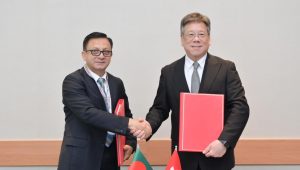
Following the seminar, DCCI and BSREA signed a memorandum of understanding (MoU) to collaborate on energy policy, innovation and market development. DCCI Acting Secretary General AKM Asaduzzaman Patwary and BSREA General Secretary Engr Mohammad Ataur Rahman Sarker signed the agreement on behalf of their respective organisations.