


As the afternoon wore on, meat seller Togor Mia sat at his shop in Kawran Bazar, waiting for customers.
“People who used to eat meat at least once a week now eat it once a month. I used to sell three cows a day. Now I cannot even sell one,” he said.
Falling sales have reduced his income and, in turn, his spending capacity.
“When sales are good, I can buy something extra for my family. Now that my income has fallen, I have stopped making additional purchases,” Togor said.
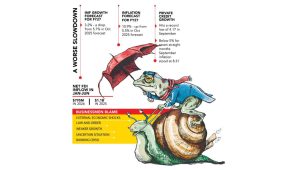
The impact of consumer spending cuts amid four years of high inflation is being felt across the economy, affecting businesses and the people who depend on them.
Sales are declining in restaurants, clothing, furniture and cosmetics, as well as mobile phones and electronic goods. Resort operators are also reporting a downturn. As businesses struggle, the incomes of people connected with them are falling too.
Economists say that when everyone cuts spending, less money circulates in the market, reducing other people’s incomes in turn.
Fahmida Khatun, distinguished fellow at the Centre for Policy Dialogue (CPD), explained the cycle, “When prices rise, people’s real incomes fall. As a large share of their income goes towards essential expenses such as food, rent, transport and healthcare, they cut back on clothing, household goods and other non-essential purchases.”
“This reduces shop sales and business owners’ incomes. Businesses then become cautious about buying new products, investing or recruiting workers. As a result, market demand and employment weaken further. This creates a cycle in which lower consumer spending leads to lower sellers’ incomes,” she said.
Businesspeople also blame high import duties and VAT, saying these push up the prices of imported goods. But with wage growth below inflation, people already under financial pressure cannot afford the higher prices. Businesses are also cutting investment because they fear lower demand will leave their products unsold.

Economist M Masrur Reaz told TIMES, “Our economy has slowed down, and investors have lost confidence in investing. If demand for products among consumers can be increased, the supply of goods will rise, encouraging investors to increase investment.”
Falling sales, businesses closing
Abul Hossain, manager of Allah’r Dan Hotel, a food outlet in Banglamotor, told TIMES, “What used to cost Tk15,000 to buy from the market now costs Tk22,000. But as we cannot raise food prices accordingly, our profits have fallen.”
The manager of a fast-food shop in New Eskaton said the price of a pastry had risen from Tk80 to Tk125. The price of each sweet had also increased by Tk20 to Tk30. Higher prices have driven customers away, reducing sales and income.
A 2021 survey by the Bangladesh Bureau of Statistics (BBS) identified 436,274 hotels and restaurants across the country, 58 per cent more than in the 2009–10 financial year. The sector employed 2.072 million people, compared with around 900,000 a decade earlier. Workers received a total of Tk31,429 crore in wages in 2021.
According to the Bangladesh Restaurant Owners Association, sales at hotels and restaurants have fallen by around 30-40 per cent over the past two to two and a half years.
Imran Hasan, secretary general of the Hotel Restaurant Owners Association, told TIMES, “We were hit hard during Covid. Afterwards, we tried to recover, but the situation has not improved. Everything has become so expensive that we can no longer cope.”
As hotel and restaurant sales decline, businesses are cutting purchases, leaving their suppliers struggling as well. The businesses and producers supplying those intermediaries are also seeing their sales fall.



Fruit sellers say some customers are buying one fruit instead of two, while others walk away without buying anything after hearing the prices.
Raju, a fruit seller on Sonargaon Road, said, “I used to sell a truckload in four days. Now it takes a week to sell the same amount. It has become difficult to cover daily expenses this way.”
Customer Abdul Alim said, “I bought half a kilogram of apples because they are absolutely necessary. I cannot afford to buy more for now.”
According to National Board of Revenue (NBR) data, the country imported 538,000 tonnes of fruit in 2025 and 412,000 tonnes up to September this year.
Fruit imports stood at 809,796 tonnes in the 2021–22 financial year. Imports have declined steadily since then, while high inflation also began during this period.
According to the Bangladesh Fresh Fruits Importers Association (BFFIA), 30 per cent of people have left the business over the past two years.
Nuruuddin Ahmed, general secretary of the association, said, “Fruit imports are subject to 122 per cent tax. As a result, fruit has become a luxury product.”
Fish sellers are also reporting fewer customers. Asadul Islam, a seller at Kawran Bazar, said, “People come, look and leave.”
Grocery shop owners say customers are now carefully calculating their expenses before buying essential goods.
The rising cost of essentials is also affecting the clothing and fashion accessories markets.
Jalal Ahmed sells trousers and shirts at Bashundhara City Shopping Complex. On some days, he opens his shop in the morning but makes no sales by the afternoon. Standing in front of his empty shop, he told TIMES, “Business is not doing well. People have no money in their pockets. Even when customers come, they ask the price and leave.”
According to the Fashion Entrepreneurs Association of Bangladesh (FEAB), sales of festival-related clothing have fallen by 10–15 per cent, while sales during ordinary periods have declined by 40–50 per cent.
Soumik Das, a former vice-president of the association, said, “People are no longer buying clothes unless they need them.”
Almas Alam, a cosmetics retailer at a shopping centre, said, “We no longer see customers who used to make large purchases as frequently as before.”
Mohammad Zahirul Islam, president of the Bangladesh Cosmetics and Toiletries Importers Association (BCTIA), told TIMES, “The government has created a system that seems designed to tie our hands and feet. If we import lotion for Tk300, the cost rises to Tk900 after taxes, VAT and transport. We have to sell it for at least Tk1,000. A customer who could previously afford it for Tk400 can no longer pay Tk1,000 because their purchasing power has not increased.”

A manager at Vista Furniture, a furniture shop in Panthapath, said, “Running the shop costs at least Tk20,000 a day. Yet on some days, we make no sales at all.”
Resort operators say rising prices are forcing ordinary people to cut spending on leisure and entertainment.
Ahsan, manager of Chhuti Resort in Purbachal, said, “People no longer visit us as they used to. Our costs are rising, but we cannot increase our charges. If we do, attracting tourists will become even more difficult.”
Expenditure exceeds income
Average monthly household expenditure in Bangladesh now exceeds average income. According to the Bangladesh Bureau of Statistics’ (BBS) “Living Standard Survey 2025”, household expenditure is Tk1,798 higher than monthly income.
Average monthly household income stands at Tk33,513, against expenditure of Tk35,311.
People in rural areas are also struggling, despite their relatively lower expenditure. The rate of borrowing to meet basic living costs is higher in rural areas. The survey found that 47 per cent of households had borrowed money over the past year to meet essential expenses. The proportion was 40 per cent in urban areas and 52 per cent in rural areas.
Three years earlier, however, average household expenditure was lower than income. According to the 2022 survey, average monthly household income was Tk32,422, while expenditure stood at Tk31,500.
Compared with 2022, average monthly income rose by Tk1,091 in 2025, while expenditure increased by Tk3,811.
Expenditure has risen further in 2026. Official figures show inflation stood at 8.34 per cent in September, while wage growth was 7.9 per cent.
Since Russia invaded Ukraine in February 2022, inflation has remained above wage growth for more than four consecutive years.
Asked what should be done, Khandaker Golam Moazzem, president of Knowledge Hub Institute Trust, said, “People’s purchasing power will not recover unless inflation comes down, and they will not be able to buy goods. To reduce inflation, the government needs to cut investment while increasing revenue collection so that it can reduce borrowing.”
He warned that the private sector would not become investment-oriented unless macroeconomic stability was restored.
Fahmida Khatun recommended, “The incomes, employment opportunities and social protection of low- and middle-income people must be increased.”
She also said affordable loans and policy support for small businesses would help keep their operations running.