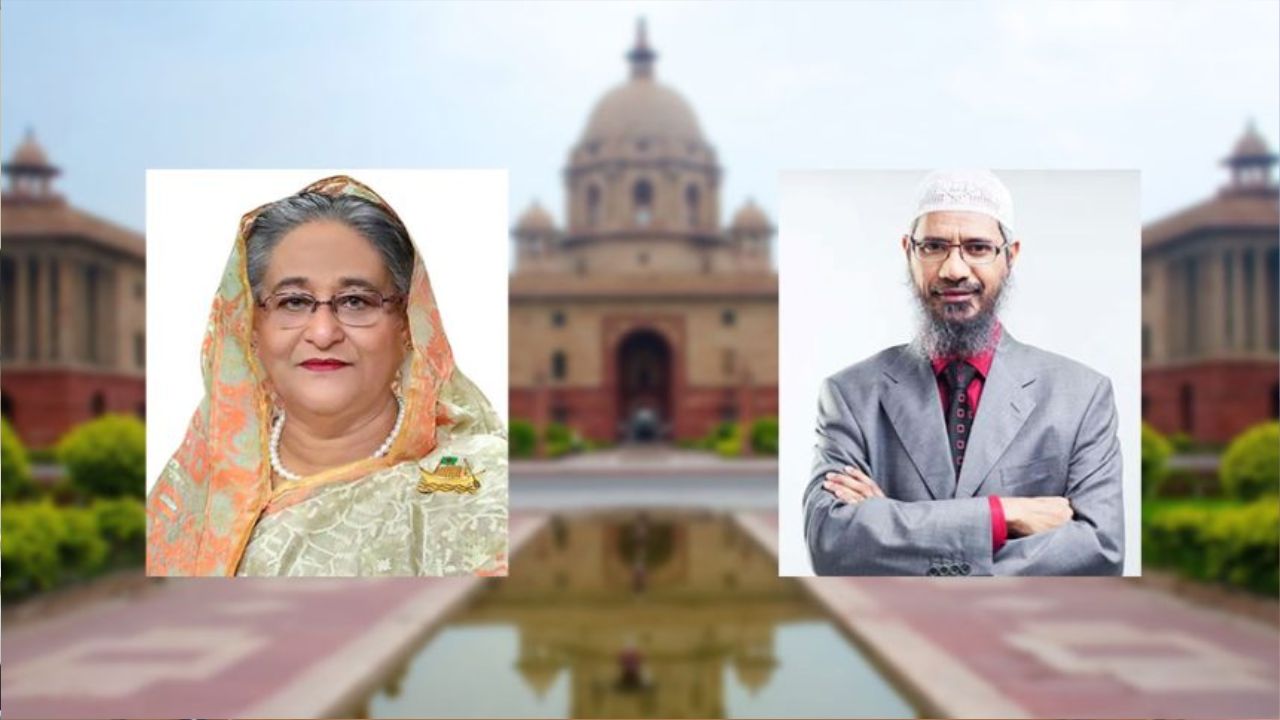



A diplomatic irony unfolds as India calls on Bangladesh to take action against Islamic preacher Zakir Naik should he arrive in Dhaka later this month. The India call has triggered a wave of incredulity across Bangladesh.
At a weekly briefing at the Indian Ministry of External Affairs on Thursday, a journalist, citing media reports, asked if there was any proposal from India to request the Bangladesh government to hand him over to New Delhi. In response, Randhir Jaiswal, the spokesperson for the ministry said, “Well, he (Zakir Naik) is a fugitive. He is wanted in India. So, we expect that wherever he goes, those people will take due action against him and meet our security concerns.”
The comment, apparently routine, has set off a storm in Bangladesh. It comes at a time when India itself is accused of giving refuge to Sheikh Hasina, Bangladesh’s ousted prime minister, now facing grave human rights charges at home. The contrast has not gone unnoticed.
Shelter for one fugitive, pressure for another
Hasina, who fled to India following the July 2024 mass uprising that toppled her government, has been charged with crimes against humanity, including extrajudicial killings and enforced disappearances. A UN fact-finding mission attributes at least 1,400 deaths to her administration’s violent suppression of protesters during the unrest.
Despite an existing extradition treaty, India has neither responded to nor acted on Dhaka’s formal request, sent in December last year, to return Hasina to face trial.
Yet, New Delhi now expects Dhaka to cooperate swiftly if Zakir Naik — an Indian citizen wanted on charges of money laundering and alleged hate speech — sets foot in Bangladesh. To many Bangladeshis, this contrast reeks of hypocrisy.

Not only Bangladeshis. Foreign diplomats also chipped in on the issue privately and publicly.
“You really can’t make this stuff up. Is India really expecting Bangladesh to cooperate in returning a fugitive while it rolled out the red carpet for scores of fugitive members of the Awami League, including Sheikh Hasina?” Jon Danilowicz, a seasoned diplomat who was deputy chief of US Embassy in Dhaka said in a post on X, formerly Twitter.
Who is Zakir Naik?
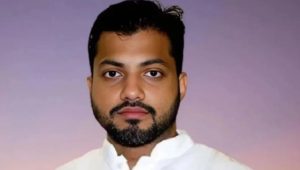
The 60-year-old Islamic preacher gained prominence in the 2000s through his TV channel, Peace TV, which broadcast his lectures across the Muslim world. Critics accused him of promoting intolerance; supporters hailed him as a defender of Islam against Western bias.
In 2016, India’s Hindu nationalist government banned Peace TV, filed multiple criminal cases, and accused Naik of spreading hate speech.




Facing arrest, he relocated to Malaysia, where he was granted permanent residency. Since then, he has refused to return to India, saying he would only do so “when justice is guaranteed.”
Ironically, the now-ousted Hasina government — known for its close ties with New Delhi — banned Naik’s entry into Bangladesh after reports emerged that at least two of the militants involved in the Dhaka Holey Artisan attack were allegedly “inspired” by his speeches. With her fall, that restriction appears to have quietly lapsed, allowing speculation about his possible visit to resurface.
Public backlash in Dhaka
The Indian foreign ministry’s remarks have provoked sharp reactions among Bangladeshis. Social media platforms have been flooded with posts denouncing what users call India’s “colonial attitude” and “selective morality”.
India never misses a chance to meddle in Bangladesh’s affairs. But when Dhaka asks for accountability for someone accused of mass killings, New Delhi turns its back.
Unequal partnership
For years, Bangladesh’s relationship with India has been marked by asymmetry. While Dhaka has refrained from commenting on India’s internal matters — including its treatment of minorities and controversial citizenship laws — Indian officials routinely weigh in on Bangladesh’s domestic issues, from election integrity to communal tensions.
It is not uncommon for Indian diplomats in Dhaka to visit incident sites, meet local communities, and even make public statements — actions that would be unthinkable for Bangladeshi envoys in India.
This perceived imbalance has bred resentment. Analysts say India’s “big brother” posture, tolerated under the pro-Delhi Awami League government, is increasingly out of place in post-Hasina Bangladesh, where nationalist sentiment is resurgent.
Reciprocity — or the lack of it
Diplomacy is built on reciprocity, but the Naik-Hasina episode has underscored how one-sided India-Bangladesh relations have become. Bangladesh, despite being the smaller neighbour, has consistently delivered on India’s security and trade concerns — from cracking down on northeastern insurgents to granting transit access — often at the cost of domestic political backlash.
In return, Dhaka’s long-pending requests on water sharing, border killings, and now extradition of fugitives have languished.
The relationship has always been heavily tilted in India’s favour. The problem is not just political imbalance but a deep lack of mutual respect.
The road ahead
For New Delhi, pressing Dhaka to act against Zakir Naik while shielding Sheikh Hasina risks reinforcing an image of arrogance and selective morality — precisely the perception that has eroded India’s soft power in the region in recent years.
Bangladesh’s new leadership, keen to assert sovereignty after Hasina’s fall, is unlikely to comply with demands it sees as unjust or hypocritical.
If India genuinely seeks a stable and mutually beneficial partnership, it will need to treat Bangladesh as an equal partner — not a client state. Respect, not pressure, is the currency that will sustain the relationship.
Otherwise, as many in Dhaka now warn, the “special relationship” between the two neighbours may continue to deteriorate — and this time, it won’t be Bangladesh that loses the most.