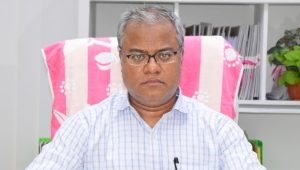
BNP Senior Joint Secretary General and Political Advisor to the Prime Minister, Ruhul Kabir Rizvi, has expressed objection to bringing small grocery stores under the VAT net, citing their extremely limited income.
Speaking at a press conference at the BNP’s central office in Nayapaltan, Rizvi said the government should instead focus on bringing individuals and businesses with the capacity to pay taxes, but who remain outside the tax net, under the taxation system.
“The income of small grocery shops is very limited. It would not be appropriate to impose VAT on them,” he said.
Commenting on the country’s economic situation, Rizvi said the government must adopt measures to protect the livelihoods of ordinary people, particularly the poor and low-income groups.

He said the current administration is accountable to the people and would govern by giving priority to their welfare, expectations and concerns.
Rizvi also claimed that the BNP, during its previous tenure in office, had not adopted policies that caused significant hardship to the public. Despite what he described as repeated conspiracies against the party, its popularity remained intact, he added.
Referring to Prime Minister Tarique Rahman’s ongoing visit to China, Rizvi expressed hope that it would further strengthen Bangladesh’s economic and strategic partnership with Beijing.



He said China has substantial investments in Bangladesh’s industrial, infrastructure and service sectors, while bilateral trade between the two countries stands at around $18 billion.
According to Rizvi, the visit would contribute to Bangladesh’s economic development and deepen the long-standing friendship between the two countries.
He also said world leaders attending the World Economic Forum meeting in China had praised Tarique Rahman’s experience and policy initiatives, particularly his remarks on climate change and Bangladesh’s efforts to address the issue.
Rizvi noted that tax incentives for renewable energy, especially solar power generation, form an important part of the government’s strategy to combat climate change. He said the government has set a target of generating around 20 per cent of the country’s electricity from solar power by 2030.
On foreign policy, Rizvi said China follows a policy of non-interference in the internal affairs of other countries and claimed Bangladesh was now pursuing a more balanced and multidimensional foreign policy.
He said the policy, first introduced by late president Ziaur Rahman and now being followed by Prime Minister Tarique Rahman, seeks to safeguard Bangladesh’s independence and sovereignty while maintaining constructive relations with all partners.
Rizvi also criticised the reported renaming of a road in Kolkata that had been named after Hussain Shaheed Suhrawardy, describing the move as “distasteful”.
He said Suhrawardy, the last prime minister of undivided Bengal and one of the founding leaders of the Awami League as well as the political mentor of Sheikh Mujibur Rahman, deserved greater respect.
Rizvi questioned the silence of the Awami League and its intellectual supporters over the issue, adding that Bangladesh continues to maintain institutions named after several Indian leaders as a reflection of mutual respect and goodwill.