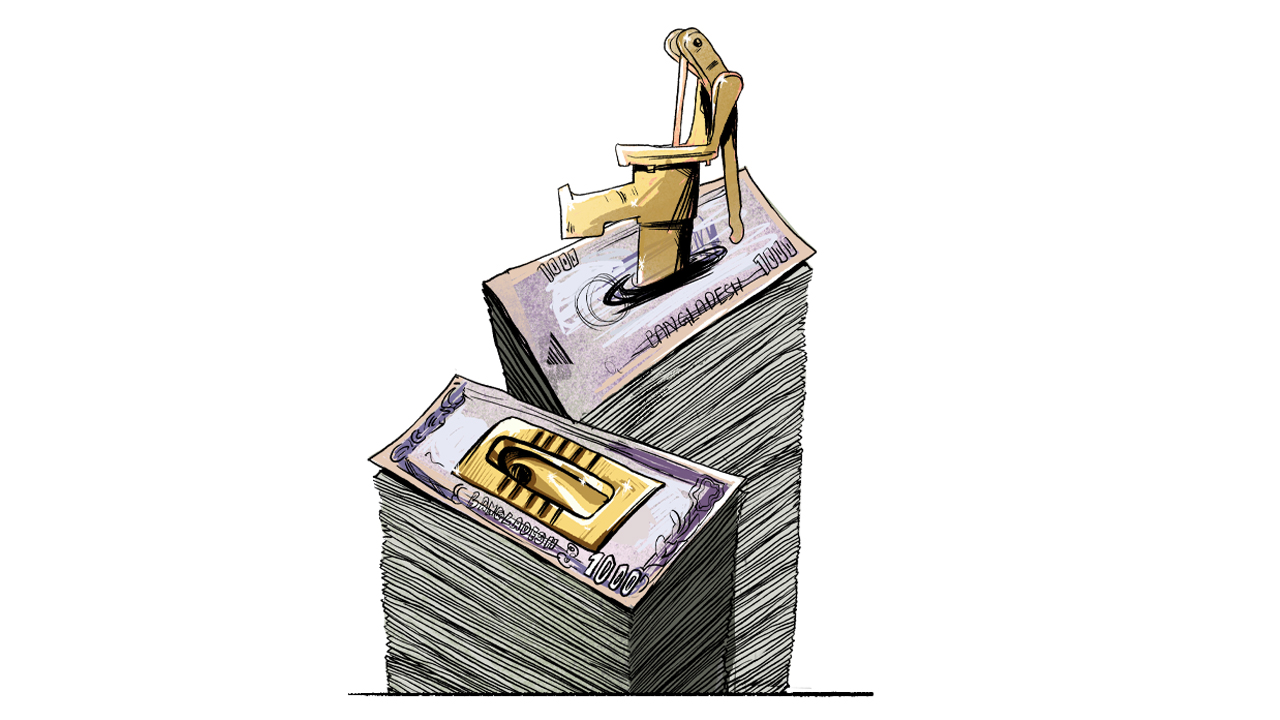



The Planning Commission’s veto of a Tk120-crore project in Bogura has ruffled political feathers in a climate plagued by inflated budgets and financial sleight of hand, blocking this inflated scheme sends a sharp, unmistakable warning.
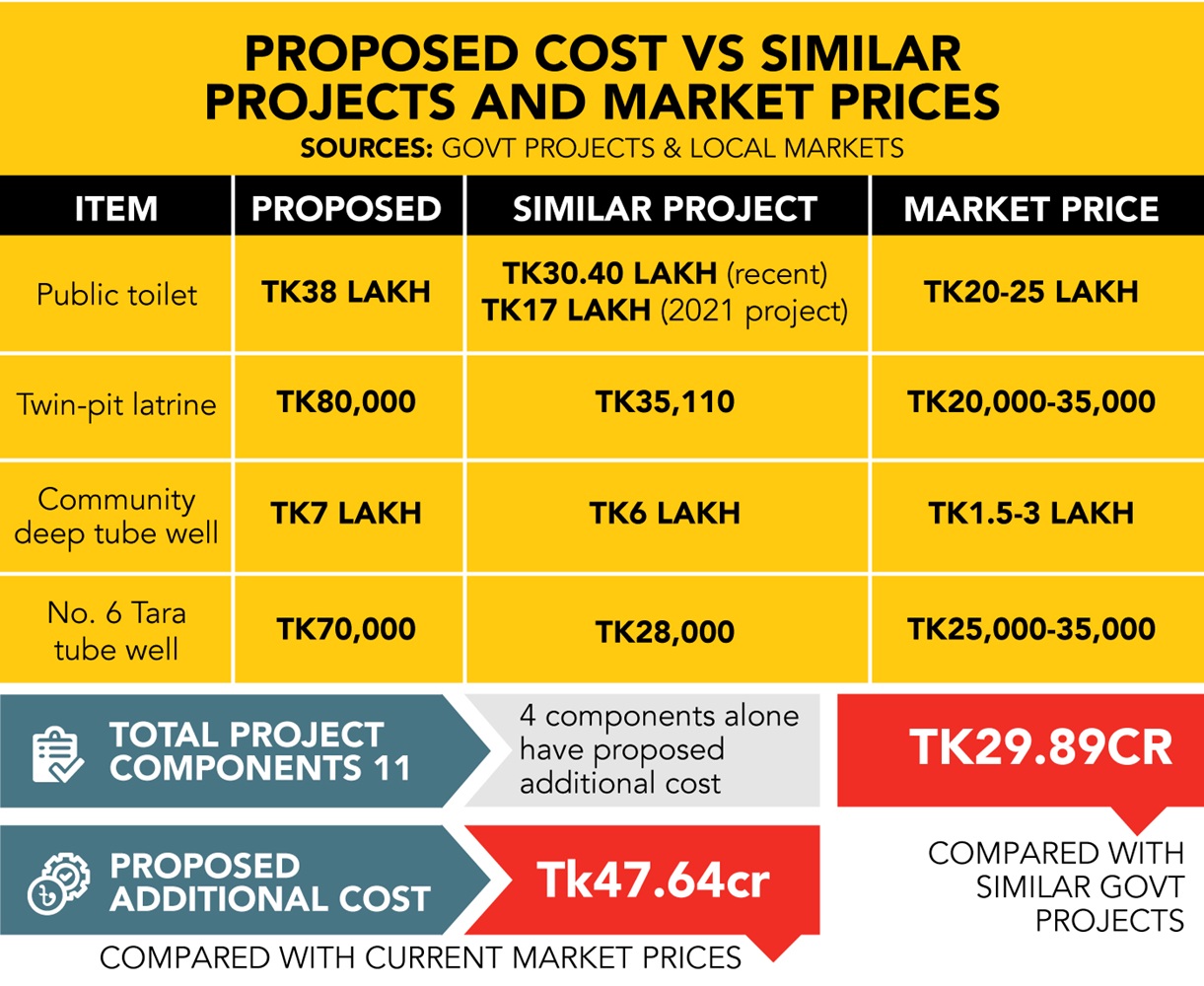
Of the project’s 11 components, just four alone accounted for proposed excess spending of nearly Tk29.89 crore compared with similar government projects and almost Tk47.64 crore above market prices.
What makes this proposal particularly noteworthy is its political backdrop.
Tailored specifically for Bogura, the home district of Prime Minister Tarique Rahman, the initiative was spearheaded by the Department of Public Health Engineering under the Ministry of Local Government, Rural Development and Cooperatives, itself led by State Minister Mir Shahe Alam, another proud Bogura native.
On paper, the Tk120.49 crore proposal titled “Integrated Water Supply and Sanitation Infrastructure Development in Bogura District” had a noble objective: securing safe water for the region until 2050.
However, once Planning Commission officials cracked open the ledger, the numbers simply failed to add up, revealing a masterclass in hyper-inflated budgeting.
The project proposed spending an astonishing Tk38 lakh to build a single public toilet at the district and upazila levels.
To put that in perspective, even recent flood-relief projects allocated Tk30.40 lakh for similar facilities, while standard government allocations just five years ago sat at Tk17 lakh.

The inflated estimates extended down to the most basic facilities.
A standard twin-pit latrine, typically constructed with simple dug pits and concrete rings, was pegged at Tk80,000, despite identical units costing between Tk20,000 and Tk35,000 on the open market and being capped at Tk35,110 in other government projects.
In effect, the Bogura proposal tacked on an extra, unexplained Tk45,000 per latrine. Standard “Tara” tube wells faced a similar markup, budgeted at Tk70,000 each compared to the national average of Tk28,000, creating an arbitrary Tk42,000 cushion per well.
Ground conditions further exposed the absurdity of these figures.
Calculations show that drilling, piping, pump heads, and platforms in Bogura’s soft, flat soil should cost no more than Tk25,000 to Tk30,000, or Tk35,000 at most in the tougher terrain of the Barind region.
Community tube wells were similarly overbudgeted at Tk7 lakh against the standard Tk6 lakh allocation seen elsewhere.


Given that a deep-bore, 400-foot submersible well costs roughly Tk1.5 lakh to install and rarely exceeds Tk2.5 lakh even in hard soil, the proposal left a glaring question as to how the remaining hundreds of thousands of taka per unit were meant to be spent.
Thanks to the Planning Commission’s intervention, this exercise in creative accounting has, for now, been firmly put on ice.
Similar discrepancies plagued the estimates for deep and shallow tube wells fitted with submersible pumps and water tanks.
In flat terrain, a complete setup, comprising a 1,000-litre tank, pump, and wiring, typically costs between Tk45,000 and Tk60,000, yet the Bogura project proposal ballooned those figures to somewhere between Tk1.10 lakh and Tk1.70 lakh.
Compounding these inflated figures was a glaring procedural omission: the complete absence of a feasibility study. Standard government policy strictly mandates technical, financial, and social feasibility assessments for any venture exceeding Tk50 crore, yet this Tk120 crore proposal was dispatched straight to the Planning Commission without one.
A closer examination of the documentation reveals that just four of the project’s 11 components accounted for an extraordinary amount of padding.
Across these four items alone, the proposed budget was Tk29.89 crore higher than comparable government ventures and a staggering Tk47.64 crore above fair market value. For instance, building 12 public toilets in Bogura was priced at Tk4.56 crore, marking a Tk91.20 lakh markup over similar state builds.
Installing 669 community tube wells was allocated Tk46.63 crore, despite market rates sitting closer to Tk20.07 crore, representing a Tk6.49 crore premium over benchmark government projects.
The installation of 2,725 twin-pit latrines was tagged at Tk21.90 crore, Tk12.33 crore higher than precedent, while 2,180 Tara 6 shallow tube wells carried an extra Tk9.15 crore in excess costs.
In total, these four line items alone sought an extra Tk29.89 crore over standard state allocations, or nearly Tk47.64 crore above real-market prices.
DPHE defends cost estimates
Faced with these figures, officials at the Department of Public Health Engineering (DPHE) were quick to offer defenses. DPHE Executive Engineer Fahim Hasan Siraji argued that precise drilling depths could not be predicted in advance, explaining that the proposal assumed a maximum depth of 1,000 feet, with actual costs to be settled during execution.
However, history suggests otherwise: past projects demonstrate that contractors routinely claim full payment for 1,000-foot drillings despite carrying out far shallower work. Defending the Tk80,000 latrine price tag, Siraji pointed out that earlier Tk35,000 units used corrugated tin, whereas the new design specified brick structures.
He added that 2019 pricing schedules were obsolete, with a new 2026 schedule currently in development, remarking casually that the budget was inflated slightly in the hope that the Planning Commission might simply pass it.
Meanwhile, the Ministry of Local Government, Rural Development and Cooperatives attempted to distance itself from the controversy. Local Government Division Deputy Secretary Mohammad Ashraful Afsar noted that the ministry does not set costs directly, relying entirely on the estimates provided by engineering teams.
However, the Planning Commission remains unimpressed by these justifications. Md Haider Ali, Joint Chief of the Physical Infrastructure Division, made it clear that there is zero leeway to bypass approved government rate schedules and that a complete overhaul of the project is non-negotiable.
Echoing that firm stance, Deputy Chief Debottam Sanyal stressed that unless genuine, rock-solid justifications for these inflated sums are brought to the table, the proposal will go nowhere.
TIB warns of political fallout
Adding further weight to the controversy, Transparency International Bangladesh (TIB) has issued a sharp warning over the potential political fallout.
TIB Executive Director Iftekharuzzaman cautioned that, had the project been approved in its original form, it would have eclipsed even the notorious “Rooppur pillow procurement scandal”, where a single pillow at a nuclear power plant housing complex was billed at Tk5,958 alongside a Tk760 delivery fee.
He alleged that the Bogura proposal mirrored the exact playbooks of inflated budgeting and systematic squandering of public funds that defined the Awami League’s tenure, practices that ultimately fuelled the mass uprising that brought down the previous regime.
Dr Iftekhar warned that if the BNP government permits such blatant pork-barrel politics to continue in the strongholds of its key figures, it risks handing its political rivals potent ammunition and courting severe political backlash.
Critics contend that by greenlighting Tk38 lakh public toilets and Tk70,000 tube wells, the administration would have unwittingly birthed its very own political liability: a fresh “toilet scandal” that threatens to derail public trust before the project even breaks ground.