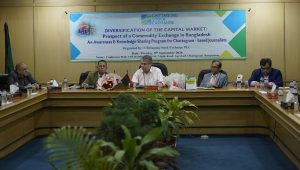
Bangladesh’s rooftop solar expansion remains heavily concentrated in Dhaka, even as policymakers explore ways to replicate Pakistan’s rapid consumer-led solar growth, speakers said at a Centre for Policy Dialogue (CPD) event on Tuesday.
Around 60 per cent of the country’s 4,500 net-metered rooftop solar installations are located in the capital, while total installed rooftop solar capacity stands at only about 200MW, according to a presentation at the dialogue, titled “Solar Revolution in Pakistan: Lessons for Bangladesh from National Budget Perspective.”
Presenting Bangladesh’s current rooftop solar status, CPD Research Associate Atikuzzaman Shazeed said installations grew by around 160 per cent between 2024 and 2025, with nearly 98 per cent of net-metered systems still operational.

Despite the gains, the sector remains hampered by high import duties, limited financing, slow net-metering approvals, weak coordination and inadequate green finance.
Speakers said Bangladesh could draw important lessons from Pakistan, where a sharp rise in consumer-led solar adoption has reshaped the country’s power sector within only a few years.



Presenting Pakistan’s experience, manager of Special Initiatives and China Program at Renewables First in Pakistan Muhammad Basit Ghauri said the country imported about 50GW of solar panels over the past five to six years, exceeding its 48GW grid capacity, while an estimated 28GW–38GW has already been installed, with nearly 98 per cent deployed through distributed systems serving households, industries and farms.
He said the consumer-financed solar boom was driven by rising electricity prices, falling panel costs, duty-free imports and favourable net-metering policies.
Drawing lessons for Bangladesh, Shazeed recommended the introduction of innovative financing mechanisms, easier net-metering rules, more affordable rooftop solar options for households, stronger maintenance services and wider access for industries to Bangladesh Bank’s green financing schemes.
Senior Assistant Vice President for Renewable Energy at Infrastructure Development Company Limited Asif Shahriar said Bangladesh aims to add 10,000MW of renewable energy over the next five years, with IDCOL targeting 5,000MW through rooftop solar, utility-scale projects and solar irrigation. He said rooftop solar should be the main driver of expansion, supported by financing aligned with consumers’ repayment capacity.
Speakers at the event said scaling rooftop solar beyond Dhaka would require stronger fiscal incentives, lower equipment taxes, easier financing and streamlined regulations to foster a broader consumer-led market.