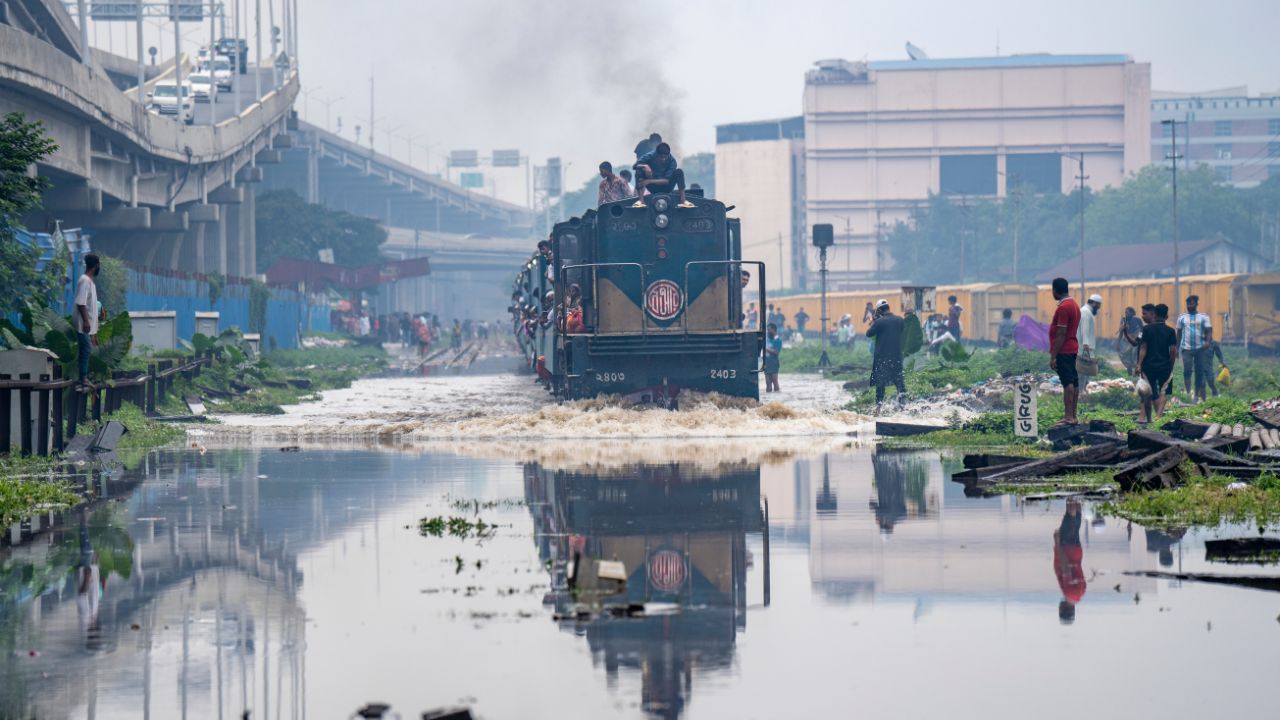

A night of heavy rain brought Dhaka brief relief from the scorching July heat, but by morning the city was once again struggling to stay afloat, with flooded streets, stranded commuters and daily life thrown into chaos.
Residents stepped outside to find familiar roads transformed into waist-high streams. Officegoers heading out on the first day of the weekend rolled up their trousers and waded through dirty water, carrying their shoes.
Countless vehicles gave up halfway through their journeys.
From Green Road, Panthapath, and Dhanmondi to Bashundhara, Uttara, and Old Dhaka, the entire capital presented the same grim picture – submerged roads and trapped residents.
At Merul Badda, driver Robin Islam recounted his ordeal to TIMES of Bangladesh, “As soon as I reached the kitchen market, water entered the vehicle. It was impossible to drive.”
With buses and cars stalled, commuters turned to rickshaws or simply walked in formal clothes, holding their shoes above the water. Nearby, a section of Shahjadpur Lake Drive collapsed, adding to the gridlock.
For residents, the latest inundation revived a frustrating question: why does Dhaka continue to sink despite repeated promises and costly infrastructure projects?
Md Shamim Hossain, referencing a massive Tk3,800 crore project aimed at solving Dhaka’s waterlogging crisis, openly questioned the effectiveness of such spending.

“Thousands of crores of taka have been spent before as well,” he told Times. “Then why does this happen after rainfall? Even the main roads have gone under water.”
The recurring chaos highlights the stark gap between expensive municipal initiatives and the reality on the ground, leaving millions of citizens stranded in a city poorly equipped for the monsoon.
A city brought to a standstill
Torrential rain brought Dhaka to a complete standstill. On the road between Banani Army Stadium and Kakali intersection, stranded passengers were forced to push broken-down CNG auto-rickshaws through deep water, while others abandoned their vehicles entirely for pedal rickshaws. As footpaths disappeared, hidden potholes made walking a dangerous gamble.
In Mirpur’s Kazipara, Shewrapara, Manipur, and Mirpur-10, floodwater invaded shops, offices, and ground-floor homes.
“Waterlogging happens whenever it rains, but the situation has worsened over the past few years,” said Shewrapara resident Sarwar Hossain, noting that waist-high water showed no signs of receding.
Meanwhile, in Panthapath, desperate furniture traders scrambled to shift vulnerable goods onto vans or raised platforms to save them from ruin.




While commuters faced delays, low-income communities endured a far harsher reality. At a Mohammadpur slum near Tin Rastar Mor, knee-deep water swept away beds, clothes, cooking utensils, and vital documents.
Inside her home, 65-year-old Sohela Banu fought a losing battle, desperately bailing out water with a bucket while trying to block her doorway with polythene and bricks.
A similar crisis unfolded at Karail slum, where narrow lanes vanished under contaminated water.
With flooded hearths, cooking ground to a halt, leaving families trapped without food. “We cannot cook or bring food from outside for the children,” said resident Sohel. “My wife is very sick, and there is no way to take her to a hospital.”
For day labourers and small traders, the downpour brought devastating financial loss.
For those who depend entirely on daily earnings, losing a single day’s work threatens to push them deeper into debt.
Schools shut, exams postponed
The playground of Siraj Mia Memorial Model School in Merul Badda was completely submerged, forcing the cancellation of classes. Similarly, half-yearly examinations at Mirpur’s Monipur High School and College were postponed due to the severe waterlogging.
“I left home with my daughter, but we could not even get out of our alley,” said Yasin Islam, a frustrated guardian. “Later, we were informed that the exam had been postponed.”
Communication gaps left some families stranded; students who did not receive the notice in time braved the flooded streets and reached the school, only to be turned back home.
Why does Dhaka keep sinking?
The Bangladesh Meteorological Department reported that Dhaka received 175mm of rainfall in 24 hours ending 6pm on Saturday, the highest recorded this monsoon.
While the city has survived heavier downpours, such widespread flooding remains unusual.
Rahela Sarker, a Dhaka North City Corporation cleaner working in Rampura-Banasree, blamed blocked drains. “Most drain openings are blocked by polythene. That is why water cannot flow out,” she said.
South Banasree resident Rakib Hasan echoed this, noting plastic bags and cigarette packets floating in the deluge. Despite a two-decade-old ban on polythene and laws against littering, residents say enforcement remains weak.
Dhaka South City Corporation’s Chief Waste Management Officer, Md Mahbubur Rahman Talukder, highlighted the scale of the crisis, “Around Tk 30 crore is spent annually just cleaning blocked drains. Without public awareness, projects alone will not work.”
During the 2024-25 fiscal year, workers cleared 221.85 kilometres of drainage channels and removed vast quantities of polythene from major canals using modern suction machines. Yet, keeping pace with the waste remains an uphill battle. Compounding the crisis, an Institute of Water Modelling survey revealed that 40 of Dhaka South’s 57 sluice gates are completely non-functional.
‘A complete failure of planning’
Urban planner Adil Muhammad Khan described the ongoing crisis as a “complete failure of planning.”
“This is no longer only a problem of cleaning drains. Thousands of crores of taka are being wasted on fragmented projects without an integrated master plan,” he told TIMES. He also pointed to the failure to provide affordable alternatives after banning polythene as a major driver of the blockage.
DSCC admits that at least eight to nine major drainage routes are required to effectively clear water from its 109-square-kilometre area. Instead, the city relies heavily on just three: Dholai Khal, Kamalapur-TT Para, and the Panthapath box culvert.
Compounding the issue, the existing drainage infrastructure is 25 to 30 years old. Runoff rushing down from elevated areas like West Rajabazar and the Parliament complex routinely overwhelms lower-lying neighbourhoods, leaving places like Sukrabad and Dhanmondi Road 27 flooded after even moderate rainfall.
Another mega project on the horizon
Following the repeated failures of these scattered initiatives, both city corporations are shifting their focus toward developing a comprehensive master plan. As part of this new approach, DSCC has signed an agreement with the Institute of Water Modelling (IWM).
Despite around Tk3,000 crore being spent over the past decade with little to show for it, another massive Tk3,800 crore project is now on the horizon.
However, relief may still be a long way off. IWM Director (WSU) Tanmoy Chaki cautioned that the initiative is still in its very early stages.