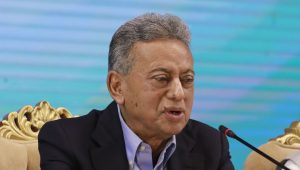
The Centre for Policy Dialogue (CPD) has questioned the feasibility of the key targets outlined in the new government’s first budget, particularly regarding its financing.
The Dhaka-based think tank presented its analysis on Friday, following Finance Minister Amir Khosru Mahmud Chowdhury’s unveiling of a Tk9.38 lakh crore budget, aimed at economic recovery and restructuring.
It also warned that the proposed strategy for funding the budget deficit could crowd out and reduce the flow of credit to the private sector.
In its overall assessment, the CPD noted, “The ultimate test lies not in the size of the budget, but in its implementation. Institutional reforms, capacity building, and good governance are critical to achieving the targets for private sector investment, job creation, and high growth.”
To fund it, the government has set a revenue target of Tk6.95 lakh crore, tasking the National Board of Revenue (NBR) with collecting Tk6.04 lakh crore, while the remaining Tk91,000 crore is expected from other sources.
However, achieving this will be an uphill battle. In the first ten months of the current fiscal year, the NBR collected only Tk3.26 lakh crore against a target of Tk4.31 lakh crore. Furthermore, for the first time in history, the deficit is projected to cross the Tk1 lakh crore mark.
Commenting on the target, CPD Distinguished Fellow Mustafizur Rahman said, “Aiming for a revenue growth of up to 30 per cent is highly ambitious, especially given the massive gap between this target and the actual revenue growth trajectory of the past decade.

If the government maintains its spending layout despite a revenue shortfall, its reliance on both domestic and foreign borrowing will inevitably surge.”
Private sector credit risks crowding out
The government’s plan to borrow Tk1.12 lakh crore from banks to fund its Tk2.43 lakh crore budget deficit will severely hit the private sector, warned CPD Executive Director Fahmida Khatun.
“Heavy public borrowing risks a liquidity crisis, making credit scarce and pushing interest rates higher for entrepreneurs,” Khatun explained. She noted the irony that while the budget relies on private sector-driven growth, excessive government borrowing inherently discourages private investment.
Despite the budget’s goal to stimulate private credit, growth languished at just 4.75% by April due to investor hesitation and economic uncertainty. “The investment climate for these ambitious targets doesn’t exist yet,” Fahmida added. “Tax incentives alone aren’t enough; we need macroeconomic stability and accessible credit.”
CPD Research Director Towfiqul Islam Khan agreed, calling the next year’s 9.4% private credit growth target “an uphill battle” unless investor confidence and the ease of doing business improve.




The CPD also cautioned regarding the government’s plan to secure Tk19,850 crore from foreign loans and grants. While Bangladesh’s debt-to-GDP ratio remains manageable at 38.2%, debt servicing costs are climbing rapidly.
“Efficiently used funds can boost jobs and income,” Fahmida concluded. “But if mismanaged, this debt will become a severe future fiscal burden.”
Are growth-inflation targets realistic?
The finance minister has projected a 6.5 per cent GDP growth rate and aims to rein in inflation to 7.5 per cent for the upcoming fiscal year.
To support this, the government plans to boost private sector investment to 21.3 per cent of GDP and public investment to 13 per cent.
Additionally, aligned with the ruling party’s electoral pledges, the minister iterated the ambitious target of creating one crore new jobs over the next 18 months.
Mustafizur Rahman sharply questioned these targets. “The underlying assumptions for boosting export growth and cooling down inflation are fundamentally detached from current economic realities,” he argued.
“We are presently grappling with negative export growth, while inflation stubbornly hovers above 9 per cent, ” he said.
The CPD further noted that both domestic and foreign direct investment (FDI) have been on a downward trajectory for the past few years, exacerbating the risk of youth unemployment. While hundreds of thousands of fresh graduates enter the labour market annually, corresponding job creation has failed to keep pace.
Compounding this issue, CPD Senior Research Associate Tamim Ahmed highlighted a growing disparity in the business ecosystem. “While the budget introduces some measures to ease the regulatory burden, it simultaneously squeezes small and medium enterprises (SMEs).
Large industrial sectors continue to enjoy lucrative incentives, whereas small businesses are being subjected to aggressive tax surveillance just to expand the revenue base,” Tamim noted.
Disproportionate tax burdens
Fahmida Khatun believes the finance minister’s proposed tax measures will disproportionately affect low-income earners.
“The tax-free income threshold set in the proposed budget is insufficient to provide meaningful relief at a time of high inflation,” she said.
CPD also argues that raising the tax-free income limit by Tk25,000 does not go far enough.
Questioning whether the current inflationary pressures were adequately considered, Fahmida said, “To what extent does this revised threshold reflect the reality of high inflation? The tax-free income limit should have been increased further to ease the burden on low-income people.”
Questions over ‘black money’ whitening scopes
The CPD strongly criticised the government’s decision to retain the provision allowing the legalisation of undisclosed wealth, commonly known as ‘black money’, through investments in the housing sector.
“This loophole completely undermines the equity of the tax system,” said Fahmida Khatun. “It is deeply discriminatory against compliant citizens who pay their taxes regularly and honestly. Furthermore, it introduces a severe moral hazard, rewarding financial non-compliance in a way that is entirely unacceptable.”
The policy of allowing undisclosed money into the mainstream economy has long been a highly contentious issue in Bangladesh, historically drawing sharp criticism from the BNP during its time in the opposition.
Mustafizur Rahman said, “This provision serves as a massive disincentive for honest taxpayers. It is equally damaging from a political standpoint.
“The general public perceives this as a system where corrupt actors and tax evaders are actively rewarded with amnesty by the government, while ordinary citizens continue to bear the heavy lifting of the tax burden.”