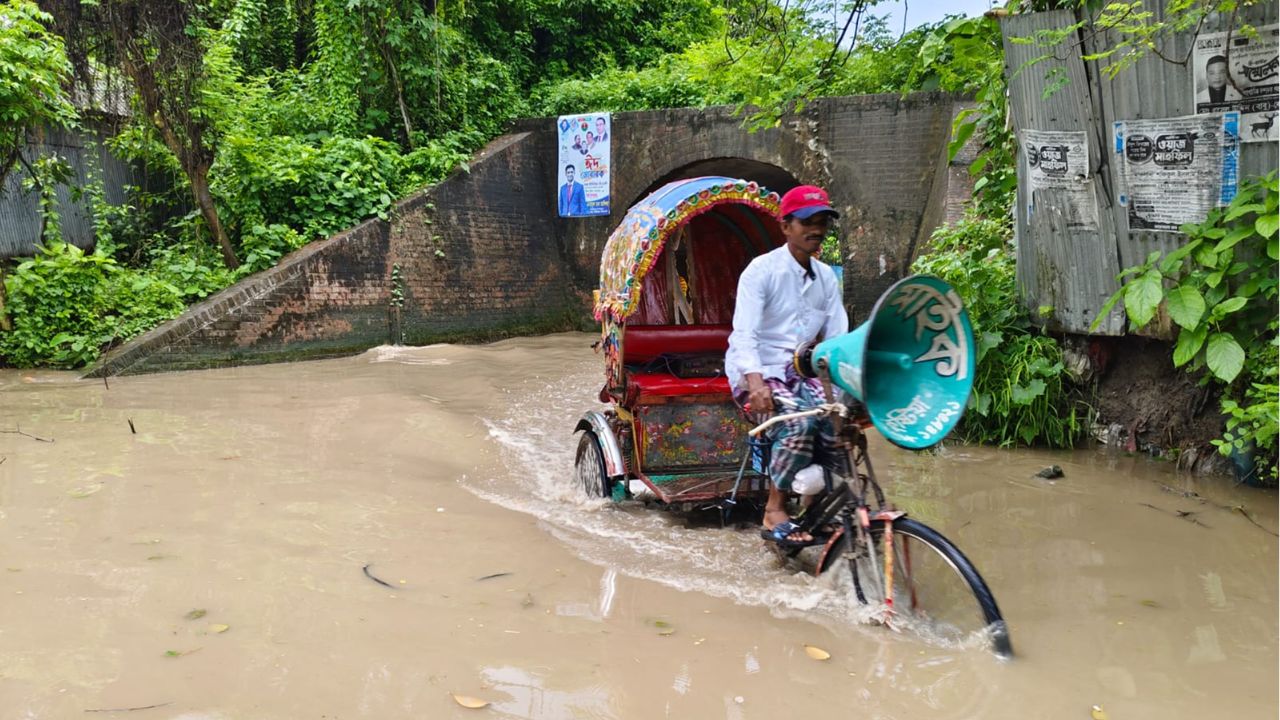



A railway tunnel built during British colonial rule has become a daily ordeal for nearly 100,000 people living in Koya and Nandalalpur unions of Kumarkhali upazila, after the short stretch of road beneath it remained submerged under knee-deep water for most of the year.
Though the tunnel itself measures just 22 yards, or around 20 metres, crossing the flooded section now takes almost half an hour, while many residents are forced into detours spanning several kilometres.
A visit to the site on Monday found the road beneath the tunnel becomes waterlogged as soon as the monsoon arrives, with the floodwater typically taking eight to 10 months to recede, leaving normal life disrupted across both unions for the greater part of the year.
The problem has persisted for more than a decade without a lasting fix, and locals accuse the Local Government Engineering Department (LGED) of failing to take effective action despite years of complaints.

Students, farmers, labourers and traders all face daily hardship as a result, with motorcycles, easy bikes and vans regularly breaking down in the water and patients travelling to hospital left struggling to get through.
Local schoolboy Farhad Reza said he previously cycled to school but now has to walk because the road stays underwater, adding that his clothes get soiled in the mud and that reaching school has become a considerable struggle.




Resident Salauddin Major said knee-deep water gathers there whenever it rains and that conditions remain unchanged for eight to 10 months at a stretch, with people enduring the situation for years without any improvement.
Abdul Razzaq, a Koya Union resident and former senior joint convener of Kumarkhali upazila BNP, said nearly 100,000 people across the two unions were effectively held hostage by a tunnel just 22 yards long.
He said residents had heard only promises for years without any practical solution, that students, patients and ordinary people suffered daily as a result, and warned that a stronger movement involving local residents could follow if a permanent fix was not found soon.
Koya Union Parishad Chairman Ali Hossain said he had repeatedly raised the issue with the administration and relevant departments but that no effective measures had been taken, noting that around 70,000 people in the union relied on the road and had suffered greatly for a long time.
An investigation found that the absence of a planned drainage system, combined with unregulated construction of houses and other structures around the tunnel, had blocked the natural flow of water. A drainage pipe previously installed by the Roads and Highways Department (RHD) is no longer functional. LGED recently stripped the road’s carpeting and laid an RCC surface, but the continued absence of proper drainage has worsened the flooding.
Kumarkhali Upazila LGED Engineer Md Nazmul Haque said the pipe that once drained the water was believed to be blocked, and that the problem could be permanently resolved through the construction of two new culverts.
Kumarkhali Upazila Nirbahi Officer (UNO) Farzana Akhter said a plan would be drawn up soon after consulting engineers, with steps to repair the road and install a permanent drainage system to follow once the necessary budget and allocation became available.