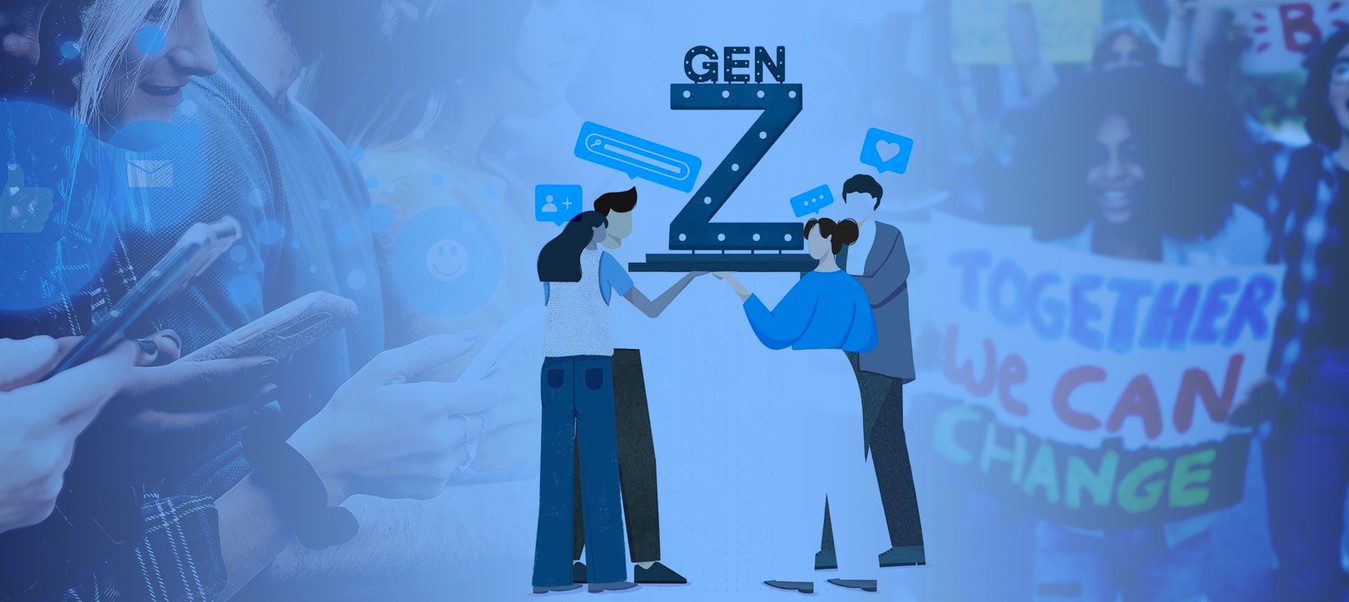

Language is used to fight political conflicts on the streets and in institutions. History proves that labels that denigrate or silence opposition can be appropriated, redefined, and transformed into rallying symbols of resistance. If one is to learn about the politics of South Asia’s Generation Z, it is necessary to begin with the politics of linguistic reversal: they don’t take offence at insults; they make them their own; they meaning-make them; they make identities out of them.
This is the trend of the last few youth movements in Bangladesh, India and Nepal. The youth are building their own symbols, language and identity, apart from the traditional political language. In the meantime, we have witnessed a fundamental shift: party offices, wall graffiti, posters, leaflets, study circles, long speeches are slowly being replaced by memes and satire, hashtags and viruses, symbols and emojis. Consequently, not only is the language of politics evolving, but so are the ways of communicating politics. Building a political movement used to take offices, constitutions, committees and conferences. Today, all it takes is a smartphone, a meme and a wrong word from the wrong people. The algorithm takes care of the rest. It could come in the form of a Facebook page, whose following can quickly exceed the number of a politician’s party members. Language has become more of an organiser of political action than just a tool of communication.
The recent events in Bangladesh are also indicative of the same trend. The move to conduct HSC exams was met with a wave of public outrage as heavy rainfall continued and waterlogging problems. Things got worse when the Education Minister used the term ‘farm chickens’ for students. But the response of the students was quite different. It was not just a protest; it became a new identity for them. The ‘Broiler Chicken Party’ quickly made it to social media within hours. Their resistance was symbolised by the very word that was meant to belittle them. This is similar to the situation that occurred in Bangladesh during the political turmoil in July 2024. A controversial political comment by the government’s top official at a press conference quickly became public opinion, satire, social media campaigns and ultimately a political revolution, of which the outcomes were dire.
The ‘Cockroach Janata Party’ is one of the most talked-about examples of this change in India. They were told that a number of young people were ‘cockroaches’ and some of the insulted took the name as their own. What started as a joke quickly turned into a well-structured political message. They created public discourse on issues such as unemployment, inflation, examination paper leaks, education crisis, and democratic rights through memes, animation, graphics and short videos. This online campaign was soon to be translated into street mobilisation. It is unique in the ways it has become a pejorative and a powerful political symbol.

What we’re seeing is that the offhand joke has become the political campaign tactic. In communication theory, it can be seen as a ‘reverse’ framing. Typically, those with power try to define the protesters’ identity or label in order to influence how they are perceived in society. For example, in this case, it’s the other way around. These identities are redefined by the protesters. Words like ‘cockroach’ or ‘farm chicken’ no longer represent a form of humiliation, but a language of resistance. The power of creating meaning is transferred, in other words.
Social media has been a key enabler in this regard. Henry Jenkins’ definition of participatory culture states that in a digital world, people are no longer just receptacles of messages but also producers, modifiers, and distributors of messages. This means that there is a minimum need for any kind of centralised propaganda machine. A meme, symbol or satirical label can gain new political meaning in a matter of hours, with the help of thousands of participants. This is not a new phenomenon. In 2015, as part of the anti-VAT movement, students were also ridiculed as ‘farm chickens’, and in 2018, as part of the Safe Roads Movement, ‘farm chickens’ were again the butt of the joke. The aim was to discredit their ability to think independently and the legitimacy of their movement. But the term which was used to devalue has now become one to protest. It’s a major shift. Those who hold power in society still use the same language, but it is not understood by society as it once was.




But similar trends can be seen globally, outside of Asia. In fact, there is a concept in political communication that has been established for this phenomenon, which is reappropriation, namely, the reclaiming of derogatory identities. It is the process in which individuals and/or groups that are the subjects of derogatory labels use the very labels as symbols for political identity and resistance.
In 2016, Hillary Clinton referred to a group of supporters of Donald Trump as a ‘basket of deplorables.’ Trump backers did just that, proudly wearing the hat. The name ‘Proud Deplorables’ was soon used on T-shirts, in political speeches, on Facebook and Twitter accounts, and at campaign rallies. Similarly, when President Recep Tayyip Erdoğan described the protesters in Gezi Park as çapulcu or looters, protesters took the term to their own ends, branding themselves with the term on the badges, posters, songs and on social media. In recent years, it has also been shown how such appropriations have the power to diminish the psychological effects of humiliation and to create new political subjectification, collective mobilisations and solidarities.
In her book, Twitter and Tear Gas, Zeynep Tufekci maintains that social media has not only allowed movements to organise quickly, but also for the creation of a shared political identity among movement participants within an astoundingly short time. A satirical symbol can bring thousands of people together within hours on the same side of a political message and eventually from online to the streets. Perhaps what most Gen Z shows us is that they don’t take it anymore. Rather, they take those identities, reinterpret them and reimagine them as new symbols. They translate the tone of humiliation into the tone of resistance. In the process, they are building a whole new lexicon for political communication, one that is being documented on social media and, ultimately, on the streets.
As history has shown, each generation has its own language of protest. That language before now was wall graffiti, posters, red flags and raised fists. Nowadays, those symbols have been gradually replaced by memes and hashtags, satirical icons, and digital communities. Finally, political battles are not confined to the streets, but also to language. Without control over language, there is a loss of control over public opinion. So, it is not about what young people are saying, anymore. But the answer is whether the politics of the older generation, still in place, has gotten the message that, in the era of algorithms, one meme can spawn a movement – a single insult can birth a political identity.
The views expressed in this article are solely those of the author
The writer is an Associate Professor, Department of Communication and Journalism, University of Chittagong; Doctoral Scholar, School of Journalism and Mass Communication, Jadavpur University, India. Email: [email protected]