
The “game” of denying social, cultural, and economic rights, along with the fundamental human rights, of indigenous communities in the Chittagong Hill Tracts (CHT) is still ongoing, says Shamsul Huda, executive director of the non-government organisation ALRD.
He added, “This game was initiated by the Pakistani rulers. However, it continued even after the Liberation War. Even in the new political settlement discussed after the 2024 uprising, the public, indigenous communities, and the rights-deprived and oppressed people remain absent.”
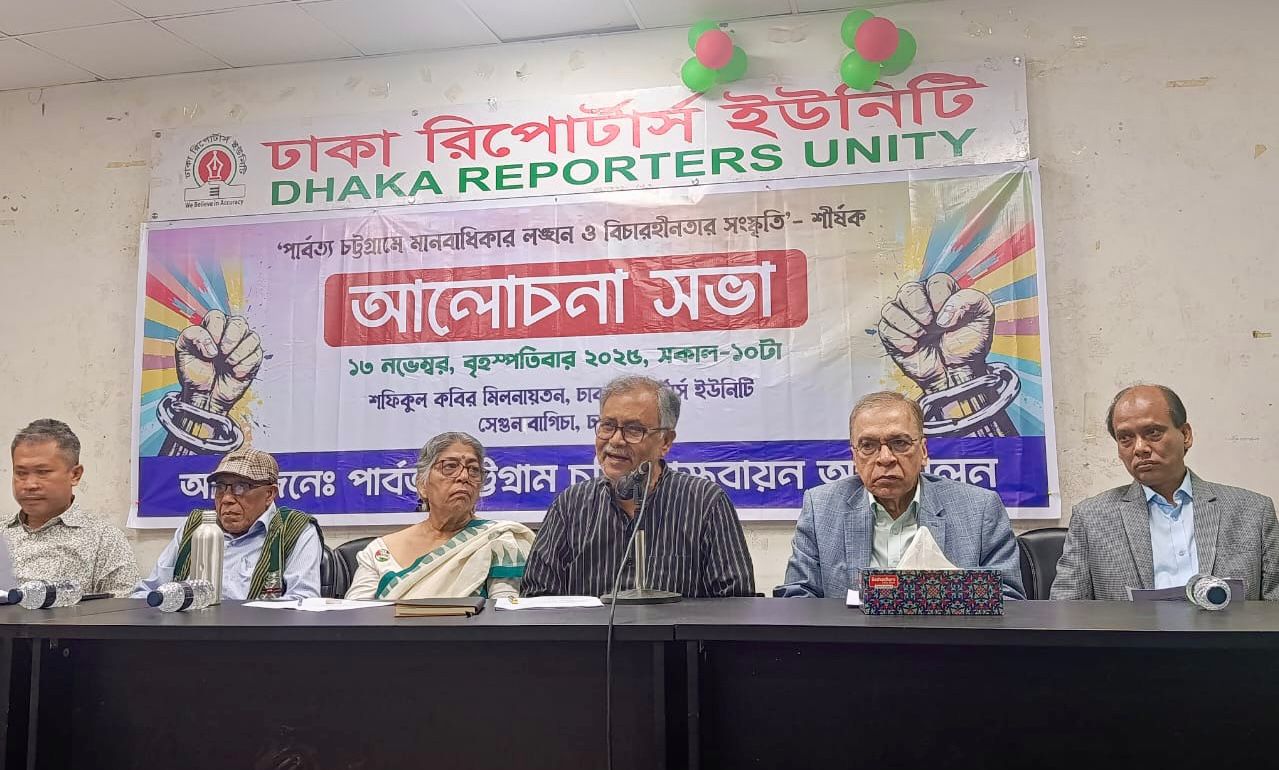
Shamsul made these remarks at a discussion held on Thursday at the Shafiqul Kabir Auditorium in the city’s Dhaka Reporters Unity.
The discussion, titled “Human Rights Violations and Culture of Impunity in the Chittagong Hill Tracts,” was organised by the Parbatya Chattogram Chukti Bastobayon Andolan.
Shamsul then pointed out, “The issues of protecting fundamental human rights of the people in hill region have always been ignored. The CHT Accord, which was signed to protect the rights of the people in that region, is not being implemented properly.

“We call upon the interim government to form an international commission to investigate the incidents of killings, land grabbing, and communal attacks committed against the indigenous people of Chittagong Hill Tracts throughout the past 50 years.
The discussion was moderated by Deepayan Khisa, a member of the Parbatya Chattogram Chukti Bastobayon Andolan, and chaired by Joint Coordinator Zakir Hossain.
Dhaka University teacher and the movement’s Joint Coordinator Professor Khairul Islam Chowdhury, Head of the Women’s Reform Commission and founding member of Nari Pakkha Shirin Haque, TIB Executive Director Iftekharuzzaman, and poet and journalist Sohrab Hassan attended the discussion among others.
Citing a report from the Parbatya Chattogram Jana Samhati Samiti, Professor Islam referenced the killings in the hill region from 1976-97, the displacement of at least one hundred thousand people over two decades, and various human rights violation incidents in the hills over the past 27 years.



Commenting that the proper adjudication of these incidents has not occurred, leading to their recurrence, he said, “To eliminate this kind of impunity, we need not only policy changes, but also legal and institutional reforms.”
In his view, establishing justice in the Chittagong Hill Tracts means implementing the promises of the Bangladesh Constitution, international human rights law, and the CHT Accord.
Sohrab Hassan said, “It is the state’s responsibility to protect the human rights of all its people. Had the state fulfilled this responsibility properly, we would not need to discuss the people of the Chittagong Hill Tracts separately today.
“The CHT Accord was signed to bring peace to the Chittagong Hill Tracts. There is no obstruction from the other party to the accord, the Jana Samhati Samiti, or the people of the CHT regarding its implementation. Rather, the full and proper implementation is not happening due to a lack of political will from the state.”
Hassan called upon the state to protect the rights of the people by establishing justice.
Shirin Haque expressed the view that imposing the term “minority” on any community in the country is an insult to their rights and human dignity.
She said, “A strong force is necessary to protect the borders. But that force should not disrupt the daily lives of the hill people.”
Iftekharuzzaman, executive director of TIB, said, “We no longer see the hopes and aspirations that existed after the mass uprising.”
However, he also noted as promising the proposed inclusion in the July Charter of a clause stating, “Bangladesh is a multi-ethnic, multi-cultural country where all communities can practice their rights,” replacing the 1972 constitutional clause that said, “The people of Bangladesh shall be known as Bengalis.”
Iftekharuzzaman believes that only the Bangladesh Army can restore and protect the rights and peace for the people of the Chittagong Hill Tracts.
Posing a question to the army, he said, “Over the past 40 years, our Army has successfully worked in ten peacekeeping missions in different countries. If they can establish peace worldwide, why aren’t they not establishing peace in the Chittagong Hill Tracts?
“If the army has the will, they can assist in implementing the CHT Accord and establish peace there.”